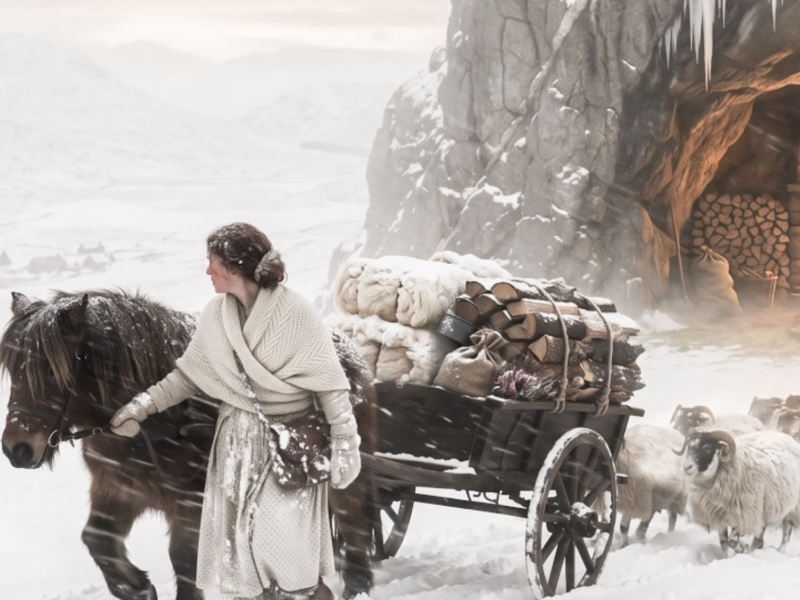
They Laughed at Her Firewood Cave Until the Blizzard Left Their Homes Freezing
THE SPRING THAW
The teaching began in the spring.
It began with three women on a morning in April, grew by the third week to seven, and by the end of May to fourteen.
Goldie taught the way her father had taught—she didn’t lecture. She stood at the mouth of the cave with a length of split oak and a scrap of raw fleece, and she showed them. She didn’t tell any woman on Willow Fork to copy her hill. They all found their own ways. Adeline Duffield lined her north wall with fleece and put a bin of river sand under her hearth. The Petersons dug into the hill behind their smokehouse.
Every household worked its own ground.
Silas Thorne and Cornelius Vance started on the freight wagon the first Monday in March. Neither boy spoke for the first hour. On the road above Fenmore Bend, they had to work together to dig a stuck wheel out of a rut. By April, they had a rhythm. By June, they were arguing about girls. By July, they had become brothers in everything but blood.
Ambrose stayed.
He built a small bunk room off the back of the barn. He slept there, took his meals at Goldie’s table, and never once asked a question that made her look away. By August, she had begun to think of him as a fact of the yard. By September, he had begun to think of her the same way.
Otis Redern lived four more years. He wrote Goldie one letter every winter, and each letter contained the same sentence: A stranger’s hand in a storm is worth more than a brother’s hand in July.
In his last winter, Lark—now eleven—added a line of her own: I am coming up your creek in July. Please tell Ren.
She stayed two weeks. She and Ren rode a brown pony in the July sunlight, their heads bent together, looking more like sisters than any two girls born to different mothers had any right to look.
The years came on.
Silas took a wife in 1892 and built his own cabin a quarter mile up the creek. Prudence became a schoolteacher. Ren went to Denver to study nursing, returned to run the county infirmary, and kept Elias’s carved wooden doll on her desk until she died at seventy-four.
Ambrose Kentner and Goldie Thorne were married on a Saturday afternoon in June of 1886. Horus stood beside Ambrose. Adeline stood beside Goldie. Silas walked his mother down the aisle. Cornelius Vance stood at Silas’s elbow as best man.
The cave stayed. The passage stayed.
Every autumn Goldie lived in that cabin, she carried the wood in herself. When her hands gave her trouble in her sixties, she did it with her grandson, Eli, beside her. And every one of them learned to leave a finger’s width of air between every stick.
In the winter of 1912, twenty-eight years after the storm, Ambrose Kentner sat on his horse at the top of the lane. He was fifty-six, his hair completely gray. He had been away seeing to a horse operation and had just returned.
The cabin still stood. The chimney still drew a perfect, straight line of smoke into the January sky.
Ambrose thought about that smoke. It wasn’t that Goldie Thorne had built a warmer fire. It was that she had spent an autumn protecting every scrap of warmth she could gather, long before the country ever asked her for any of it.
That was the whole trick of her.
Ambrose tipped his hat to the hill, clucked to his horse, and rode down the lane toward the cabin, where the woman he had loved for twenty-six years was waiting for him, banking the fire so it would keep itself warm through the long, beautiful night.









