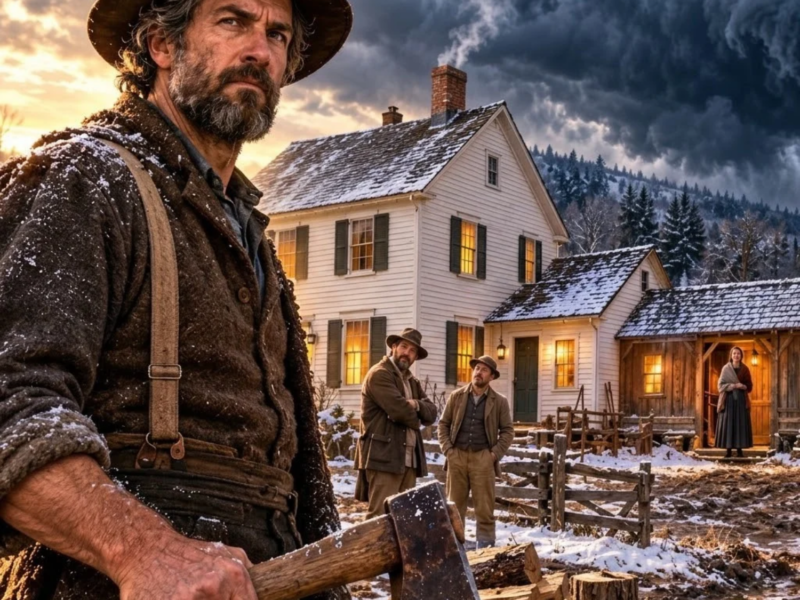
They Laughed When He Built a HOUSE Connected to His BARN — Then Winter Hit
Raising the Walls
The transformation of the Marsh farm had begun during the quiet, industrious months of the previous year. Gideon had started small, focusing first on the domestic core of the house.
He added a narrow kitchen wing to the back of the white farmhouse. This was designed as the warm heart of the operation, centered around a heavy, iron wood-burning cook stove that radiated a steady, welcoming heat. It was stocked with shelves, jars of preserved summer food, household tools, and neat stacks of dry firewood.
Beyond the kitchen, Gideon built what he called the “back house”—a utilitarian wooden structure with a low roof, rough plank flooring, a heavy oak workbench, and ample storage for farm implements, harnesses, and repair gear. From the back house, he extended a long, low-slung covered passage that stretched all the way across the yard, terminating in a set of heavy wooden double doors that opened directly into the timber barn.
It was an architectural chain: the main house, the kitchen wing, the workroom, the covered passage, and finally, the barn. Four distinct functions united into one continuous, sheltered route.
When Silas Bennett, a neighboring farmer whose land abutted Gideon’s, first saw the framing take shape, he shook his head in disbelief. Silas rode over on a crisp autumn morning, leaning against the fence rail as Gideon planed a cedar board.
“Gideon, you’re building a village, not a farm,” Silas called out, laughing. “You’ve got more walls, doors, and roof joints there than the town meeting house. And what about fire? You tie that barn to your kitchen, and one stray spark from your cook stove means your whole livelihood goes up in smoke.”
Gideon wiped the sawdust from his forehead, looking down the long spine of his expanding buildings. “Silas, I know the fire risk is real, and I’ve built firewall breaks and heavy doors to manage it. But you’re thinking about the farm in July. Come February, when the snow is piled to the windows and the wind is howling at forty below, you won’t care about extra roof joints. You’ll care about whether you can keep your cattle alive without freezing your ears off in the yard.”
Silas remained unconvinced, convinced that Gideon was simply creating unnecessary maintenance and inviting disaster. But Gideon pressed on, finishing the siding, shingling the overlapping rooflines, and fitting heavy, solid wooden doors between each section. He didn’t heat the whole chain—the kitchen was warm, the workroom cool, and the barn left naturally ventilated for the animals—but the entire route was protected from the wind and the falling snow.









