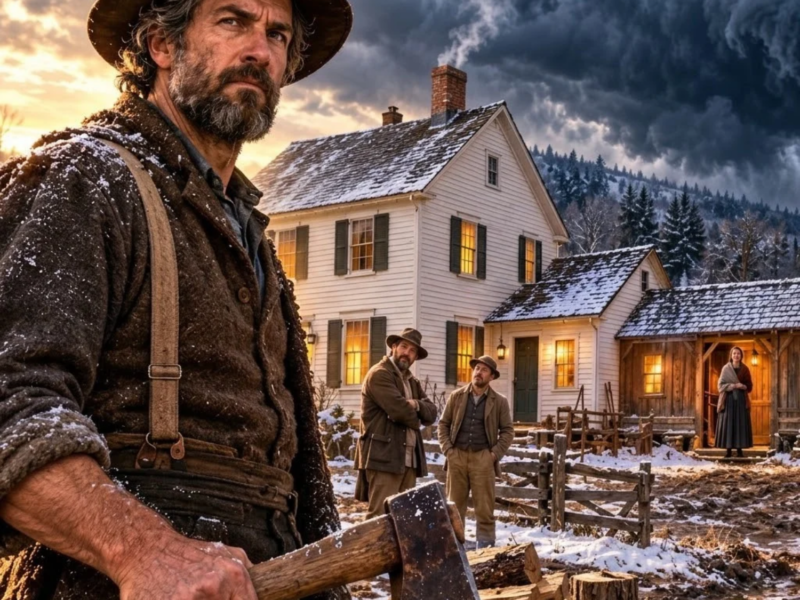
They Laughed When He Built a HOUSE Connected to His BARN — Then Winter Hit
The Legacy of the Long Roof
The realization that settled over Oxford County in the spring of 1887 was slow, profound, and entirely pragmatic. For generations, New England farming traditions had been dictated by the fear of fire. The distance between house and barn was meant to be a safety barrier, a firebreak of open air designed to keep a chimney spark from leaping into a loft full of dry hay. But as the survivors of the blizzard of ’88 looked back at the toll taken by the sub-zero winds, a new arithmetic took hold in their minds: fire was a sudden, violent possibility, but winter was a certainty.
Silas Bennett was the first to act. In May, long before the ground had fully softened to its summer give, Silas appeared at the Marsh farm with a heavy canvas bag of tools and a quiet, deliberate look in his eye. He didn’t say much by way of apology, but as he dropped the bag onto Gideon’s workroom floor, he offered a grin that crinkled the corners of his weathered eyes.
“Gideon,” Silas said, pulling a worn cedar shingle from his pocket and tossing it onto the workbench. “I’ve been doing some figuring. My old woodshed is sitting twenty feet off the kitchen door, and every time I haul wood in a sleet storm, I feel like a candidate for the asylum.”
Gideon leaned against his workbench, wiping grease from a harness ring. “Thinking of extending, Silas?”
“Thinking of connecting,” Silas grunted. “Not all the way to the barn—my missus says she draws the line at milking cows under the pantry window—but I’m linking the house to the woodshed and the tool room. I figured if a fool’s errand can keep twenty people alive in a gale, it might be worth a try on a smaller scale.”
That summer, the sound of saws and hammers echoed across half the farms in Oxford County. The traditional isolated New England farmstead began to sprout limbs. Neighbors who had laughed at Gideon’s “village” were now sketching their own architectural chains on scraps of brown wrapping paper, figuring out how to link kitchens to woodsheds, and woodsheds to carriage houses.
The design varied from farm to farm depending on the layout of the original buildings. Some built straight, arrow-like corridors just like Gideon’s; others formed gentle L-shapes or snug U-shapes that cradled a sheltered, wind-free courtyard in the center. But the underlying philosophy remained identical: form was finally following the harsh truth of function.
For the Marsh family, the years that followed the blizzard were marked by a quiet, steady prosperity. The connected layout didn’t just save them during emergencies; it transformed the tedious, grinding rhythm of daily farm life. Chores that had once eaten away at precious hours of daylight were now completed with efficient economy. Abigail could move from the warmth of the kitchen to the supply shelves of the workroom without wearing out her boots or battling the damp autumn chills. Gideon could overhaul a plow harness in the dim, sheltered quiet of the back house while the rain lashed harmlessly against the heavy timber siding outside.
The newborn calf that had survived that freezing February night grew into a magnificent, deep-chested Holstein cow, anchoring a dairy herd that steadily expanded over the next decade. As the farm grew, so did the family. Two more children—a sturdy boy named Thomas and a bright-eyed girl named Clara—were born into the white farmhouse, growing up in a home where winter was a season to be managed and lived through, rather than a brutal endurance test fought out in the snowdrifts.
Years later, architectural historians and rural sociologists would give a formal name to the vernacular style that swept through Maine and the broader northern frontier during the late nineteenth century: Big House, Little House, Back House, Barn. They would write academic papers about the sociological shift from isolated structures to integrated homesteads, analyzing the thermal efficiency, the labor-saving logistics, and the cultural evolution of rural domestic design.
But down in Oxford County, long after Gideon and Abigail had grown old and handed the reins of the homestead over to their grown children, nobody talked about architectural theory.
On crisp winter mornings, when the smoke rose straight and blue from the farmhouse chimney and the wind came howling down across the frozen fields, people simply looked toward the long, low spine of the Marsh farm. They saw a home that defied the biting cold, a fortress of warmth built out of stubborn foresight and practical love. And they knew, with absolute certainty, that when the frost bit deep, the smartest thing a family could do was bring their world a little closer under one roof.









