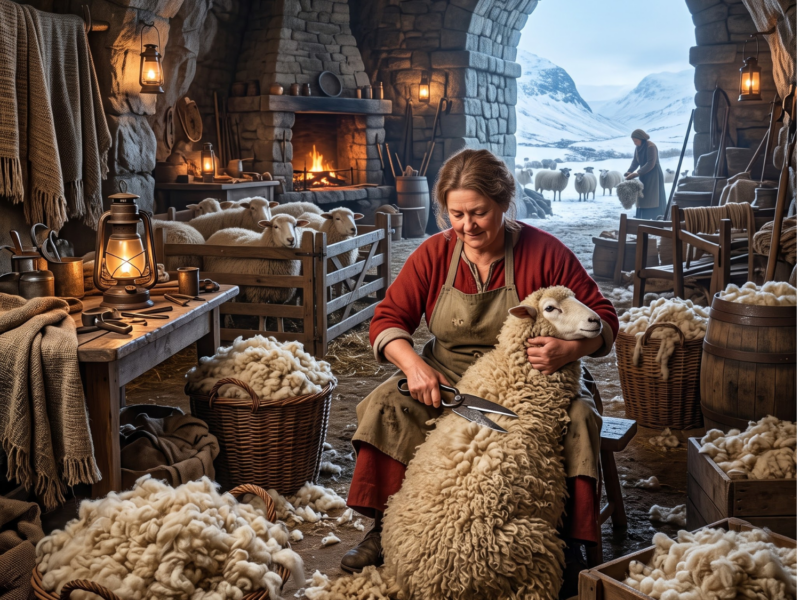
They Mocked Her for Stocking a Cave — Until the Blizzard Forced the Whole Valley to Find Her
THE TUESDAY
The day the barn fell was a Tuesday.
That was the detail Maggie Whitlock could never stop repeating to herself. Not the horrifying crack of the ancient timber. Not the color of the autumn sky. Just the day of the week. Because Tuesdays were bread days. Because she had flour on her hands and the loaves were still rising on the sill when the neighbor boy came sprinting up her porch steps.
His mouth was open, but no words came out. He didn’t need to speak. Wives always know.
The barn was almost a hundred years old. Silas had told her that morning it needed a new center post. He had told her the same thing every autumn for seven years. And every autumn, he had climbed up inside it anyway, whistling a tune his mother used to sing, a hammer in one hand and a lantern in the other.
He did not come down that Tuesday.
They pulled him out just before sunset. Ambrose Rutherford, the two Ford boys, and Father Doyle, the Baptist preacher who was the only man who thought to bring a blanket. He didn’t bring it for Silas. He brought it for Maggie.
“A widow’s hands go cold first,” the old preacher murmured, draping the wool over her shaking shoulders. “And a woman with cold hands cannot pray.”
She did not cry at the funeral. She did not cry three days later.
She did not cry when her brother-in-law, Jasper Whitlock, rode up her lane on his tall gray horse and walked into her kitchen without taking off his hat.
That was the first thing Maggie noticed. The hat. Silas had never worn a hat inside her kitchen. Not once in seven years.
Jasper looked like Silas around the eyes, but nowhere else. Silas had a slow smile that made his whole face soft. Jasper had a smile that made you instinctively check your pockets.
He tossed a leather folder onto her flour-dusted table. “Sit down, Maggie.”
She didn’t move.
Behind Jasper, lingering near the doorframe, stood a thin, nervous man in a black coat, a notary seal hanging on a chain around his neck. The man refused to meet Maggie’s eyes.
“What is this?” Maggie asked. It wasn’t a question. It was a flatline.
Jasper opened the folder. “Silas owed me eight hundred dollars,” he said, his voice smooth as polished stone. “Signed for it back in ’93 when you two bought the North Forty.”
Maggie stared at the paper. Silas’s signature was at the bottom. Almost.
It was almost his signature. But the ‘t’ in Whitlock was wrong. Silas made his ‘t’s with a hard downstroke, a movement that came from his shoulder, not his wrist. This ‘t’ was thin. Delicate. A woman’s ‘t’, perhaps, or the stroke of someone practicing very hard to mimic a dead man.
She said nothing.
“I’m not here to be cruel, sister,” Jasper said, feigning a gentle tone that made Maggie’s stomach turn. “I loved my brother. But this land was never meant for a woman alone. Especially not…”
He stopped himself. He didn’t need to finish. The whole valley had already finished that sentence for him, whispering it in the general store and the back pews of the church. Especially not a woman like her. A woman who took up two chairs. A woman whose wedding dress had to be let out three times. A woman whose husband had been lean and handsome as summer wheat, leaving the town to wonder for seven years what a man like that saw in a woman like her.
Maggie knew what he had seen. Silas had told her once, during a winter they were snowed in for eleven days, his hand flat on her hip. But that memory belonged to her. Not Jasper. Not the valley.
“You have four months,” Jasper said. “Pay the eight hundred by the first of February, or the sixty acres come to me. Silas would have wanted this simple.”
Silas would have wanted to kill him.
She just looked at Jasper’s hat, still on his head, still in her kitchen. Her husband had been dead for exactly twenty-two days, and the wolves were already inside the house.
Jasper left the papers. The gray horse trotted out of the yard.
Alone, Maggie slid down the kitchen cabinets until she hit the floor. She sat where Silas used to kneel to unlace her boots after she’d walked the east pasture in the rain. If she sat on the floor, she could almost pretend he was about to walk through the door.
She put her face in her flour-white hands, and finally, twenty-two days late, she cried.
She was still on the floor when the sun went down. She was still on the floor when a soft knock came at the door.
She opened it. The porch was empty. But on the top step, wrapped in a familiar blue cloth, was a loaf of bread. Father Doyle. Widowed himself in ’87, the preacher never came inside houses anymore. He just left bread on Wednesdays and Sundays.
Maggie unwrapped the cloth. It wasn’t bread. It was gingerbread.
She let out a choked, broken laugh. Gingerbread was for Christmas. It was only September. Somehow, Father Doyle knew that Christmas was not going to come to her house this year unless someone else brought it.
Eating the gingerbread in the dark, she stopped thinking about the forged signature and the eight hundred dollars. She started remembering the journal.
Silas kept a leather-bound journal in the bottom drawer of his desk. She had walked past it forty times in the last three weeks, terrified that reading his handwriting would shatter whatever was left of her sanity.
But Jasper had given her four months.
She lit a lamp. She opened the drawer. The journal was there, but it was not alone. Tucked beneath it was an envelope, sealed with red wax. Her name was written on the front in her husband’s slow, heavy hand.
Maggie. For when you need me most. Do not open this until you do.
She traced the red wax with her thumb. Her heart pounded against her ribs. She wasn’t ready to open the envelope. Not tonight, smelling of stale bread and grief. She placed it carefully on the mantle.
Instead, she opened the journal.
It was eight years of weather records. Wind directions, snow depths, frost dates. Her husband had been a man who trusted a place slowly. But in the middle of the book, she found a page dated December of the year they were married.
Underlined twice: The East Crevice.
Below it: Warmer than the pasture by 10 to 15 degrees. Wind curls into the hollow before it drops. Does not come out the same way it goes in. Something about the rock. Have not figured it yet. Worth watching.
She turned the pages, following a trail of obsessive entries spanning years.
January. 15 below outside. Inside the crevice I could stand without my coat buttoned.November. Snow on the ridge. Crevice dry all the way to the back wall. Air moves inside it. I do not have the science for it.
The final entry was dated the Friday before the Tuesday he died.
Maggie, if you are reading this and I am not sitting next to you, something has happened and I am sorry. I have been meaning to tell you about the crevice properly. If the valley ever has a real winter—a hundred-year winter—the East Crevice is where you go. Take the wool. Take the good firewood. Do not tell Jasper. He would not understand. You will. I love you. I love you. I love you.
Three times. Once for every year they had tried for a child that never came.
Maggie closed the journal. The clock ticked in the silent parlor. Eight hundred dollars was an impossible sum. But a hundred-year winter… that was something else entirely.









