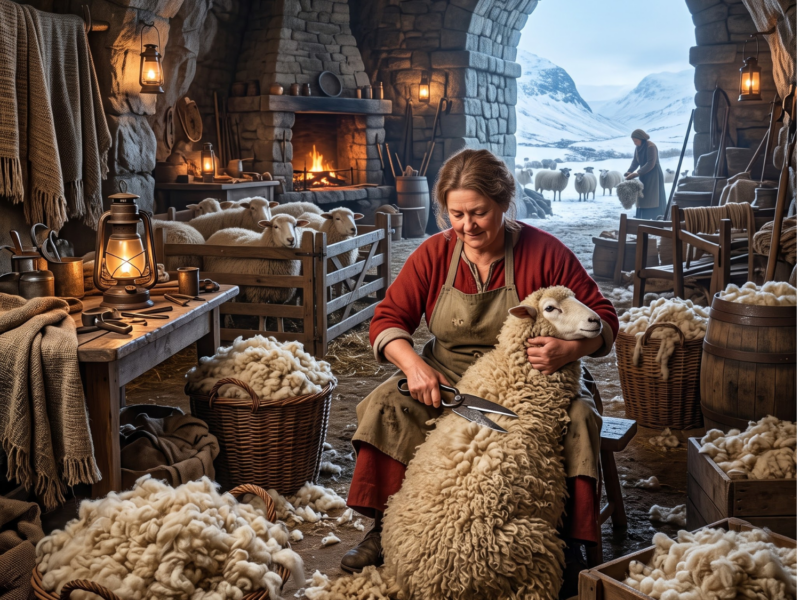
They Mocked Her for Stocking a Cave — Until the Blizzard Forced the Whole Valley to Find Her
THE NORWEGIAN CRONE
Forty days.
Maggie learned that her back could carry more if she wrapped Silas’s wide leather belt tightly around her waist. She learned that her feet would blister, burst, and eventually turn to callous leather. She learned that Ruth’s unborn baby stayed calm if Ruth hummed during the climb.
And she learned that four hundred and eighty pounds of wool takes twenty-four agonizing trips.
On the second Tuesday of November, they finally finished. The wool was stacked in the back of the crevice, just as Silas had drawn it. The firewood was piled high.
Three days later, Maggie went up alone to check on it. She put her hand against the stacked wool.
It was damp.
Panic flared in her chest. She pulled her hand back and knelt by the firewood. She peeled a piece of bark off a bottom log. It came away like wet paper. The wood was soft and rotting. Wood like that wouldn’t burn—it would smoke, and in a cave, it would kill them.
Silas had written, I do not have the science for it. Neither did she. And neither, she realized with crushing despair, had he.
Defeated, exhausted beyond measure, she started down the mountain. Halfway down the switchback near a burnt pine, her right ankle turned violently on a loose stone.
She went down hard. Her forehead cracked against the granite.
The edges of the world bled into gray. She lay on her back, looking up at a November sky the color of old pewter. Nobody knows I’m up here, she thought hazily. If I don’t get up, nobody comes.
She closed her eyes.
Tap. Pause. Tap. Pause.
The steady, wooden sound of a walking stick striking rock approached. A shadow fell over her face.
An old, unhurried voice, shaped by an accent Maggie had never heard, spoke from the gloom. “Ah. There you are, child. I have been waiting to meet you for seven years.”
Maggie woke to the smell of melting butter.
She was in a small, low-ceilinged cabin that smelled of dried herbs and woodsmoke. At the stove stood a tiny woman with stark white hair braided down her back, wearing thick woolen socks and no shoes.
“Where… my house,” Maggie croaked, trying to sit up. Her ankle screamed in protest.
“Your legs were not working. I dragged you on a sled,” the old woman said without turning around. “I am seventy-eight years old. I do not carry grown women anymore. I am not ashamed of this.”
Maggie let out a weak, delirious laugh.
The woman finally turned. Her face was a map of deep lines, but her eyes were the palest, sharpest blue Maggie had ever seen.
“My name is Ingred Salberg. You have walked past my gate for seven years and never once looked in. This is not an accusation. It is only a fact.”
Ingred brought her a bowl of pale golden fish soup. Maggie took one spoonful and, inexplicably, began to cry. Ingred sat across from her and simply watched, letting the silence do its work.
“How did you find me?” Maggie finally choked out.
“I heard you fall. I have been listening for you for a long time. Your husband came to see me three summers ago. He asked me about rock. About air moving through rock. He asked questions no one in this valley has asked me in thirty years.” Ingred tilted her head. “You have gotten it wrong, haven’t you? The crevice.”
Maggie stared. “How do you know?”
“Because you fell down a mountain with an empty sack. The wool is damp. The bottom logs are rotten. Silas was a good man. But he was an American.”
Ingred went to a wooden chest and pulled out a cracked leather scroll. She unrolled it on the table. It was a cross-section drawing of a hillside cave.
“My father drew this in Bergen, 1856,” Ingred said. “He was a miner. His ancestors kept winter food alive in holes cut into the hillsides. We called them varmagrop. Warm pits. You are building one. But you are missing three things.”
Ingred held up a gnarled finger. “First. Air must move. Warm, damp air rises. Cold, dry air falls. You need three vents. One low, one middle, one high. Not two. Three.”
Maggie pulled her notebook from her apron. Her hands shook as she wrote. Three vents.
“Second. The floor. Limestone weeps in winter; it is a sponge. You must line the floor with basalt. Black stone. It drinks heat from a fire and gives it back for two days. There is a dry creek south of here. I have seen it.”
Basalt. Dry creek.
“Third,” Ingred said, her pale eyes flashing. “Americans stack. They pile. Wool cannot be stacked in a cave. Wool touching stone is wool dying. Wool must hang on a wooden frame, not touching any wall. Air on all sides. Firewood the same—weave it like a fishnet, do not pile it.”
Maggie stared at the old woman in awe. “How do you know all this?”
“Because my mother died in a cellar that was built wrong in the winter of ’41,” Ingred said softly. “My father spent the rest of his life making sure no one else ever built one wrong again. He told me to immigrate to a country that does not know, and teach one woman. You are the one woman.”
Maggie’s vision blurred with tears.
“Now,” Ingred said sharply, “eat your soup. Then I will teach you how to walk. You walk as if you are apologizing to the ground for being on it. A woman of your size must walk the way the earth expects you to walk. Heel first. Knees soft. The earth was made for women like us. We are not too much for it. It is exactly enough.”









