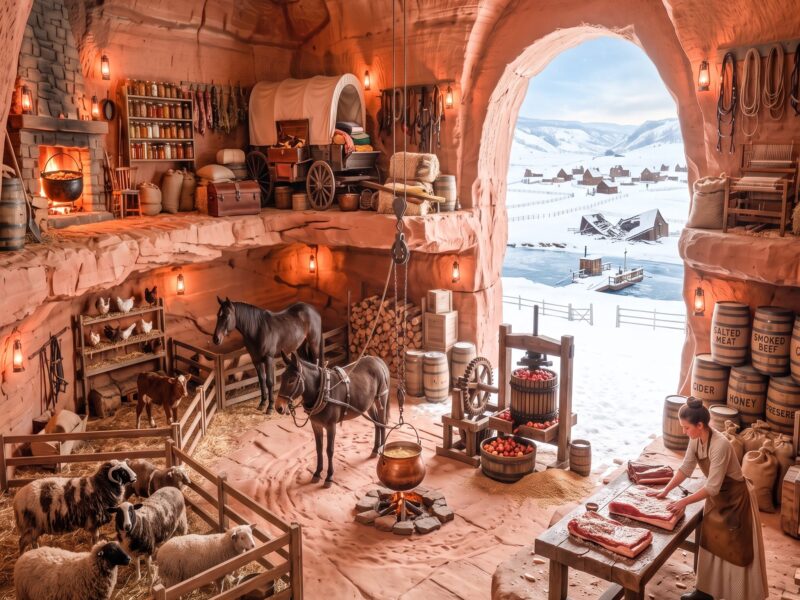
They Mocked Her Mountain Barn Until the Blizzard Sent Half the Valley to Her Door
THE FOUNDATION
Barnaby Ashcraftoft’s empire crumbled before the snow melted.
The small ranchers pulled their leases. The bank in Silverton called in his notes. Before the Federal Marshals could arrive with a warrant, Ashcraftoft boarded a train for San Francisco in the dead of night, leaving his ranch to be divided and sold by creditors. He was never seen in New Mexico again.
Spring came to Copper Horn Draw. The wash turned vibrant green.
One evening, Winnie sat on the bench outside her cabin. The sun was going down, casting the red cliffs in a warm, copper glow. Ambrose sat beside her, whittling a stick. Pru was nearby, carefully building a miniature wall out of the pebbles she had sorted all winter, instinctively leaning the stones backward for support.
Ambrose stopped whittling. “Do you think Papa would be proud of us, Mama?”
Winnie looked at her son. He had grown two inches since Christmas. The hard, haunted look in his eyes had finally softened back into boyhood.
“He would be proud that we lived,” Winnie said softly. “He would be proud that we didn’t sell. But I think he would be proudest that we opened the door when the neighbors came. A person who builds only for herself builds a small thing. A person who builds so others can find shelter… that is something the country remembers.”
Ambrose smiled.
Pru placed a red pebble on her wall. “If another bad man comes, what do we do?”
Winnie looked at the massive stone barn standing proudly in the alcove, unmovable, eternal.
“We stand,” Winnie said. “We keep building.”
Forty years later, in the autumn of 1927, an old man walked up Copper Horn Draw with his three grandchildren.
He was tall, with white hair and a walking stick he did not lean on. The youngest child, a little girl named Winnie, held his hand tightly.
The cabin was long gone. But the cottonwood tree remained, and the spring still flowed. And standing in the shadow of the cliff was the barn.
Ambrose Howerin, fifty years old, placed his hand on the red sandstone wall near the doorway. The mortar was cracked with age, but the stones were as true as the day they were laid.
He led the children inside. The roof beams were dark, the air smelled of dry earth. On the back wall, the ancient petroglyphs—the spiral, the snake, the sun—still watched over the space.
Ambrose knelt in front of little Winnie.
“Your grandmother built this with her own two hands,” Ambrose said, his voice echoing softly in the chamber. “Every neighbor told her it couldn’t be done. We had no money. We had no help. But she didn’t listen to the people who laughed.”
He pressed the little girl’s palm against the cool stone.
“She listened to the mountain,” Ambrose smiled. “Sometimes, the strongest answer a woman can give to being laughed at is to keep laying stones, one at a time, until the work speaks for itself.”
The little girl looked at the wall, her eyes wide with understanding, touching the stone of the fortress that had saved her family, built by a woman who refused to break.









