They Mocked Her Mountain Barn Until the Blizzard Sent Half the Valley to Her Door
THE FALLING TIMBER
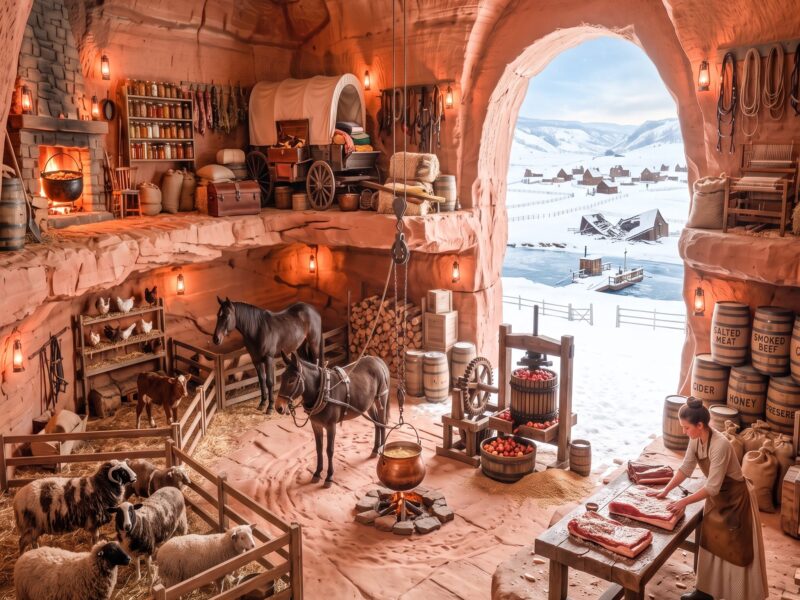
The sandstone alcove was fifteen feet deep and forty feet wide, a natural amphitheater curved into the base of the mountain. Winnie had quarried the stone herself using a set of feather-and-wedge tools her father, a master carpenter in Pittsburgh, had sent her.
By the third week of September, the walls of the barn had reached her collarbone. They were two feet thick, packed dense with chip and rubble, mortared with slaked lime she had burned in a pit behind the cabin. She leaned the wall back a quarter-inch to every foot of rise, pressing the weight of the stone into the mountain itself, exactly as Roman engineers had done two thousand years ago.
But the walls meant nothing without the roof beams.
On the morning of the 23rd, Winnie rigged the heavy block and tackle to the massive cottonwood tree near the alcove. The fourth beam, a green pine log weighing nearly eight hundred pounds, needed to be hoisted twenty feet into the air and seated into the notches she had carved.
Ambrose stood near the base of the tree, his hands ready on the tail of the fall rope.
“Alright, Ambrose,” Winnie called out, wiping the sweat from her brow. “When I give the word, you pull the slack and tie it off on the cleat. Do not let it slip.”
“I’m ready, Mama,” Ambrose said, his small face set in grim determination.
Winnie walked over to inspect the rig one last time. She reached up to test the tension on the primary load-bearing rope.
Her fingers brushed something frayed.
She stopped. She pulled the rope down to eye level. Her stomach violently dropped out from beneath her.
The thick hemp rope was cut. It wasn’t worn. It wasn’t frayed from use. A sharp knife had sliced exactly three-quarters of the way through the fibers, leaving just enough intact that it wouldn’t snap under its own weight.
But the moment the eight-hundred-pound pine log was hoisted into the air, the rope would part. The timber would plummet nose-down into the dirt.
Directly where Ambrose was standing.
Winnie couldn’t breathe. A coldness traveled from the small of her back into the base of her skull. She looked at her nine-year-old son, standing faithfully by the cleat, waiting for her command.
They weren’t trying to scare her anymore. They were trying to cause a fatal accident. They were trying to kill her son.
“Ambrose,” Winnie said, her voice sounding hollow, distant. “Step away from the rope.”
“But the beam—”
“Step away from the rope right now!” she screamed, the sudden ferocity in her voice making the boy flinch and jump backward.
Winnie slumped against the stone wall, her chest heaving. She closed her eyes, fighting the urge to vomit. Ashcraftoft had realized that killing her cows wouldn’t break her. He had to break her heart.
She replaced the rigged line with the good rope Desmond had bought in Silverton. She hoisted the beam alone, using the mule and a complex secondary pulley system, refusing to let Ambrose anywhere near the alcove until the timber was safely seated in its mortise.
That night, Winnie did not sleep.
She sat at the heavy plank table with the oil lamp turned low. She dismantled Desmond’s Winchester rifle piece by piece. She oiled the action. She wiped the barrel. She loaded five brass cartridges into the tube, leaving the chamber empty. She set the rifle on two pegs by the front door.
If they came in the night, she would not warn them. She would put them in the ground.









