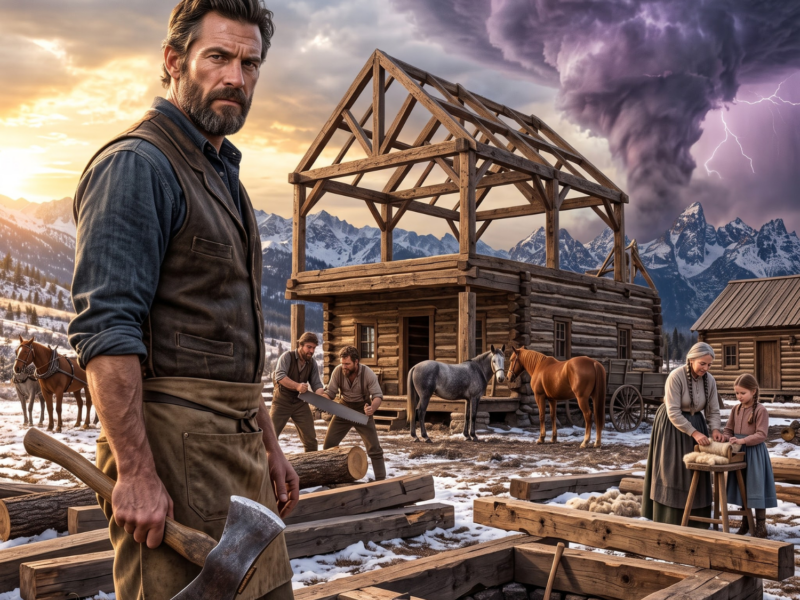
They Mocked Him for Building a SECOND ROOF Over His Cabin — Until WINTER CAME
The Carpenter's Warning
The local master carpenter, Edwin Pike, could not resist the urge to see the foolishness for himself.
Unlike Caleb Dorsey, Edwin did not laugh immediately. He rode his horse into Owen’s yard, dismounted, and walked slowly around the massive timber frame. He possessed the critical, calculating eye of a man who understood load-bearing physics and the brutal realities of Rocky Mountain weather. He measured the thickness of the posts with his eyes, squinted at the heavy crossbeams, and looked at the existing, low-pitched cabin roof sitting miserably in the shadow of the new structure.
Edwin hooked his thumbs into his suspenders and walked over to where Owen was sawing a plank.
“I’ll tell you exactly why this is going to fail, Owen,” Edwin said, his tone carrying the weary authority of an expert addressing an amateur.
Owen stopped sawing and stood up, wiping sawdust from his trousers. He didn’t look angry; he looked genuinely attentive.
“A roof that high, suspended entirely in the air, is going to catch the wind like a ship’s sail,” Edwin explained, gesturing to the open space between the frame and the cabin. “If you make the overhang too wide, a strong canyon gust will get underneath it, create an updraft, and lift the entire structure right out of the dirt. You’ll find your new roof in the river.”
Edwin pointed a thick finger at the top beams. “If you make the pitch too flat, the snow will stay on it. When three feet of wet snow sits on a freestanding frame, it becomes top-heavy. If the structure shifts even a quarter of an inch, thousands of pounds of snow and timber are going to push sideways and collapse directly onto your family.”
Owen listened carefully, absorbing every word. He looked at the frame, then back at the master carpenter.
“How steep would you make it, Edwin?” Owen asked quietly.
Edwin frowned, irritated that his warning hadn’t deterred the man. “I wouldn’t make it at all, Owen. I’d tear off your old shingles and lay new ones. Like a sane man.”
But Owen had already made up his mind. He did not want a second roof just because the first roof leaked. At least, not only because it leaked.
Years earlier, before he married Mara, Owen had worked briefly at a brutal, high-altitude logging camp in the San Juan Mountains. The main bunkhouse there had an unusual, ugly storage shed built beside it.
The shed had two roofs: a low, flat inner roof directly over the building, and a much steeper, massive outer roof supported on separate, heavy timber posts.
At first, a younger Owen had assumed the outer structure was simply an unfinished barn that they had given up on.
Then, deep winter arrived.
Massive blizzards dumped feet of snow on the camp. But the snow that landed on the steep outer roof of the shed simply slid away, crashing harmlessly to the ground before it could accumulate into a crushing weight. Rain hit the outer shingles instead of the building below. The space between the two roofs stayed open to the air, constantly ventilated by the mountain breeze.
When the outer roof eventually took damage and needed repair, the building beneath it remained perfectly dry.
Owen had never forgotten it. It was a masterpiece of passive engineering.
His new cabin in the North Fork sat in a narrow, funnel-like part of the valley where storms often arrived violently from the west. The old, original roof had a shallow, lazy pitch. Snow did not slide off it easily; it accumulated, heavy and stagnant.
Then, the heat from the iron stove inside the cabin would rise, warming the ceiling boards and the roof from beneath. The bottom layer of the snowpack would melt into water. At night, when the fire died down, that water would freeze again, expanding into solid ice. Over time, this freeze-thaw cycle aggressively pried the cedar shingles apart, allowing water to find every weakness and drip onto their beds.
Owen wanted to separate those two specific problems. The cabin would keep its original roof to hold in the heat, but the brutal mountain weather would hit something else first.
He designed the new, outer roof to be incredibly steep—an aggressive A-frame pitch that would shed snow rather than hold it. Because it stood on independent posts, its lowest edge sat roughly two feet above the original roof. The highest gap, near the peak, was even larger. Freezing air could move freely between the two structures, ensuring the old roof stayed cold, preventing the melt-freeze cycle from destroying the shingles.
And because the new roof extended significantly beyond the cabin walls like a massive awning, rain and melting snow would fall much farther away from the stone foundation, preventing the ground from turning into a muddy swamp.
At least, that was the theory.









