They Threw Her Out at 15—Until Her Secret Shelter With a Heated Floor Shocked Everyone Forever
The Leaky Seam
It lasted four days.
On the fourth night, with a slightly larger fire built to fight off a harder frost, Varity woke from a shallow, exhausted sleep to a smell that did not belong. Wood smoke, yes—but wrong, somehow thicker, closer, without the clean draw she had grown used to.
She sat up on the platform and found the air in her shelter hazy, stinging faintly at the back of her throat.
She scrambled down and crawled toward the firebox, holding her breath as best she could, and found the source within seconds: A thin gray ribbon of smoke was seeping upward directly from the earth floor beside the third tile in her buried channel, rising through a crack no wider than a fingernail, invisible until it began actively leaking.
Her stomach dropped.
A cracked tile somewhere along forty feet of buried clay tile, laid tile by aching tile through six weeks of blistered labor. One seam had failed, and it was bleeding smoke directly into the soil beside her sleeping platform instead of carrying it the full length of the channel and out through the chimney.
Her first thought was not fear. It was arithmetic—cold and immediate. If that wall failed further, it would not simply block her firebox; it could collapse directly onto the buried tile channel running just beneath it, crushing forty feet of carefully laid clay under an uncontrolled weight of falling earth.
She worked through the rest of that day and into the next with a kind of desperate, methodical calm, because panic was a luxury she could not afford. The wall would not wait for her to indulge.
She cleared the slump soil away from the firebox by hand, careful not to disturb the tiles beneath, and then faced the real problem. The wall itself needed reinforcement—something with more structural integrity than raw earth alone, something that could hold against saturation the next time rain came without warning.
She thought of the old ruin. It had been sitting in the back of her mind for weeks: a name pressed into brittle paper, a rusted cup she had not been able to throw away. Ezra Doyle’s collapsed shelter still lay perhaps thirty feet from her own excavation, its rotted timber frame half-swallowed by the prairie. Most of the wood was too far gone to use—soft and crumbling at a touch—but not all of it.
She spent the better part of an afternoon carefully working through the collapsed remains and found, near what had once been the deepest and driest corner of the older pit, three lengths of support timber that had somehow escaped the worst of the rot, protected by a fold of earth that had kept them dry for seven years. They were not much, but they were seasoned, solid wood, and they were exactly the right size to serve as structural bracing.
She cut fresh blocks of prairie sod—thicker and denser than the ones she had used originally—and rebuilt the wall around Ezra Doyle’s salvaged timber, using the old wood as a hidden internal frame the way a mason uses iron rebar inside a stone wall: something with enough tensile strength to keep the whole structure from slumping again under saturation.
She packed the new sod tight, layer by layer, and this time angled the outer face of the wall slightly inward at the top—a small design change born entirely from watching where the previous wall had failed, meant to shed rainwater outward rather than letting it pool and soak straight down into the join.
There was something strange and quietly moving in it: using a stranger’s abandoned wood to save her own shelter. Ezra Doyle had failed on this ground for reasons she would likely never fully know, and yet some small, stubborn piece of what he had built was now holding up the wall that was keeping her alive.
Her failure had become, in its own small way, part of her survival. She did not know if that was fair; she only knew it was true. And true was worth more to her in November of 1883 than fair had ever been.
Act III: The Great Blizzard of ’83
Chapter 7: The Uninvited Guest
The rain stopped on the third day. But the incident cost her nearly a week of careful, exhausting labor she had not budgeted for, and it left her with a lesson written into her hands and her back that she would carry the rest of her life: The ground that seemed so solid, so eternal, was not a fixed thing at all. It was alive in its own slow way, and it would test every seam a person dared to build into it sooner or later, whether they were ready for the test or not.
She had barely finished the repair when the second piece of trouble arrived, and this one wore a human face.
Silas Puit had been watching the smoke for weeks, the way a careful man watches anything on the open prairie that does not behave the way he expects. A thin gray curl rising from open, empty ground where no house stood, no chimney should exist, had unsettled him from the very first time he noticed it.
On a bitter, still morning in the third week of November, the smoke did something it had not done before. The wind lay dead calm that morning, and rather than dispersing thin and pale into open sky, Varity’s chimney smoke hung low and thick over the flat, spreading in a gray haze across the grass the way smoke settles when the sky refuses to take it.
From a mile off, riding the creek bottom, Silas Puit saw a haze of smoke lying flat and heavy over open prairie grass—exactly the way a man expects to see it lying over a grass fire about to run. He did not hesitate. He turned his horse hard toward Bitter Creek and rode as though the whole county depended on the next twenty minutes, because in a dry prairie autumn, it very well might have.
By the time he reached the edge of town, he was shouting before his horse had fully stopped: “Fire on the Kesler flat! Grass fire spreading low! No wind to push it yet, but that could turn any minute!”
Within a quarter-hour, four men had saddled horses and loaded a wagon with water barrels and wet sacks—the standard prairie response to the one disaster every homesteader feared more than almost any other.
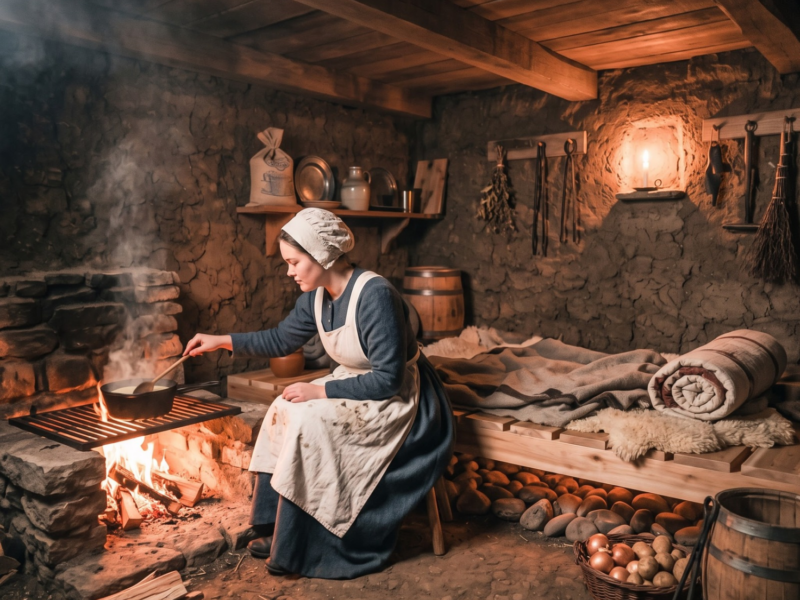
তারা over the last rise above Varity’s shelter at a hard gallop, ready to fight flames, and found instead a fifteen-year-old girl kneeling calmly beside a small, contained cooking fire, stirring a pot of beans with a thin column of smoke rising from a chimney built of stacked sod blocks a few feet from where she sat.
The silence that followed was its own kind of small disaster.
Silas swung down from his horse, chest heaving, and stared first at the fire, then at the buried chimney, then at Varity herself, working through what he was seeing with visible difficulty.
“That’s your smoke?” he said—not quite a question, not quite an accusation. “That’s been your smoke this whole time?”
“Yes,” Varity said, setting down her spoon, meeting the eyes of four grown men who had just ridden hard enough to lather their horses over her cooking fire. “I’m sorry for the trouble. I didn’t know it could be seen from town on a still morning.”
One of the other men laughed—short and sharp, more out of released tension than genuine humor—and turned his horse back toward Bitter Creek without another word, muttering something about wasted mornings. A second followed him, but Silas Puit stayed a moment longer, looking past Varity toward the low mound of earth and sod that marked her chimney, then toward the sloped entrance ramp cut into the ground beside it.
“You’re really living out here,” he said. “Under the ground itself.”
“I am,” Varity said simply.
Oaks—or in this case, Puit—crouched without quite meaning to, and laid his palm flat against the sod blocks near the chimney’s base: the exact same instinctive gesture Varity herself had made countless times over the past two months. Whatever he expected to feel, warmth radiating faintly through packed earth and stone, clearly was not it.
Something shifted in his face, suspicion softening into something closer to careful curiosity. “Chicken coop trick,” he said slowly, almost to himself. “My grandfather used to run a little vent line like that under a brooder box back in Ohio. Never seen anyone try it for a whole shelter.”
“My father did,” Varity said. “He said before he died, I only made it bigger.”
Silas did not offer help that day, and he did not offer an apology beyond his silence, which was, in its own quiet way, an apology all its own. But he did not ride away with the same hard suspicion he had arrived with either.
Over the following weeks, he began appearing at odd intervals: never announced, never asked for. A dressed rabbit left near her entrance ramp after a good trap line. A word passed along about where dry, deadfall wood could still be found before the snow buried it. Once, without comment, a small sack of dried beans set just inside her ramp while she was away gathering wood—more than she would have spent money on for herself.
Small things: the things one prairie survivor offers another once suspicion has finally given way to something like respect. He never told her outright that he had changed his mind about the girl living in a hole in the ground. He did not need to. The rabbit, the wood, the beans, and the occasional silent nod when their paths crossed in town said it plainly enough.









