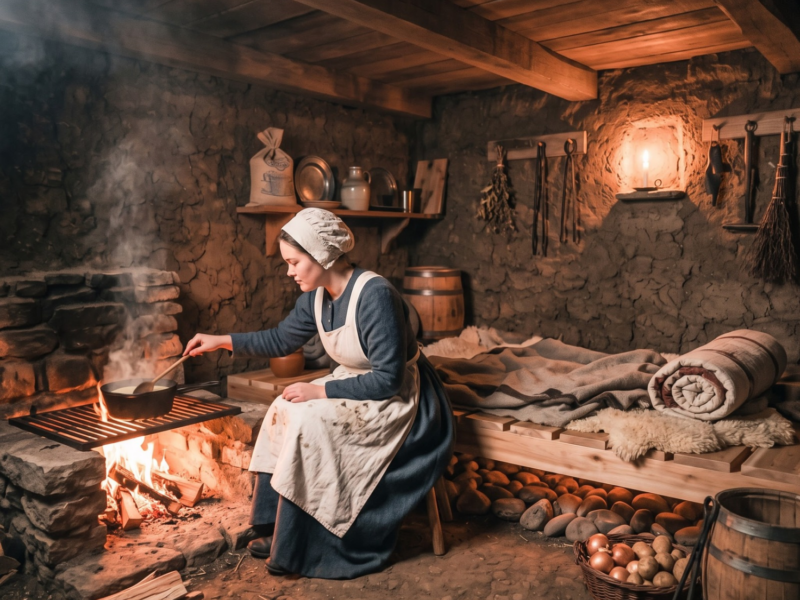
They Threw Her Out at 15—Until Her Secret Shelter With a Heated Floor Shocked Everyone Forever
The Great Blizzard of '83
By the end of November, the cold had turned genuinely serious, dropping well below freezing most nights and staying there through the day as well. It was, in its own way, the truest test the shelter had yet faced—a sustained cold rather than a single hard frost—and Varity watched the results with the intent focus of someone whose life quite literally depended on the outcome.
Outside temperatures fell to the low twenties, some nights occasionally lower. Inside her shelter, even without a fire burning, the packed earth walls held a stubborn baseline warmth, somewhere near fifty degrees, the deep soil simply refusing to care what was happening on the surface above it.
When she lit her fires morning and evening, as always, the platform climbed reliably into genuine comfort: high enough that she slept without shivering, low enough that she never needed to fear the fire itself. Her fuel use held steady at roughly the same six or seven small pieces of wood a day she had settled into weeks earlier.
She began, almost without meaning to, keeping a rough count in her head of what the Croft household likely burned by comparison, remembering the woodpile beside Barnabas’s farmhouse, remembering how often smoke poured thick and constant from that chimney even on merely cold days, let alone brutally cold ones. She did not yet know exactly how badly that comparison would matter.
She only sensed in the quiet arithmetic she had learned to trust more than any clerk’s opinion of her age, that a reckoning of some kind was coming, and that it would not announce itself gently.
The first week of December brought a stretch of days that felt briefly, almost peaceful. The shelter held its warmth. The repaired wall stood firm against another round of light rain that turned to sleet before it stopped. Silas Puit’s occasional visits had become something Varity found herself quietly listening for, though she would not have admitted as much out loud to anyone.
She began, for the first time since late August, to believe she might actually make it through to spring.
Then, on the 12th of December, the air itself began to change in a way that unsettled her more than any single storm had yet managed.
She noticed it first in the animals: the handful of prairie chickens that normally scattered lazily at her approach along the creek bottom went strangely silent and still one afternoon, hunched low against the cold in a way she had not seen before. Then she noticed it in her own body, a dull, persistent ache behind her eyes and across her joints that she had felt only once before in her life—the winter her father had once told her meant a hard storm building somewhere just past the horizon, felt through the changing pressure of the air itself long before any cloud appeared to prove it.
That evening, the sky to the northwest took on a strange, flat, yellow-gray cast as the sun went down—a color Varity had never seen before and did not like the look of at all. The wind, which had been blowing steadily from the west for days, died away entirely into an unnatural, waiting stillness.
She banked her fire a little larger than usual that night, some instinct she could not fully name telling her to store as much heat into the earth beneath her platform as her fuel supply could reasonably spare. She lay awake longer than usual, listening to a silence outside that felt less like calm and more like something enormous holding its breath.
Three miles away in the Croft farmhouse, Barnabas stood at his own window that same evening, watching that identical strange yellow light fade out of a stone-still sky, and felt an old, familiar unease settle into his chest: the kind every honest Nebraska farmer kept coiled somewhere in his bones after enough winters on this land.
He did not know, standing at that window, how much his family’s woodpile would be tested in the days ahead, or how badly it would fail them. He did not know that three miles away, a fifteen-year-old girl he had turned out of his home four months earlier was at that very same moment banking her own fire a little higher than usual, some deep and correct instinct warning her that whatever was coming, it would not be an ordinary cold.









