Unaware of His $200M Inheritance, In-Laws Threw a Navy SEAL Dad and His Twins Out — Until His Dog Fo
The Black Ice Highway
The rain started an hour into the drive. It wasn’t a gentle autumn shower; it was a freezing, relentless downpour that rapidly turned the interstate into a slick, treacherous sheet of black ice. The truck’s heater core had died three years ago, and the vents blew only lukewarm air that smelled faintly of exhaust fumes and wet dog.
“Daddy, I’m cold,” Leo mumbled from the back seat, his teeth chattering slightly as he pulled his thin, autumn fleece jacket tighter around his small shoulders.
Arthur’s jaw tightened until his teeth ached. He reached back blindly, his hand finding Leo’s knee. “I know, buddy. We’re almost there. I promise.”
It was a lie, but there was nowhere to go but north.
A week before Claire died, Arthur’s estranged father, Thomas Pendleton, had passed away from a massive, sudden heart attack. Thomas was a reclusive, eccentric man who had lived completely off the grid in the dense, suffocating woods of the Appalachian foothills. He and Arthur hadn’t spoken in nearly a decade. Thomas was a deeply paranoid man who hoarded junk, muttered endlessly about government collapse and fiat currency, and trusted absolutely no one.
The only thing Thomas had left Arthur in his sparse, handwritten will was a dilapidated hunting cabin fifty miles from the nearest incorporated town. It was a worthless piece of real estate, rotting from the inside out, sitting on soil too rocky to farm. But tonight, as the freezing rain lashed against the windshield, it was the only piece of the world that Arthur actually owned.
They pulled into a brightly lit, desolate gas station off the interstate. The fluorescent lights flickered in the storm. Arthur pulled his wallet out and counted the crinkled bills. He went inside, the bell above the door chiming weakly, and bought two foil-wrapped hot dogs spinning on a heat roller, a bag of plain potato chips, and two small cartons of chocolate milk.
The total was twelve dollars. The math in Arthur’s head was a relentless, running ticker of dread. Forty-two minus twelve left him with thirty dollars. Thirty dollars to keep two children alive in November.
Back in the freezing cab of the truck, he handed the meager food to the kids. They ate in silence, the rhythmic, squeaking slap of the worn windshield wipers the only sound. Barnaby rested his chin on the center console, watching Arthur with sad, highly intelligent eyes. Arthur broke off a piece of the stale hot dog bun and fed it to the dog.
“Eat up, Barnaby,” Arthur muttered, staring out into the blackness of the highway. “It’s a long way to the bottom.”
They drove for another three agonizing hours, the roads steadily deteriorating. They turned off the main highway onto a cracked two-lane asphalt road, and eventually onto a washed-out, muddy dirt path that wound deep into the foothills. The trees pressed in on all sides, skeletal and imposing, their bare branches clawing at the headlights. The truck jolted over deep, water-filled ruts, the suspension groaning in violent protest.
Finally, the headlights swept across the clearing, catching the shape of the cabin.
It was worse than Arthur remembered. The porch roof was sagging heavily on the left side, looking as though a strong gust of wind would collapse it entirely. The windows were grimed with years of dirt and dead leaves, and the front door hung slightly off its rusted hinges. The front yard was a graveyard of rusting scrap metal, old tractor tires, and waist-high weeds that the winter cold had turned into brown, brittle stalks.
“Is this the camping spot?” Maya asked, her voice impossibly small. She sounded skeptical, and for good reason.
“This is it,” Arthur said, putting the truck in park. He killed the engine.
The silence of the deep woods descended on them instantly—heavy, absolute, and suffocating.
“It’s an adventure, guys,” Arthur forced a smile, though his heart was hammering against his ribs in sheer panic. “We’re roughing it.”
He carried Maya through the freezing mud while Leo held tightly to the hem of his jacket. Barnaby trotted ahead, his nose instantly going to the ground, sniffing furiously at the damp earth and rotting wood. Arthur kicked the front door open, the hinges screaming.
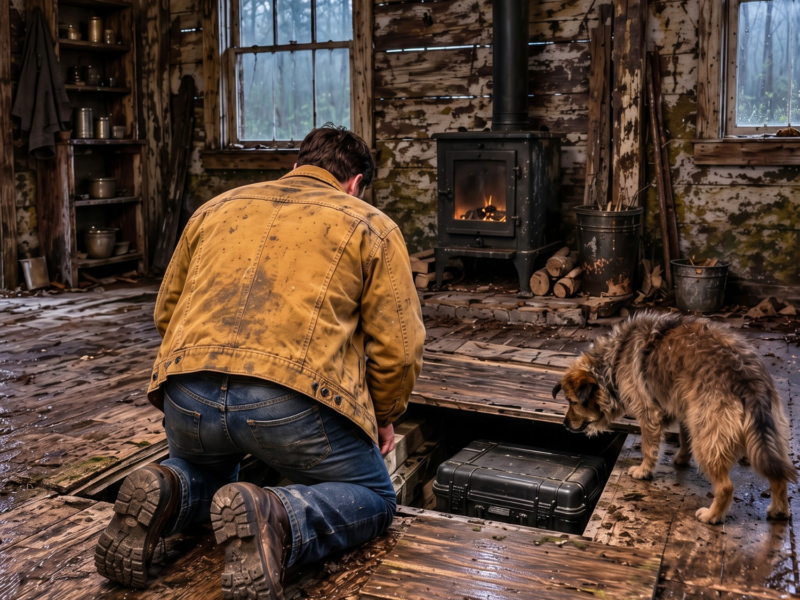
The inside of the cabin smelled of mildew, ancient dust, and old tobacco. It was a single, sprawling room. A heavy cast-iron wood stove sat in the center, rusted but intact. Against the far wall was a metal military-style cot with a bare, deeply stained mattress. A few rough-hewn wooden shelves held rusted cans of indeterminate food and old mason jars filled with screws and bent nails.
It was a literal shack.
Arthur set Maya down on her feet. He pulled a heavy tactical flashlight from his pocket and swept the blinding LED beam across the floorboards. “Okay, first things first. We need a fire.”
He spent the next hour breaking apart an old, rotted wooden chair he found on the back porch, using the splinters as kindling in the stove. The wood was damp, and it took a dozen matches and a lot of frustrated swearing under his breath before it finally caught, sending a weak, smoky warmth into the freezing room.
He laid out the twins’ sleeping bags on the floor as close to the stove as he dared, wrapping them in every spare blanket and towel he had in the truck.
Once the kids finally fell asleep, their breathing evening out, exhausted by the emotional and physical toll of the day, Arthur sat on the edge of the rusted metal cot. He put his head in his calloused hands. The adrenaline of the escape was gone. The SEAL training, the stoicism, the pragmatism—it was all stripped away in the dark, leaving only a hollow, terrifying exhaustion.
He had failed them. He had failed Claire.
He had dragged his kids into the freezing wilderness because he couldn’t afford to put a roof over their heads. A tear, hot and unbidden, slipped down his cheek. He wiped it away angrily.
Suddenly, he felt a wet, cold nose nudge his hand. Barnaby was standing there, but the dog wasn’t looking for affection. Barnaby let out a low, persistent whine, looking over his shoulder toward the dark back corner of the cabin.
“Go to sleep, Barn,” Arthur whispered, rubbing his burning eyes.
Barnaby didn’t listen. The dog trotted over to the corner near a stack of molding firewood and began to scratch frantically at the floorboards.
Scratch. Scratch. Scratch.
“Hey, knock it off,” Arthur hissed, glancing nervously at the sleeping twins. “You’ll wake them up.”
Barnaby ignored him. The dog’s paws were moving in a blur, his claws tearing at the rotted wood. He let out a sharp, urgent bark.
Arthur sighed, his bones aching as he stood up. He walked over to the corner, reaching down to grab the dog by the collar. “Come on, buddy. There’s nothing there but rats.”
But as Arthur pulled the dog back, the beam of his flashlight caught something strange. The floorboards in that specific two-by-two-foot corner were different. They weren’t nailed down like the rest of the floor. They were fitted together with a crude but highly deliberate tongue-and-groove joint, completely unattached to the joists underneath.
Barnaby’s frantic scratching had dislodged one of the boards, pushing it up slightly, revealing a seam of total darkness beneath.
Arthur frowned, his tactical instincts suddenly flaring. He knelt down, running his fingers along the edge of the wood. The craftsmanship was entirely out of place in this haphazardly built shack. He wedged his strong fingers under the lip of the board and pulled.
The wood groaned, giving way with a sharp crack that made Arthur wince and look back at the twins. Maya shifted in her sleeping bag, but didn’t wake.
Arthur turned his attention back to the floor. Beneath the removed board was a dark, square cavity lined with thick, industrial black plastic. Barnaby pushed his snout past Arthur’s arm, sniffing aggressively at the gap. Arthur gently pushed the dog’s head aside. He reached his hand down into the cold, dusty void.
His fingers brushed against cold, hard metal. Gripping a heavy, rubberized handle, Arthur pulled.
It was incredibly heavy, awkwardly weighted. He grunted as he hauled it up out of the hole and onto the floorboards. In the beam of the flashlight, he stared at it. It was a military-grade Pelican case—completely airtight, waterproof, and virtually indestructible, covered in a thick layer of fine gray dust.
Arthur stared at it, his mind racing. His father was a hoarder, a man who kept broken toasters, tin foil, and empty jars. He didn’t buy three-hundred-dollar waterproof tactical cases.
The latches were incredibly stiff. Arthur had to use the hard rubber heel of his boot to pop them open. The heavy plastic lid swung back on its steel hinges, breaking the vacuum seal with a soft, audible hiss.
Inside, there were no gold bars. No stacks of hundred-dollar bills. No dramatic pirate treasure.
There was a thick manila envelope, a small black moleskine ledger, and a handwritten letter resting on top of a dark velvet jewelry box.
Arthur reached in, his hands remarkably steady, and picked up the letter. The handwriting was unmistakable. It was the cramped, frantic, leaning scrawl of Thomas Pendleton. Arthur unfolded the yellowed paper. The ink was slightly faded, dated exactly one year ago.
Arty,
If you’re reading this, I’m dead. And you’re probably swearing at me for leaving you this miserable, rotting shack. Good. You always were too rigid, too much like your mother.
But you’re a good man. A better man than I ever was.
I know what you think of me. A crazy old bat living in the dirt. But I wasn’t always just a crazy old bat.
Long before you were born, before I went off the deep end, I started a little software company. I sold it in the late 80s. Put the money into the market. I bought Apple before it was Apple. I bought server farms before anyone knew what the hell the internet was. But I didn’t want the life. The suits, the taxes, the vultures. I saw what money did to people.
So, I hid it. I grew it, and I hid it. I didn’t give you a dime because money ruins people. I watched it ruin my partners. I wanted you to build your own spine. You went to the Teams. You built it. You proved yourself.
You don’t need my money to be a man, Arty. But looking at the world, you might need it to be a father.
In the ledger, you’ll find the account numbers. The trust is in Zurich. The corporate shell is in Delaware. The law firm managing the blind trust is Winston and Hayes in New York. The code word to access the principal is Barnaby. (I liked your dog more than your in-laws).
The current valuation, after taxes and reinvestment, is somewhere north of 200 million.
Don’t waste it on fancy cars. Buy yourself some decent land. Protect the kids.
Dad.
Arthur stopped breathing. The air in the cabin suddenly felt incredibly thin, as if the oxygen had been sucked out of the room.
Two hundred million.
He read the words again. And again. The cynic in him, the grounded, battle-hardened realist, immediately rejected it. It was a delusion. A final, cruel prank from a man who had lost his mind to paranoia and isolation.
Arthur dropped the letter and grabbed the black ledger. He flipped it open, shining the flashlight directly onto the pages. It wasn’t the rambling manifesto of a madman. It was a meticulous, painfully detailed accounting record. It tracked compound interest, offshore wire transfers, routing numbers, and corporate entity formations stretching back thirty years. There were contact names, phone numbers, and encryption keys.
He opened the manila envelope next. Inside were certified bank statements from a private Swiss wealth management firm, bearing Thomas Pendleton’s name as the sole beneficiary of a trust. The bottom line on the most recent statement, dated just weeks before Thomas’s death, read: $214,600,000 USD.
Arthur’s hands began to shake. A violent, full-body tremor. He dropped the ledger and gripped the edges of the Pelican case. The rough plastic grounded him. He looked over at his children. They were sleeping on a filthy floor in a freezing shack, wearing hand-me-down coats, rejected and discarded by the people who were supposed to love them.
He looked back at the papers in the box. He thought about Richard Carmichael’s smug, polished face. He thought about Patricia’s cold, dismissive eyes as she ordered him out of her pristine house. They thought they had crushed him. They thought they held all the power, the wealth, the leverage.
Arthur reached into the case and picked up the small velvet box resting at the bottom. He snapped it open. Inside was a heavy, solid gold signet ring featuring the Pendleton family crest, and a heavy brass key for a safe deposit box in Manhattan.
Barnaby let out a soft boof, nudging Arthur’s elbow.
Arthur looked down at the dog. He reached out, burying his hand in the scruffy fur behind Barnaby’s ears. A slow, terrifying smile spread across Arthur’s face. It wasn’t a smile of joy. It was the smile of a man who had just been handed a loaded weapon after bringing a knife to a gunfight.
“Good boy,” Arthur whispered into the dark room. “Good boy.”
He carefully placed the documents back into the case and snapped it shut, sealing it with a hiss. He pushed the case back into the floorboards, pulling the wood tight over it. He didn’t need to count cash. The proof in the ledger was enough.
Tomorrow, he would drive to town. He would find a payphone or buy a cheap burner. He would call Winston and Hayes in New York.
And then, he was going to buy the Carmichaels’ world. And he was going to burn it to the ground.









