Unaware of His $200M Inheritance, In-Laws Threw a Navy SEAL Dad and His Twins Out — Until His Dog Fo
Oak Haven
The cold didn’t wake Arthur. The silence did.
The wind had died down over the Appalachian Ridge sometime during the night, leaving a stillness so absolute it felt heavy on his chest. He opened his eyes, staring at the sagging wooden beams above him. His breath plumed in the freezing air, a pale ghost in the weak morning light filtering through the grime-caked windows.
The wood stove had burned down to fine gray ash hours ago. He sat up on the rusted cot, his joints popping in protest. Across the room, Leo and Maya were huddled together in their sleeping bags, only the crowns of their heads visible. Barnaby was curled into a tight ball at their feet, acting as a living space heater.
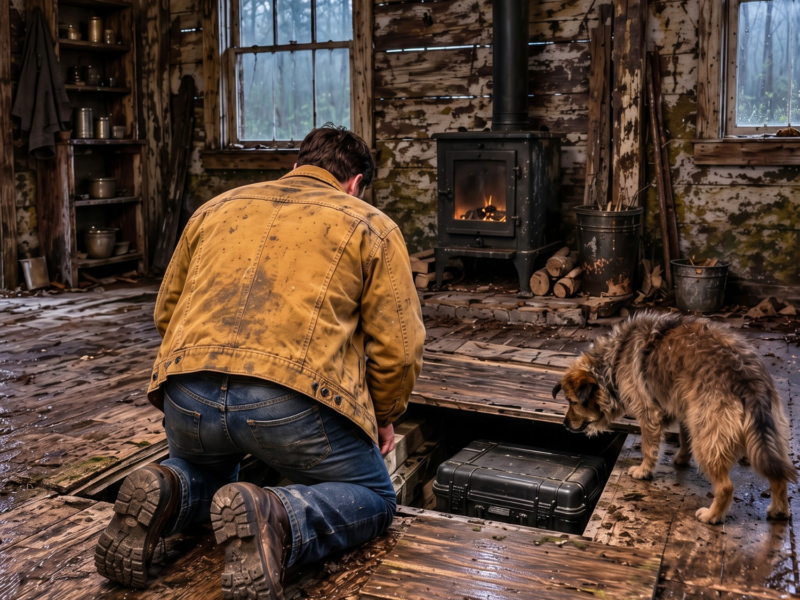
Arthur didn’t move immediately. He let his eyes drift to the corner of the room, to the floorboards he had hammered back into place at three in the morning. He hadn’t dreamed it. His knuckles were still raw and stinging from prying the wood up.
Arthur threw off his thin blanket and pulled his boots on. The leather was stiff and agonizingly cold. He quietly built another fire using the last of the dry kindling and a few pieces of damp wood that smoked aggressively before finally catching flame. Once the small shack began to warm, he woke the kids.
Breakfast was a bag of stale pretzels and the rest of the chocolate milk. Leo didn’t complain, but his small shoulders were hunched against the chill. Maya just chewed her pretzel in silence, her eyes wide and observant. They were tough kids. Claire had made sure of that. But they were six years old, and they were scared.
“Alright, boots on,” Arthur said, his voice carrying a forced, steady cheerfulness. “We’re heading into town. Time for some real food.”
The drive to the nearest town, a depleted mining community called Oak Haven, took forty minutes. Oak Haven was a collection of boarded-up storefronts, rusting gas station canopies, and a relentless, pervasive greyness. It wasn’t exactly a hub of high finance, but it had a diner, a hardware store, and a local bank branch. Most importantly, it had a cellular tower.
Arthur parked the sputtering truck in front of a diner named Dotie’s. The neon sign in the window buzzed angrily, half the letters burned out. He ushered the kids inside, the bell above the door jingling weakly. The air smelled of bacon grease, old coffee, and bleach. To Arthur, it was the best thing he had smelled in a week.
He slid into a cracked vinyl booth near the back, putting Barnaby on a short leash under the table. A tired-looking waitress with a nametag that read Brenda wandered over, a steaming coffee pot in hand.
“What can I get ya, hon?” she asked, her eyes skimming over Arthur’s worn jacket and the kids’ oversized, cheap sweaters. There was pity in her eyes, but not unkindness.
“Three short stacks of pancakes, a side of bacon, two orange juices, and a black coffee,” Arthur said. He pulled a ten-dollar bill and a five from his pocket—almost the entirety of his remaining cash—and placed it flat on the table. “Keep the change. And… can you keep an eye on them for exactly five minutes? I need to make a phone call outside.”
Brenda looked at the money, then at the twins, who were staring at the laminated menus with quiet desperation. Her expression softened. “Sure thing, honey. Go do what you need to do.”
Arthur stepped back out into the freezing air. He walked to the edge of the cracked asphalt parking lot, pulling a cheap, prepaid burner phone from his pocket. He had bought it at a gas station months ago for emergencies. He pulled the crinkled piece of paper from his jacket, the one he had painstakingly copied from his father’s ledger.
He dialed the New York number. His thumb hovered over the call button for a second. The cynical, grounded part of his brain told him this was a dead end. A phantom hope. But the memory of Patricia Carmichael looking at his fraying collar with utter disgust pushed his thumb down.
The phone rang twice.
“Winston and Hayes. How may I direct your call?” a polished, frictionless female voice answered.
“David Hayes, please,” Arthur said.
“Mr. Hayes is in a partner meeting. May I ask who is calling?”
“Arthur Pendleton.”
There was a pause, the sound of keyboard clicking. “I don’t have a Pendleton on Mr. Hayes’s schedule. If you’d like to leave a message—”
“Tell him Thomas Pendleton’s son is on the line,” Arthur interrupted, his voice dropping into the flat, authoritative tone that used to make junior officers stand at attention. “Tell him I have a Pelican case, a ledger, and the word is Barnaby. Pull him out of the meeting.”
The line went silent. It stayed silent for a full forty-five seconds. The cold wind bit through Arthur’s denim jacket, but he didn’t shiver. His eyes were locked on the bank across the street.
“Mr. Pendleton.” A new voice came on the line. It was an older man, breathless, stripping away the usual corporate pleasantries. “This is David Hayes.”
“My father left me a letter,” Arthur said, his voice flat. “He said you manage a blind trust. Delaware shell. Zurich accounts.”
“Arthur, my God.” Hayes sounded genuinely shaken. “We’ve been trying to locate you for eight months. Your father… he was an incredibly private man. He forbade us from using private investigators. He insisted you would find the cabin when the time was right.”
“I found it.”
“The verification code?” Hayes asked, his tone shifting back into professional caution.
“Barnaby,” Arthur said. Under the diner table fifty feet away, he imagined the scruffy dog begging for bacon.
A long, heavy exhale hissed through the phone speaker. “Verification confirmed. Arthur, first, allow me to offer my condolences on your father’s passing. And your wife’s. We were informed of the accident. It is a profound tragedy.”
“Save it,” Arthur said, the words clipping off sharp and cold. “I don’t need condolences, Mr. Hayes. I need liquidity. Right now.”
“Of course.” Hayes shifted gears immediately, recognizing the tone of a man who did not want his hand held. “The principal is fully vested and entirely at your disposal. The current valuation as of market open today is two hundred and fourteen million, six hundred thousand dollars. The holding company is wholly owned by you. We are merely the administrators.”
Hearing the number spoken aloud by a man sitting in a glass tower in Manhattan made the breath catch in Arthur’s throat. The world tilted slightly on its axis. He looked through the diner window. Leo was pouring an excessive amount of syrup onto his pancakes. Maya was laughing at something the waitress said.
“I need cash today,” Arthur managed to say, his voice perfectly level despite the hammering in his chest.
“I can wire fifty thousand dollars to any account you specify within ten minutes,” Hayes replied smoothly. “Consider it petty cash from the holding accounts. We will arrange a secure transfer of the primary infrastructure next week. Do you have a routing number?”
Arthur didn’t have a bank account that wouldn’t immediately swallow the money for Claire’s medical debts. “No. I’m in a town called Oak Haven. There’s a First National branch across the street. Can you wire it there for a cashier’s check pickup?”
“Name?”
“Arthur Pendleton. Have them hold it.”
“Done. Give me fifteen minutes to push it through their compliance department. Arthur… where have you been?”
“Camping,” Arthur said, and hung up.
He walked back into the diner. The warmth hit him like a physical blow. He sat down in the booth. The kids were happily demolishing their breakfast. Barnaby thumped his tail against the floorboards.
“Everything okay, Daddy?” Maya asked, a smear of syrup on her cheek.
Arthur reached across the table and wiped the syrup away with his thumb. The crushing, suffocating weight that had sat on his chest for six months—the fear of starvation, of failure, of losing his children to the state—evaporated. It was replaced by a cold, quiet clarity.
“Everything is perfect, Maya,” Arthur said. He looked at his black coffee. “Eat up. We have a lot of shopping to do.”









