He’d Hidden Alone for 7 Years — Then a Little Girl Walked Up, Looked at His Scars, and Said Something That Changed Everything
CHAPTER 1: THE VOICE IN THE STORM
A man who hadn't spoken to another person in four years watched a broken wagon limp up his mountain trail — Then a seven-year-old girl walked straight up to him, looked at his scars, and asked "Did it hurt? Mama can fix that"
The first snow of November came down soft and deliberate, the way bad news always does.
Gently, so you almost don’t notice until it’s already covered everything.
Gideon Hail stood at the edge of his property line, the tree line at his back, and the long gray valley spread out below him, and he watched it fall. He’d been watching weather come in off these mountains for seven years now.
He could read a sky the way other men read newspapers — the angle of clouds, the color of afternoon light, the way birds moved or stopped moving. This storm had been building for three days.
He’d already laid in extra wood, patched the weak corner of the barn roof, and moved his two horses and the mule into the back stall where the walls were thickest.
He was ready. He was always ready. Readiness was the only religion Gideon practiced anymore.
He was a big man, wide through the shoulders, with the kind of density that comes not from lifting weights, but from seven years of splitting wood and hauling stone and sleeping on a dirt floor when the cabin wasn’t finished yet. His hands were cracked and calloused.
His coat was elkhide, cured himself, stitched with a thick needle and waxed linen thread. He wore it open despite the cold, because the cold had stopped meaning much to him around year three.
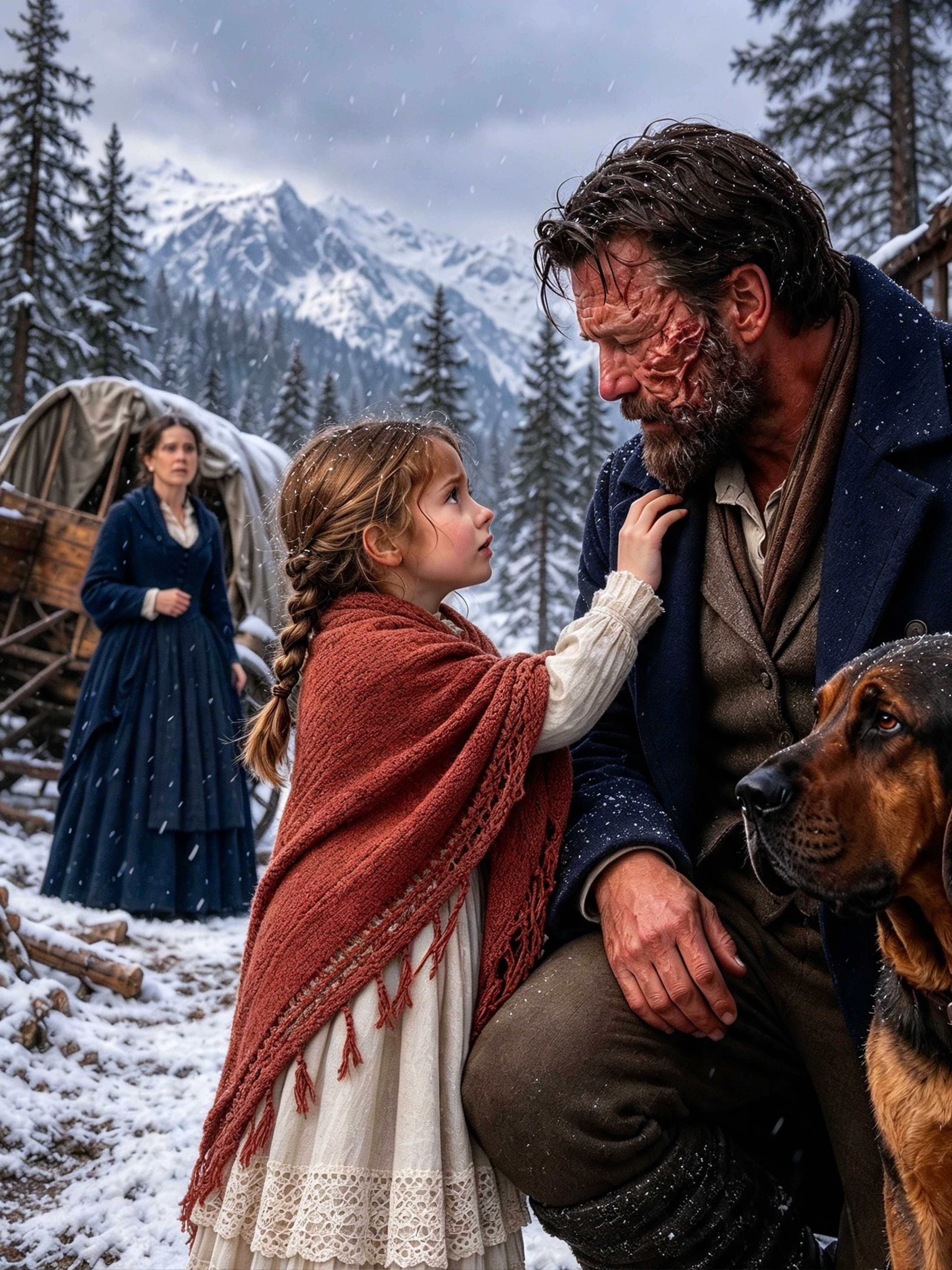
The left side of his face was a landscape of old damage — a fire, years ago, before the mountains, before everything.
The skin there had healed the way burned skin does: tight and uneven, pulling the corner of his eye slightly down, twisting the left side of his mouth into something that could look like a sneer if you didn’t know him.
He’d had seven years to get used to it. He’d never gotten used to it, but he’d gotten used to the fact that other people couldn’t. Children cried. Grown men stared and then looked at their boots. Women stepped back. He’d stopped counting how many times.
At some point you stopped keeping score of things that only hurt you.
He turned back toward the cabin. Smoke was already rising from the stone chimney. Rascal, his old hound, watched him from the front step with the particular exhausted affection of a dog who had decided years ago that his human was strange but acceptable.
“Storm’s close,” Gideon told the dog.
Rascal’s tail moved once, twice. This was most of what passed for conversation in Gideon Hail’s life.
He was nearly to the door when Rascal suddenly stood up straight — not the slow alertness of a dog who smells dinner, but the rigid full-body attention of an animal who hears something wrong. Nose up, ears flat. Gideon stopped and listened.
The sound came faint through the falling snow — the creak of strained wood, the snap of a splitting spoke, a wheel thudding heavily into frozen ruts.
Someone was coming. Up here. Where no one ever came.
He walked down the trail fast, long legs eating the ground, until the wagon came into view — one wheel hanging crookedly, spokes splintered, a thin mare heaving beneath the yoke. And on the seat, a woman with a shawl pulled tight, and beside her, a small figure in a coat too big.
The wagon stopped when it couldn’t lurch another inch. The woman climbed down slowly, stiff, exhausted. She was young, maybe twenty-eight, with dark hair half-fallen from its pins and eyes that looked as though they’d seen too much.
“Sir,” she called, her voice thin against the wind. “I’m sorry to intrude. The wheel gave out. We don’t mean to be a burden —”
Gideon didn’t answer. He never did. He just stood there, big and scarred and silent, and watched her step back.
Then the small figure hopped down beside her.
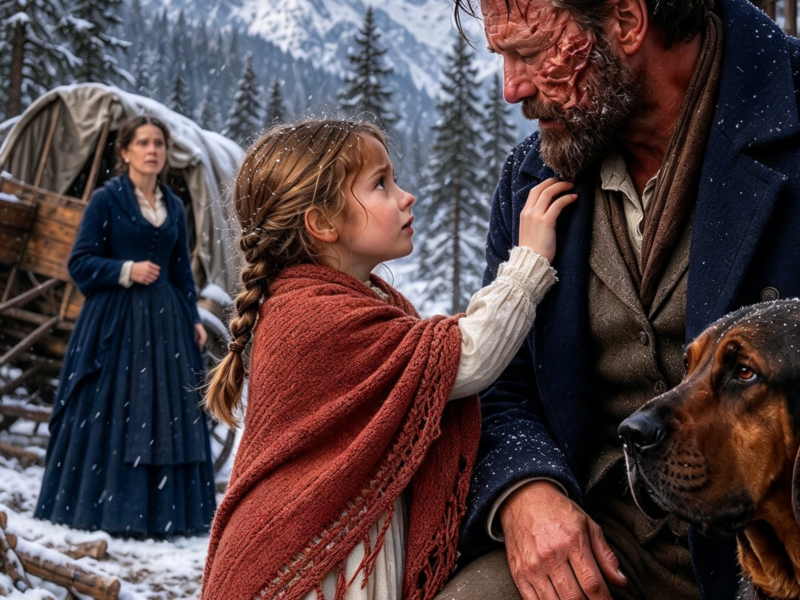
A girl. Seven years old, maybe. Braids tied with frayed ribbon, boots caked in mud, cheeks flushed pink. She didn’t step back. She didn’t hide behind her mother’s skirt. She walked straight past the woman, straight past Rascal who gave a low, uncertain rumble, and stopped right in front of him.
She tilted her head. Looked up. Looked right at the scarred side of his face.
No flinch. No gasp. Just quiet, unblinking curiosity.
“Did it hurt?” she asked.
Gideon froze. No one had asked him that. Not in seven years. Not ever.
“My mama can fix things,” she said, as if she hadn’t noticed his silence. “She mends knees and kettles and everything. She can fix that too.”
The woman hurried forward, alarmed. “Lila! Come back — I’m so sorry, sir, she doesn’t mean —”
Gideon lifted one hand. Stopped her. His eyes were still on the girl.
“You can’t fix this,” he said, his voice rough from disuse.
Lila shook her head firmly. “You don’t know what she can do.”