They Put Me Away and Sold My Home — Then My Brother Left Me a Secret Worth Millions
CHAPTER 1: THE BARN THAT KEPT A PROMISE
After My Children Put Me in Assisted Living and Sold My Home, I Inherited My Brother’s Worthless Farm—But When I Cut the Rusted Chain From His Locked Barn and Pulled Back the First Dusty Tarp, I Discovered Why He Had Spent Forty Years Keeping Its Contents Secret
The rusted chain snapped, and Edith Harper nearly lost her balance.
At her feet, the heavy links fell into the mud. For the first time in years, the barn doors were no longer locked.
Edith was seventy-eight, her hands swollen with arthritis, and her bad hip had been aching since sunrise. She had spent nearly two hours locating a pair of old bolt cutters and dragging them across the property. Now she leaned against the weathered timber, struggling to catch her breath.
Her brother Arthur had left her this farm. Eighty acres of exhausted land, a collapsing farmhouse, a rusted silo, and a barn no one appeared to have opened in decades. The entire property was assessed at barely $40,000. And it came with approximately $12,000 in unpaid taxes.
Her children had called the inheritance worthless.
Looking at the enormous padlock lying in the mud, Edith began to wonder why Arthur had taken so much trouble securing a building on a farm that seemed to have nothing worth stealing.
She gripped the iron handles. The doors resisted. She pulled harder. The swollen timber scraped across the concrete threshold until an opening appeared. Edith slipped inside.
The smell surprised her immediately. The farmhouse had reeked of mildew and neglect. The barn smelled of grease, rubber, leather, and old machinery. The air was remarkably dry.
She raised the kerosene lantern she had brought from the house. Its orange light reached into the darkness.
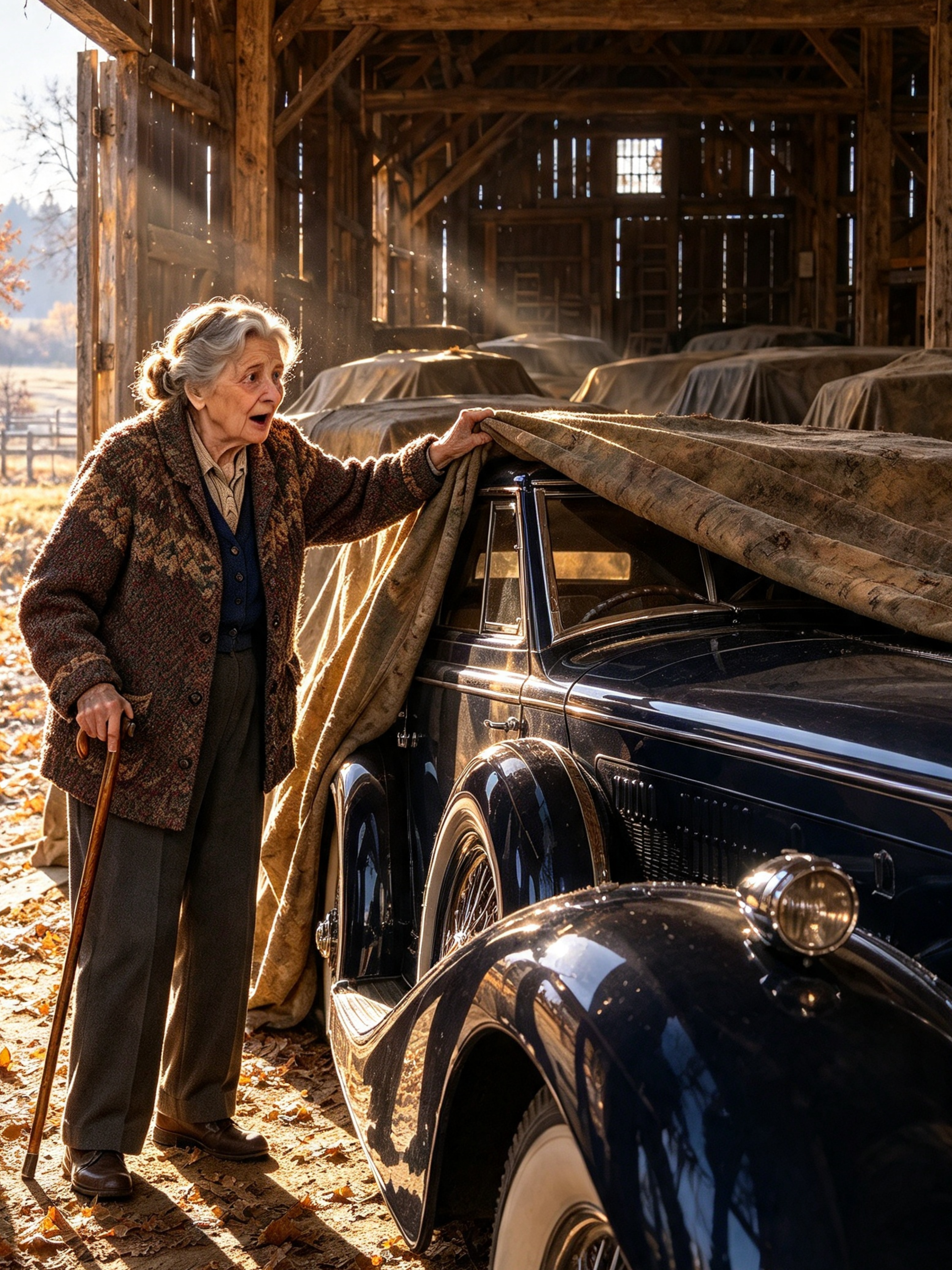
Seven enormous shapes stood across the concrete floor in orderly rows. Each was covered with heavy gray canvas.
Edith stopped walking. There was no hay. No ruined tractor. No collection of worthless farm equipment. Whatever occupied this barn had been deliberately arranged and protected.
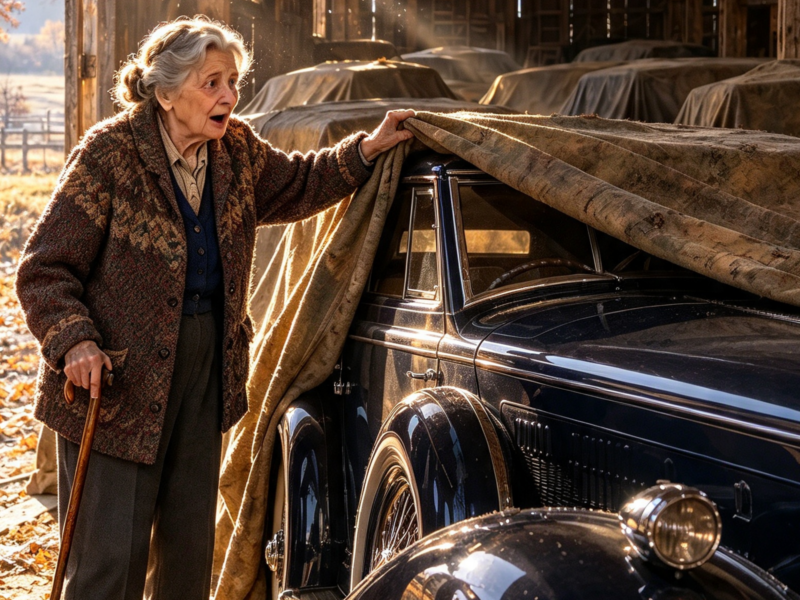
She approached the nearest covered shape. The canvas was thick with dust. Edith reached out, caught the edge, and pulled.
A sheet of dust slid to the floor.
Underneath, polished chrome flashed in the lantern light. A midnight-blue automobile emerged from the covering. It had sweeping fenders, delicate wire-spoke wheels, an impossibly long hood, and the unmistakable elegance of another era.
Edith did not know the make. She did know that nothing about this machine resembled the worn-out belongings Arthur had left inside his house. The chrome was brilliant. The bodywork looked carefully maintained. The tires were clean. Someone had devoted extraordinary attention to preserving it.
Edith stepped backward. Her cane struck the concrete.
“Arthur,” she whispered, “what have you been keeping in here?”
Only three days earlier, she had been sitting in the visitor’s lounge at Shady Pines Assisted Living, waiting for her children to finish explaining why she no longer had a home.
Richard had been checking his phone. Sarah had been smoothing the cuff of her expensive coat. They told Edith the house had become too difficult for her to maintain. The stairs were dangerous, they said. The property taxes were burdensome. Her hip had become unreliable. An assisted living facility would be safer.
But Edith had discovered that the proceeds from selling her longtime home were being used for more than her care. Richard had financial problems involving his startup. Sarah was planning an expensive kitchen renovation. And Edith — who had raised both children inside that four-bedroom suburban house — had been placed in a facility whose bare lounge smelled of disinfectant and institutional food.
They spoke about her as though she were no longer capable of making decisions.
Then Harrison Clark arrived. The attorney carried a leather briefcase and asked for Edith Harper. He represented her estranged older brother, Arthur Pendleton. Arthur had died three weeks earlier from heart failure. Edith had not spoken to him in nearly twenty years. Their relationship had fractured after their father’s funeral, and Arthur had withdrawn to his rural property in Oak Haven.
Now his will named her as his sole beneficiary.
Richard immediately asked what she was inheriting. Harrison explained the condition of the farm — bad soil, a deteriorating house, five years of tax arrears, a county auction threatened if the debt remained unpaid.
Richard dismissed the inheritance before Edith had finished hearing about it. “We aren’t taking on twelve thousand dollars in debt.”
Edith looked directly at him. “It isn’t yours to refuse.”
Sarah protested that her mother could barely manage stairs, much less a farm. But Edith had spent months listening to other people decide what was possible for her. She was tired of it.
She asked Harrison whether the property would belong to her if she accepted the inheritance. He confirmed the transfer could proceed, while warning her about the unpaid taxes.
“Then give me the pen.”
Richard became angry. He said they would not help her pay. They would not come rescue her if the farmhouse proved unlivable. She would be on her own.
Edith signed anyway. “I already was,” she told him.
Two days later, she boarded a bus carrying one suitcase, her medication, a few photographs, and a tin of tea. Neither child came to say goodbye.
The journey to Oak Haven took seven hours. By the time she reached the farm, the light was fading. The farmhouse was worse than she had imagined — peeling wallpaper, no electricity, mouse droppings, windows that let cold air through the frames. She spent her first night fully dressed beneath two blankets on a sagging downstairs mattress.
By morning, she was exhausted and frightened. Then she noticed the barn. Unlike the farmhouse, its roof looked intact. Its doors were secured by a heavy chain. She decided to investigate.
And now, standing before the midnight-blue automobile, Edith realized that Arthur’s apparent poverty had concealed something much more complicated.
She turned toward the next covered vehicle. Its silhouette was different — longer, lower. She moved carefully between the cars, supporting herself with her cane. Then she caught the second canvas covering and began drawing it backward.