I Crossed 1,200 Miles to Marry a Stranger — Then Found His Secret: 8 Children Hiding in the Dark
CHAPTER 1: THE MESSAGE IN THE ASHES
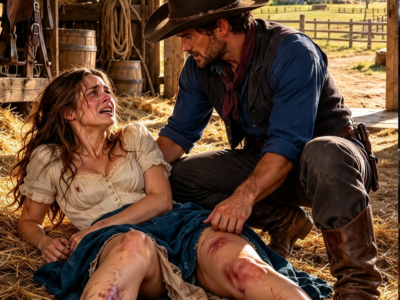
I crossed twelve hundred miles to marry a man I had never met, but when I reached his Nebraska farm, his cabin was burned to the ground and Samuel Morrison was dead behind the barn. Someone had shot him, stolen his livestock and tools, and destroyed almost everything he owned. Then, while searching the ashes for anything that might explain what happened, I found a root cellar door slightly open—and heard a frightened child's voice whisper from the darkness, "Please don't hurt us."
I had left Philadelphia with forty-seven dollars, one traveling trunk, and nine letters from Samuel tied together with blue thread. At thirty-one, I had lost my job at a dressmaker’s shop and had little waiting for me back East. Samuel’s advertisement had seemed like one last chance to build a life with someone who wanted a partner instead of a servant. Now the future I had traveled across the country to claim was lying beneath a canvas sheet.
Tom and Janet Parker had driven me from Kearney to Samuel’s homestead, and even they were shaken by what we found. The cabin had collapsed into its foundation, the barn was nothing but scorched beams, and bullet holes marked the surviving timber. In the grass, I found half of the rocking chair Samuel had written that he was building especially for me. That broken chair hurt almost more than seeing his body because it proved he really had been waiting.
Tom wanted us to leave before dark, but something about the destruction bothered me. Samuel had described every corner of his property in his letters—the barn, the workshop, the fences, even the shelves he had built. Whoever attacked him had taken what they could use and burned what they could not. I decided that if Samuel had hidden anything important, I might be the only person there who knew where to look.
That was how I noticed the root cellar near the remains of his workshop. It had escaped the fire, and there were fresh scratches in the dirt around its heavy wooden door. When I pulled it open, cold air carrying the smell of earth, preserved food, smoke, and fear rose from below. Then came that tiny human voice asking me not to hurt them.
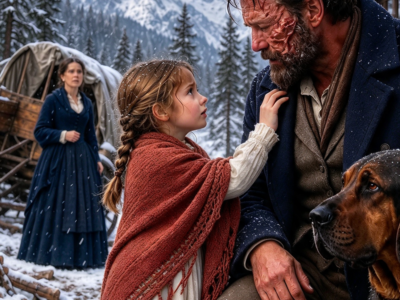
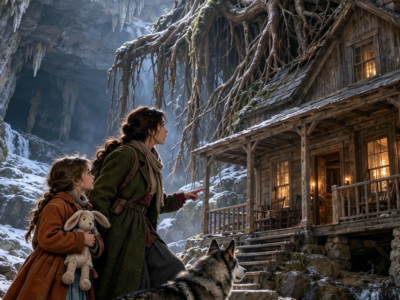
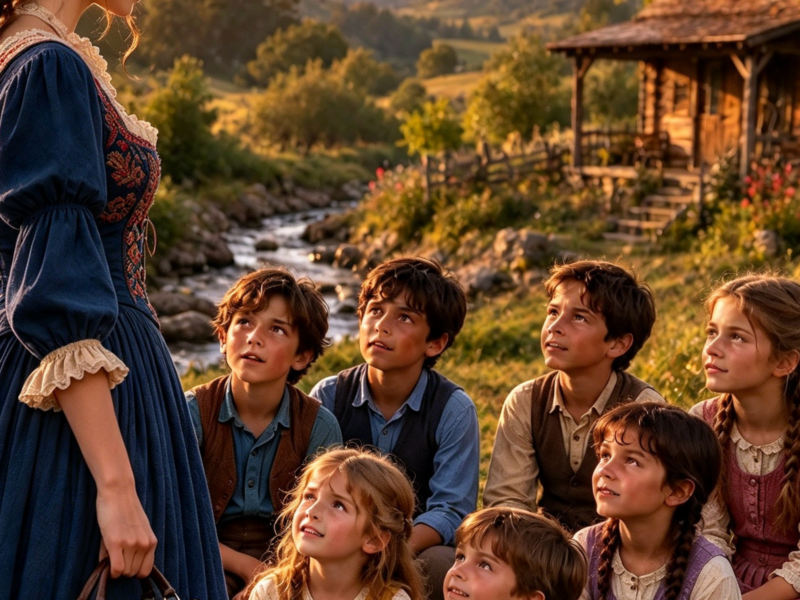
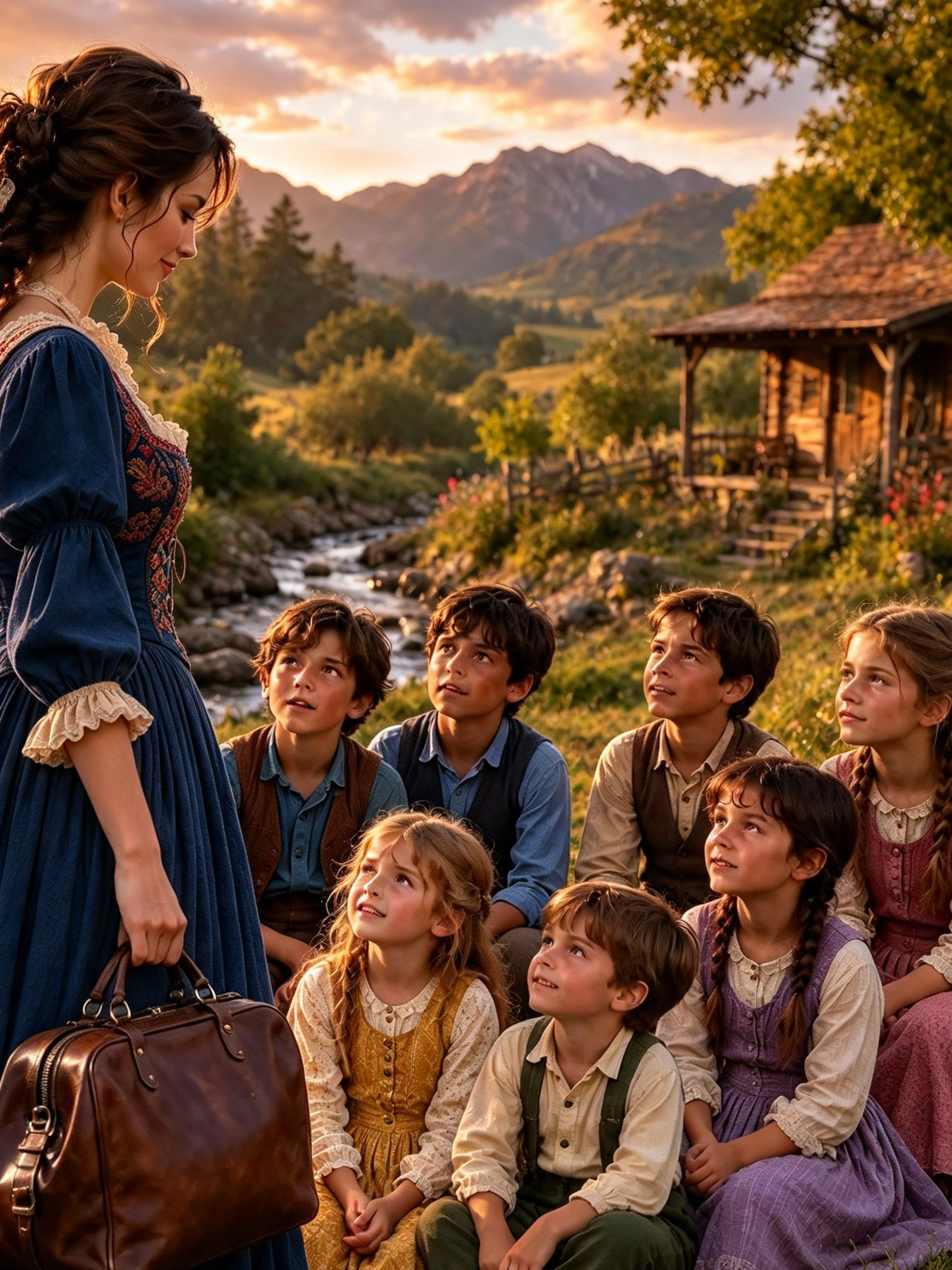
Tom climbed down first. A moment later, a thin boy of about fourteen appeared at the top of the ladder, placing himself between us and whoever remained below. Seven more children followed him into the fading October light, all dirty, hungry, exhausted, and terrified. The youngest was a three-year-old girl clutching a corn-husk doll against her chest.
The boy told me his name was Marcus. Behind him were Lucy, Rebecca, Michael, Sarah, five-year-old twins Jacob and Joshua, and little Emma. They had been hiding underground for three or four days, surviving on whatever food they could reach without coming outside. When I asked where their parents were, Marcus’s face became frighteningly still.
“The bad men hurt them,” he said. “We buried them before we hid.”
I looked at those eight children and felt something inside me turn cold with anger. Marcus was fourteen, yet he stood like a tired father protecting seven children because the adults who should have protected them were gone. Emma pressed herself against his leg while Lucy watched me with the same distrust in her eyes. They had learned, far too young, that grown people could disappear without warning.
I had nowhere to take them. I had no husband, no home, no farm, and barely enough money to take care of myself. Yet when Marcus said, “We didn’t steal anything. We were just trying to stay alive,” I knew I could not climb into the Parkers’ wagon and leave those children standing in Samuel’s ashes. Before good sense could stop me, I told him, “You’re coming with me. All of you.”
That first night, all thirteen children—the Parkers’ five and the eight orphans—were crowded into Tom and Janet’s small farmhouse. Janet fed the newcomers carefully because they were so hungry that eating too quickly could make them sick. Marcus divided food among his younger siblings before taking anything for himself. When I finally pushed my own bowl toward him, he insisted he wasn’t hungry until I told him I wasn’t asking.
Later, I found him sleeping on the floor beside the front door. When I asked why, he said he needed to hear if the men came back. I reminded him that Tom had a rifle, but Marcus looked at me with eyes no fourteen-year-old should have had and said, “So did my pa.” There was nothing I could say that would make the world safe again.
Near dawn, he asked the question he had apparently been carrying all night. “Are they going to split us up?” He had already understood what I had not—that eight orphaned children were unlikely to find one family willing to take them together. I told him I didn’t know what would happen, but I reminded him of the only promise I had made: all of them.
The next day, Tom rode into Kearney to speak with the sheriff and find out who the children were. Their story was confirmed—their parents had been homesteaders whose farm had also been attacked. But there was one part of the story I still didn’t understand. If their parents’ home was miles away, how had eight terrified children ended up hiding beneath Samuel Morrison’s workshop?
Marcus answered that question while I was peeling potatoes at Janet’s kitchen table. He said Samuel had seen smoke from their farm, gone looking, and found the children hiding near a creek after their parents were killed. Samuel brought all eight of them back to his homestead and cared for them for two days. Then the same men came for him.
“He put us in the cellar,” Marcus said.
The potato slipped from my hand. Samuel had ordered Marcus not to open the door unless he heard Samuel’s voice, then went outside alone while armed men approached. The children heard gunshots, the barn burning, and Emma crying in the darkness while Marcus tried desperately to keep her quiet.
Samuel never returned.
I thought that was the worst thing Marcus could tell me, but then he looked directly into my eyes. “Mr. Morrison knew you were coming,” he said. Before Samuel went outside to face the men who would kill him, he had given Marcus one final message for a woman he had never met.
And when Marcus repeated Samuel’s last words about me, I finally understood why those eight children had been waiting in the darkness.
“He said, ‘If she’s brave enough to come all this way, tell her I didn’t get to build her home — but she can. Tell her the land is hers. And so are they.’”