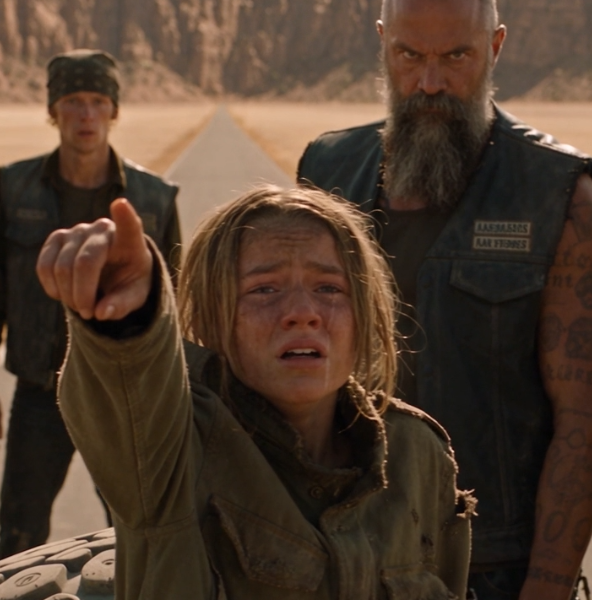
THE GIRL WHO STOOD IN THE ROAD
CHAPTER 2 — THE GIRL WHO HAD NO NAME
(~820 words)
Emily.
That was the only name she gave him, and even that felt like something she might lose if she said it too loudly.
She sat on the gravel shoulder, knees pulled tight to her chest, while Cole stood over her, watching, listening, his skepticism warring with something deeper — something that recognized the look of someone who had seen too much too young.
“I’ve been walking for three days,” she told him. The words came slowly, as if she hadn’t spoken to another soul in all that time. “Since… since they came. At night. Quiet. No lights. Just engines.”
“Who?” Cole asked again, softer this time.
She hugged her knees tighter. “We lived in a valley. Far back. My dad died last winter. After that… things changed. Men started coming. Asking questions. Checking papers. Saying the land wasn’t ours anymore.” She paused, swallowing hard. “Mom said we should leave. But we didn’t have anywhere to go. And then… the night before last… they came for us.”
Her voice broke. She pressed her forehead to her knees.
“Your family?” Cole prompted gently.
“Mom told me to run,” she whispered. “She pushed me out the back. Said to hide in the rocks. Said don’t come back no matter what I heard. I watched from up high. I saw them drag my brother. He’s only ten. He was screaming…” She stopped, breathing raggedly. “And then it went quiet. And I didn’t see any of them again.”
Cole felt a coldness settle in his chest that had nothing to do with the wind. He had seen cruelty before. He had caused some of it. But this — this small, fierce girl sitting in the dust, carrying the weight of her whole world on her shoulders — struck something deep and buried in him.
“And you stood in the road,” he said, “to stop me from going there.”
She lifted her head. Her eyes were red-rimmed, fierce.
“They took everyone who went past,” she said. “Three cars. Two trucks. None came out the other side. If you go… you’ll be next.”
Cole looked toward the curve in the road. Reason told him this was a child’s fear, magnified by grief and isolation. Reason told him to get back on his bike, ride past, and never think about this again. But reason also knew that people did not vanish from highways without a reason.
He looked back at her — barefoot, starving, shaking, alone.
“Get up,” he said.
Her eyes widened. “Why?”
“Because you’re not standing in the road alone,” he said. “And I’m not riding into something blind. We check it out. Together.”
She hesitated. “You believe me?”
Cole looked at the cliffs, then at her.
“I believe you’re terrified,” he said. “And I believe something made you that way. That’s enough for me.”
He extended a hand. She stared at it — large, calloused, scarred — then slowly placed hers inside. Her hand was so small it disappeared completely.
They rode together, slow and careful, the bike’s engine muted as they approached the curve. Emily sat behind him, arms wrapped tight around his waist, her grip desperate, as if she feared letting go would mean losing the only safety she had left. As they drew closer to the cliffs, the atmosphere shifted. The wind died. The heat grew heavier, thick and still. The road wound between towering rock faces that blocked out the sun, casting everything in a premature twilight.
Cole killed the engine a quarter-mile out, coasting silently until he found a sheltered spot among boulders. He helped Emily off, then crouched low, scanning the terrain ahead with eyes accustomed to reading ground and shadow. There was a clearing beyond the curve — a wide, flat basin ringed by cliffs. And in the center of it… vehicles. Dark. Unmarked. At least six of them.
“That’s where they take them,” she whispered. “I saw.”
He looked at her. “Did you see faces? Badges? Anything?”
She shook her head. “They wear masks sometimes. Or hats. They don’t speak much. They just… take.”
Cole studied the layout. The cars were arranged in a loose circle around a low, prefabricated building — metal siding, narrow windows, no sign. Several men stood outside. Even from this distance, their posture was unmistakable — watchful, armed, waiting.
“Checkpoint,” he said quietly. “Smugglers. Or worse. They’ve been diverting traffic, seizing people, hiding them away.” He glanced at her. “Your family…”
She nodded slowly. “They won’t let anyone go.”
Anger rose in him — hot and sharp, sharper than anything he had felt in years. These were innocent people. A mother. A boy. A girl who had been left to stand alone in the dust.
“Is there another way around?” he asked.
She thought hard. “Old tracks. Higher up. My dad used to take them when he herded sheep. They’re steep. Hard to see. But they come out above the building.”
“Show me.”









