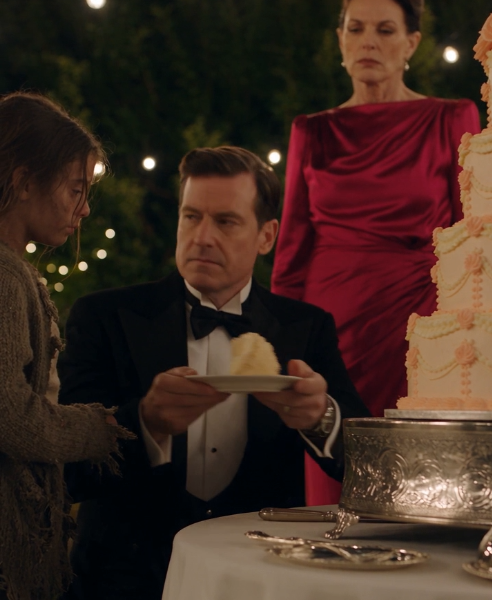
THE NOTE IN THE CAKE
The Woman Who Did Not Belong
Seven years earlier, Adrian Volkov was not yet the cold man of today. He was younger, less hardened, and — though he would never have admitted it to anyone — still believed in love.
He met Elena Ward on a late autumn day, in a small community library on the outskirts of Chicago. He had come to meet a witness — an old librarian holding information about a traitor within the family. But when he walked in, he did not find the witness. He found Elena.
She was standing on a step ladder, wearing an oversized grey sweater and faded jeans, her golden-brown hair in a ponytail. She was holding a book of poetry, so absorbed she had forgotten the world. She did not see him, did not know who he was, and when she stepped down the ladder she nearly fell — Adrian caught her.
She looked up at him and smiled. “Thank you. I get so caught up in stories I forget where my feet are.”
That was the first thing she ever said to him. And Adrian Volkov, the man the whole city feared, stood there and lost his footing.
Elena Ward was twenty-three, orphaned young, raised in foster care, just out of college with a teaching degree. She worked at the library to pay off student loans. She knew nothing of the criminal world, of power, of money. She lived in a tiny apartment, ate instant noodles three meals a day, and still smiled at everyone.
Adrian started coming to the library every day. Not to meet the witness — that man had been dealt with long ago — but to see her. He learned how to make ordinary conversation, not give orders. He learned how to listen. He learned how to laugh — truly laugh — when Elena told silly stories about the children at the library.
Three months later, he took her to dinner at a small restaurant he had rented out entirely so they would not be disturbed. Elena wore an old blue dress, and to Adrian she was more beautiful than any queen in the magazines. He told her: “Elena, I am not a good man. I do things good men do not do. But with you, I want to be better.”
Elena looked at him, her green eyes clear. “I don’t care who you are. I only care how you treat me.”
They loved each other in secret. Adrian never let Elena appear in public — not out of shame, but out of fear. Fear that his enemies would find her. Fear that his family — who wanted him to marry the daughter of a rival family to end a war — would never accept her. Fear that his own world would stain her innocence.
Vivienne Ashford appeared around that time. The Ashford and Volkov families had been negotiating peace, and the condition was a marriage between Adrian and Vivienne. Adrian had refused. He told his father: “I love someone else.” His father, still alive then, looked at him with cold eyes: “Love does not feed a family. Peace does. If you do not marry Vivienne, war will break out, and the girl you love will be the first to die.”
Adrian had gone silent. He knew his father was not threatening — it was the truth. But he could not give up Elena either. He continued seeing her in secret, promising her that one day he would find a way to make everything public.
Then one day, Elena told him, her voice trembling but happy: “Adrian… I’m pregnant.”
Adrian remembered that moment exactly. He was standing on the balcony of Elena’s apartment, looking out at the city at night. He turned, looked at her, and for the first time in his life, he cried. He held her, promised he would protect her and the baby, promised he would find a way out of everything.
But walls have ears. A maid in the Ashford household — Maeve Donnelly — had accidentally overheard one of Vivienne’s phone calls. Vivienne had discovered Elena’s existence. She had hired people to follow her, learned Elena was pregnant, and learned that Adrian planned to abandon everything and flee abroad with Elena and the baby.
Vivienne could not allow it. Not only was her pride insulted — but if Adrian ran off with Elena, the peace contract would collapse, the Ashford family would lose everything, and Vivienne herself would become a laughingstock of high society. She could not let that happen.
The accident happened on a rainy night, on Interstate 93. Elena was driving home from the grocery store. A black truck rammed the back of her car, sending it rolling multiple times, then it burst into flames. The police ruled it: the truck driver was drunk, dead at the scene. No other evidence.
Adrian got the news that night. He raced to the scene, stood in the rain, stared at the burning wreck. The body inside was charred beyond recognition. But there was Elena’s purse, her bracelet, the silver ring — or so he thought. He identified everything, and buried “Elena” in a Cambridge cemetery.
He never knew that at the scene, before the fire consumed everything, a woman had pulled Elena from the car. Maeve Donnelly. The Ashford maid, who had overheard Vivienne’s plan and had followed Elena’s car trying to stop it. She arrived too late to prevent the crash, but in time to pull Elena out.
Elena survived, but with severe burns and a head injury. She was comatose for three days. When she woke, she knew she was about to give birth. Maeve took her to a small cabin on the outskirts of town, where two weeks later Elena gave birth to a baby girl and named her Wren. And two days after that, Elena died of burn infection, in Maeve’s arms, with a final message: “Protect my daughter. Bring her to her father. But only when it’s safe.”
Maeve raised Wren for six and a half years, moving constantly, changing names, living in poverty but always keeping Wren safe. She kept the evidence: Adrian’s ring, the photograph, and a letter Elena had written to her daughter before she died. She waited for the right moment to reveal the truth.
But Vivienne Ashford never forgot. She always suspected the baby might have survived. She had searched for seven years. And two weeks ago, when Maeve finally left a trail, Vivienne gave the order. Another “car accident.” Maeve was dead. But before she died, she had sent Wren away — with a note, a ring, and an address: the Volkov estate, the night of the engagement gala, October fourteenth.
—