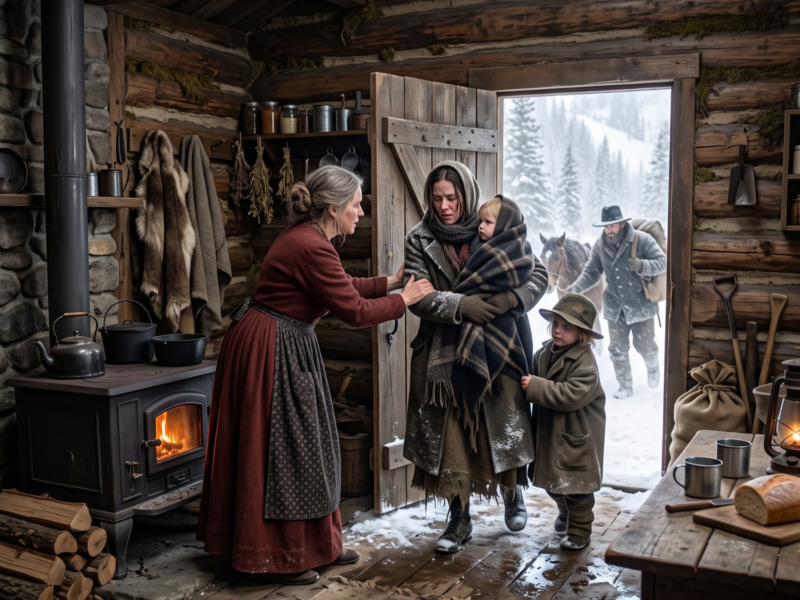
A 33 Year Old Woman Built a Quonset Hut From 40 Discarded Iron Sheets — Then Winter Proved Its Worth
A 33 Year Old Woman Built a Quonset Hut From 40 Di…
A 33 Year Old Woman Built a Quonset Hut From 40 Discarded Iron Sheets — Then Winter Proved Its Worth
The first sheet of corrugated iron very nearly killed Margaret Hail long before she had even decided where it would go.
It happened late on a Tuesday afternoon in September 1892. The Wyoming wind, notoriously fickle, dropped suddenly from the jagged western mountains entirely without warning. It did not build to a howl; it simply arrived as a concussive wall of moving air.
Margaret was standing beside her heavy freight wagon, sorting through the massive pile of discarded metal she had spent the week salvaging.
Suddenly, a loose sheet of heavy, rusted iron tore violently free from the top of the pile. It lifted straight up into the air above her head and hung there for a terrifying, impossible second, vibrating loudly like a massive, dark, mechanical wing.
Instinct, sharpened by grief and solitude, took over. Margaret threw her body violently backward, scrambling behind the heavy wooden wheel of the wagon.
The wind shifted. The heavy iron sheet twisted sideways in the air and slammed downward into the frozen, dead grass like a guillotine blade. Its jagged, rusted edge buried itself four inches deep into the soil—less than a yard from where her neck had been a second earlier.
For several agonizing seconds, Margaret stayed crouched behind the muddy wheel. Her heart hammered against her ribs like a trapped bird. She stared at the quivering metal embedded in the earth, listening while the wind screamed across the desolate valley, tearing at her clothes.
Slowly, carefully, she stood up. She brushed the dirt from her heavy wool skirt, walked over to the sheet, gripped it with both leather-gloved hands, and pulled it free from the ground with a grunt of exertion.
She turned it over and examined it critically.
One corner was heavily bent. An old, rusted nail hole near the center had widened into a jagged tear. The galvanized surface was heavily scratched and scarred by decades of industrial abuse. But the core of the iron was still solid. It was still strong. It would not yield.
She carried the heavy sheet back to the wagon bed, laid two massive river stones across it to hold it down, and methodically tightened every single hemp rope securing her load.
Margaret Hail was thirty-three years old. She was entirely alone on a remote homestead claim several miles from the nearest semblance of a settlement. She had exactly forty discarded, ugly iron sheets to her name, and one brutal, inescapable deadline pressing down on her shoulders.
Winter was coming.
It was not a threat; it was a geographical certainty. Ice had already begun to form in crystalline sheets along the edges of the creek at night. Pale, stubborn snow remained clinging to the higher mountain slopes even after three days of direct sunlight. Soon, the dirt prairie roads would become a slurry of freezing mud, and then they would become utterly impassable under feet of drifting snow.
Most sane settlers in her desperate position would have gone into debt to build with timber.
But Margaret had already learned, in the most agonizing way possible, exactly what expensive timber could not guarantee.
Three years earlier, she and her husband, Thomas Hail, had arrived in this valley full of optimism. They had built a handsome, traditional pine cabin. Their few neighbors had ridden over and admired its thick, straight walls, its expertly fitted dovetail corners, and its steeply pitched shake roof.
It looked safe. It looked permanent. It looked exactly like a proper frontier home was supposed to look in all the romantic illustrations back East.
Then, their second winter came, and outward appearance entirely stopped mattering.
The northern wall of Margaret and Thomas’s beautiful cabin took the absolute full, uninterrupted force of the prevailing winter wind. The thick clay chinking they had painstakingly packed between the massive pine logs dried out in the arid air, shrank, and cracked.
Fine, powdery snow began entering the cabin through microscopic gaps that were almost impossible to notice in the daylight.
Thomas spent long, freezing nights awake, desperately pressing fresh, freezing clay into those opening gaps while sub-zero air poured violently through the walls like water through a sieve. By the time the spring thaw finally arrived, the desperate work and the constant chill had taken their toll. Thomas’s mild winter cough had become deep, wet, and constant.
By early summer, the consumption had taken him completely.
Margaret was alone.
She buried him on the hill behind the drafty cabin. And as she stood over his grave, she did not angrily decide that wood was a useless material. She learned something much deeper, much more profoundly important about survival.
Material was only half of the problem.
A wall could be two feet thick and still leak lethal air at the joints. A roof could be massively heavy with timber and still completely fail when snow collected in the wrong geometric place. A beautiful building could contain a forest’s worth of expensive timber and still rapidly lose all its life-saving heat through invisible gaps, floor drafts, and poorly controlled interior moisture.
Several months later, after a particularly violent summer thunderstorm, Margaret had been riding back from town when she passed an abandoned, decrepit railroad equipment shed near the old tracks.
Several nearby, traditionally built wooden structures had suffered broken, caved-in roofs and collapsed wall sections from the sheer force of the microburst wind.
The railroad shed, however, was incredibly ugly. It was dented, heavily rusted, and completely unpainted. But its curved, semi-cylindrical iron shell was still standing perfectly intact.
Margaret stopped her wagon. She got down and studied the strange, aerodynamic shape for a very long time.
There was no broad, flat, vertical wall standing up to face and fight the wind. There was no sharp, pronounced roof ridge where heavy, wet snow could concentrate and break the rafters. The wind was forced to travel smoothly over the continuous curve, and the crushing weight of the snow was naturally spread along the entire arch of the shell, transferring the load directly into the ground.
That afternoon, staring at the rusted shed, Margaret permanently stopped asking what a “proper” frontier cabin should look like to impress her neighbors.
She started asking, with the cold, clinical desperation of a widow, what a winter shelter actually needed to do to keep a human being alive.
Related Articles

They Mocked the Widow’s Dirt Cellar—Then the Freeze Left Every Cabin Cold but Hers Warm
They Mocked the Widow’s Dirt Cellar—Then the Freeze Left Every Cabin Cold but Hers Warm…

A Homeless Veteran and His German Shepherd Inherited a Ridge No One Wanted — 35 Feet In, They Found
Chapter 1 / 7 A Homeless Veteran and His German Shepherd Inherit… A Homeless Veteran…

Neighbors Laughed When He Built A Cabin Inside An Old Barn—Until It Kept His Home 35 Degrees Warmer
Chapter 1 / 8 Neighbors Laughed When He Built A Cabin Inside An… Neighbors Laughed…

His Sod House Had No Woodpile in January – Until the Trains Stopped and the Town Came Begging
Chapter 1 / 10 His Sod House Had No Woodpile in January – Until t……

She Built Her Cabin Over the Woodshed and Never Burned Wet Wood Again
Chapter 1 / 8 She Built Her Cabin Over the Woodshed and Never Bu… She…

The Duke Abandoned Her on Their Wedding Day—Years Later, He Discovered What He Had Lost
Chapter 1 / 7 The Duke Abandoned Her on Their Wedding Day—Years… The Duke Abandoned…

He Wedged a Tiny A Frame Into a Crevice Before Winter and His Family Slept at 75°F While Town Hit
Chapter 1 / 7 He Wedged a Tiny A Frame Into a Crevice Before Win……

He Was Too Old to Ride—So He Bought the Ruined Ranch and Found the Room Behind the Fireplac
Chapter 1 / 5 He Was Too Old to Ride—So He Bought the Ruined Ran……

Settlers Laughed at His Underground Heat Recovery Duct — Until It Kept His Cabin 71°F Warmer
Chapter 1 / 9 Settlers Laughed at His Underground Heat Recovery… Settlers Laughed at His…

A Navy SEAL Built a Home Inside a Mountain—Then His Dog Warned Him Before the Storm
Chapter 1 / 5 A Navy SEAL Built a Home Inside a Mountain—Then Hi… A…