A 33 Year Old Woman Built a Quonset Hut From 40 Discarded Iron Sheets — Then Winter Proved Its Worth
The Ark of Iron
By deep January, the relentless, brutal winter had violently exposed every single structural weakness across the entire settlement of Pine Hollow.
Massive snowdrifts completely buried the tall property fences, turning the landscape into a featureless white ocean. Horses stood miserably in the fields with their heads lowered entirely against the howling wind, their coats matted with ice.
Human families made repeated, exhausting, terrifying trips to their rapidly shrinking wood piles in the dark. They realized with sinking horror that the roaring fires that had seemed so wonderfully adequate and comforting in mild November were absolutely no longer enough to push back the encroaching, lethal cold of January.
Inside her shell, Margaret kept measuring. Outside temperature. Inside temperature. Fuel weight used. Wind direction. Condition of the bolted seams.
Her experimental shelter developed unexpected problems, too. The physics of the building were constantly shifting.
During a rare, bright sunny day following a deep freeze, meltwater suddenly entered the cabin through a lower floor seam. The intense sunlight had rapidly warmed the dark outer iron on the south side, melting the snowpack touching it, but the ground below was still frozen solid, leaving the water nowhere to drain but inside.
Margaret didn’t panic. She methodically traced the exact path of the water. She went outside and significantly extended the depth and angle of the drainage trench away from the foundation. She reinforced the interior seam with waterproof pitch, and added another angled strip of flashing metal completely beneath it to deflect future flow.
The next storm brought a massive freeze-thaw cycle, but the interior floor stayed perfectly, completely dry. She logged the success in her book.
Then, in mid-February, the absolute worst storm of the season arrived with apocalyptic fury.
The snow began falling heavily and silently through the gray afternoon. By nightfall, a hurricane-force wind was driving the loose, dry snow completely sideways across the settlement. Visibility vanished entirely across the open ground; you could not see your own hand stretched out in front of your face.
Margaret secured everything she possibly could outside, tied down the wagon, and retreated to the safety of the iron shelter. She locked the heavy door. She fed the small stove a modest ration of oak, checked the internal roof supports, and sat back. She listened to the deafening roar of the wind, and watched through the small window as the snow gathered briefly on the roof, and then inevitably, safely slid down the rounded, aerodynamic shell to the ground.
Across the wider settlement, disaster struck.
Traditional, flat-pitched roofs began to groan and sag dangerously under the immense, accumulated weight of the wet snow. Snow jammed so high and hard against flat, vertical doors that families had to physically chop their way out with axes just to fetch wood.
Families who were rapidly running out of fuel, struggling desperately to keep their drafty cabins above freezing, began abandoning their homes and gathering together in the most secure buildings they could find, pooling their firewood and body heat to survive.
Sometime long after midnight, sitting by her stove, Margaret heard a dull, rhythmic thumping sound outside her door. It wasn’t the wind.
Then, she heard a muffled, desperate human voice screaming over the gale.
People were coming through the storm.
Margaret threw the bolt and hauled the heavy door open.
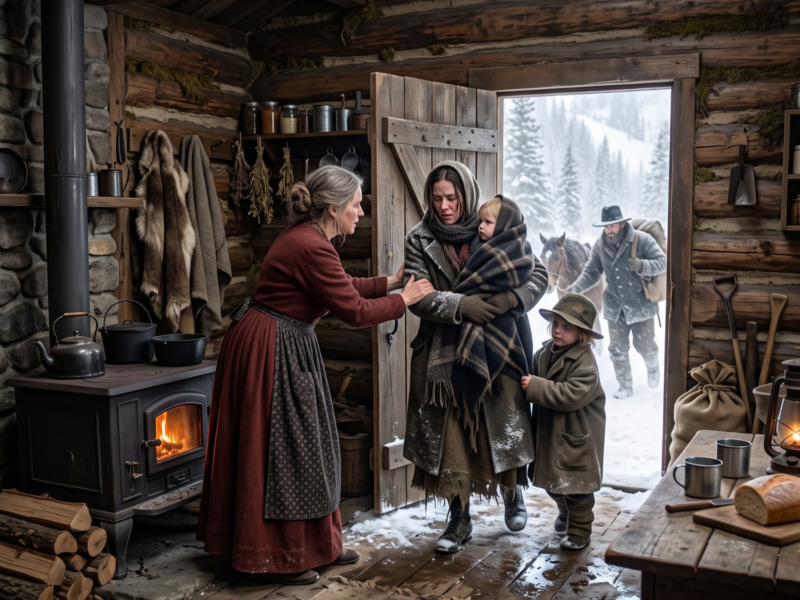
A group of her neighbors stood shivering in the blinding whiteout. They arrived completely wrapped in ice-caked coats and blankets, carrying crying children and whatever small, vital belongings they had managed to frantically grab before fleeing their freezing homes. Henry Dalton was among them, carrying his youngest daughter.
Margaret opened the shelter wide and pulled them inside.
More people followed Henry’s tracks an hour later. And then more.
The bizarre, ugly, iron building that had once been loudly mocked by the entire town for looking too strange, too industrial, and too small… suddenly had a profound, life-saving purpose that absolutely nobody needed explained to them.
Margaret moved with calm, authoritative efficiency. She quickly reorganized the interior layout so that the influx of freezing people could physically fit without blocking the vital airflow paths around the heating stove. The small room became incredibly crowded.
Wet, snowy clothing steamed heavily as it hung near the radiating heat of the stove. The adults stood pressed tightly close to the warm inner walls, while the shivering children were given the warmest, safest spaces directly near the center of the room.
Eventually, there were vastly more people packed inside the iron shell than the building had ever, theoretically been designed to hold comfortably.
Margaret fed the stove incredibly carefully. She knew she could absolutely not afford to burn through her meticulously measured wood supply too quickly, just in case this massive storm lasted into another full day and night. She kept the damper low, relying on the immense body heat of the crowd and the sealed insulation to do the heavy lifting.
The air inside the sealed shelter quickly became heavy, humid, and smelled strongly of wet wool and unwashed bodies. The crowded space became physically uncomfortable and claustrophobic.
But the lethal, freezing cold remained firmly trapped outside.
And through the longest, darkest, most terrifying hours of that howling night, the ugly, curved iron shelter held them all safe.









