A 33 Year Old Woman Built a Quonset Hut From 40 Discarded Iron Sheets — Then Winter Proved Its Worth
The Hearing and the Proof
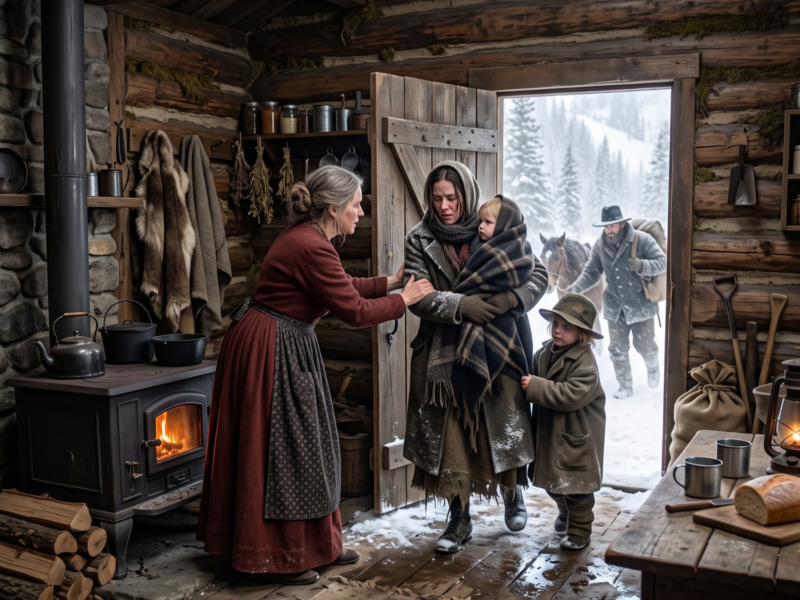
At first light on the third day, the wind finally broke, and the survivors stepped outside.
The settlement of Pine Hollow looked almost entirely unrecognizable. The massive blizzard had buried the tall wooden fences, completely covered the smaller storage sheds, and formed incredibly deep, impassable ridges of packed snow entirely around the square cabins.
One large, traditional cabin roof had partially collapsed under the immense weight of a snow drift, crushing the kitchen below. Another prominent, two-story building in town had lost a massive part of its outer wooden siding to the sheer, tearing force of the wind. A vital food storage building was damaged so badly that several exhausted men had to spend the entire morning desperately digging a tunnel just to reach its doorway.
Margaret’s iron shelter, however, stood completely intact beneath the snow.
The aerodynamic roof had held perfectly, shedding the crushing load. The reinforced walls remained secure and plumb. The physical damage to the structure was entirely limited to several small, superficial areas of torn canvas near the vent, which could be easily and cheaply repaired once the weather improved.
The storm fundamentally and permanently changed how the people of the valley looked at the curved building.
Though, human nature being what it is, not absolutely everyone changed their stubborn opinion immediately. Some of Silas Crowe’s cronies in town still loudly dismissed it as mere “survival luck,” claiming the wind had simply hit other houses harder.
Margaret did not argue with them in the mercantile. She knew that one single, difficult night of survival could easily be explained away by arrogant men. But an entire, documented winter of success would be vastly harder to dismiss in a court of law.
So, she returned to the quiet discipline of her notebook.
The next several freezing weeks provided all the hard, empirical evidence she needed to build her case.
Temperatures repeatedly fell dangerously low, low enough to brutally force several prominent families to burn completely through their expensive winter wood supplies, leaving them begging for coal.
Margaret’s meticulously recorded fuel consumption, however, remained unusually, consistently low. Her shelter never became luxuriously, comfortably warm by modern, Eastern standards—it hovered around 50 degrees—but it stayed warm enough to safely work, sleep deeply, cook meals, and physically recover without constantly, exhaustingly fighting the bitter cold.
The sawdust insulation drastically reduced the heat loss. The curved iron roof effortlessly resisted the snow accumulation. The compact, efficient interior reduced the sheer volume of air the small stove had to heat.
Even Silas Crowe’s lucrative timber business suffered immensely as the winter tightened its icy grip. The heavily drifted roads became completely impossible to travel for his heavy wagons. His lucrative timber deliveries to the railroad were indefinitely delayed. The desperate local demand for firewood skyrocketed, but he couldn’t physically move the product from his yard to the farms.
Margaret took absolutely no joy or pleasure in his financial difficulties. She understood far too well, from the death of her husband, exactly what the cold could do to anyone who underestimated it.
As January finally passed into February, the looming legal homestead challenge returned to the absolute center of her attention.
Now, Margaret had vastly more than just a theoretical explanation for her strange house. She had hard data. She possessed months of precise temperature records, exact fuel weight measurements, daily structural observations, logs of continuous occupation, notes on preventative repairs, and undeniable witness evidence that the building had successfully, warmly sheltered not only her, but a dozen other freezing people during the absolute worst storm of the decade.
The brutal season had stress-tested the house under extreme, lethal conditions that absolutely no lawyer’s theoretical argument could ever reproduce in a warm courtroom.
Soon, Margaret would pack her bag and carry that heavy notebook of evidence into the federal land hearing in Cheyenne.
At the formal hearing, Silas Crowe’s expensive lawyers gave grand, sweeping, emotional speeches about “civilized standards,” “property values,” and the “dignity of the American frontier.”
Margaret brought no grand speech. She simply brought her records.
The core legal challenge questioned whether her curved, scavenged iron shelter actually qualified as a “permanent, habitable residence” under the strict Homestead Act. The government officials wanted undeniable evidence that she genuinely, permanently occupied the land and maintained a functioning home, rather than just using the property temporarily as a squatter’s camp.
Margaret’s leather-bound notebook answered those bureaucratic questions in devastatingly precise dates, temperatures, fuel weights, repair logs, and environmental observations.
It mathematically proved continuous, daily occupation. It proved the existence of a functioning heating stove, layered insulation, secure stored supplies, and daily, rigorous maintenance through the absolute worst of the winter. It irrefutably showed that the structure remained safely usable and warm during plunging temperatures that caused serious, life-threatening trouble and structural failure in the conventional timber homes elsewhere in the county.
And, most damningly to Silas’s case, it included signed affidavits from Henry Dalton and the other neighbors, proving that the “equipment shed” had served as a vital, life-saving community shelter during the worst blizzard of the season.
The federal officials examined the meticulous records and listened to the overwhelming evidence.
Margaret was honest. She did not arrogant claim that the experimental building had never once failed. Her own detailed notes showed the early, terrifying water leak on the eastern floor, and the frantic repairs that immediately followed. The logs showed the damaged exterior seams, and the iron reinforcement she had bolted on. They showed a shelter that was constantly, intelligently adjusted and improved as the severe weather exposed its hidden weaknesses.
To the judges, that honest admission did not make it less of a home. If anything, it definitively proved that the place was being actively lived in, fiercely defended, and rigorously maintained by a true homesteader.
The final, deciding legal question was straightforward: Did a permanent, legal frontier home have to aesthetically resemble every single conventional, wooden cabin built around it?
Margaret Hail had secure shelter. She had reliable heat. She had deep insulation. She had proven protection from heavy snow and hurricane-force wind. And she had continuous, documented occupation.
The fact that her impenetrable walls were brilliantly built from discarded, rusted railroad iron, rather than newly cut, expensive pine timber bought from Silas Crowe, did absolutely not erase those fundamental facts of survival.
Her homestead claim was officially, permanently approved, and the deed was stamped in her name.
She still had next year’s firewood to collect, rusted metal to inspect, and another, inevitably brutal winter that would eventually come for her. The work of the frontier never truly ended.
But the way the people of the valley looked at the ugly, curved shelter had permanently changed.
The same rugged neighbors who had once openly mocked the rusted, curved roof in September started riding out to her claim in April, asking polite questions about how the iron had been shaped. They genuinely wanted to know exactly how she had packed the sawdust insulation so tightly without it settling, how she had sealed the overlapping seams with pine tar, how she engineered the drainage trenches to divert the meltwater, and mostly, how she had kept her winter fuel use so incredibly, enviably low.
Margaret patiently answered all their questions, showing them her handiwork.
She had never needed everyone in town to admire the aesthetic beauty of the house. She only desperately needed it to work. And after surviving an entire, brutal Wyoming winter that had broken stronger men and richer houses, that was the one, undeniable thing absolutely nobody could honestly ignore.
By late spring, the deep snow finally retreated from the open ground, and Margaret’s iron shell emerged completely into the warm sunlight once again.
It was still heavily scratched, deeply dented, visibly patched, and aesthetically mismatched. It was not beautiful.
She spent the spring repairing the minor damaged sections, carefully inspecting every single bolted joint for rust, and began happily planting young, fragile fruit trees in the thawed earth around the property.
The forty discarded sheets of railroad iron had never become valuable simply because iron was inherently a superior building material to wood. What truly mattered was the specific, engineered way the materials were used.
The aerodynamic, curved shell drastically reduced the broad, flat surfaces exposed to the violent wind, and fundamentally changed the way crushing snow loaded the roof. The packed sawdust insulation aggressively slowed the lethal heat loss. The deep drainage trenches kept the freezing melting snow safely away from the vulnerable foundation. A compact, intelligently designed interior drastically reduced the wasted volume of empty air the small stove had to heat. And her careful, constant, daily repairs stopped tiny, insignificant failures from ever becoming dangerous, catastrophic ones.
None of those brilliant survival ideas had arrived complete in a sudden flash of genius.
Thomas’s beautiful, traditional log cabin had tragically shown Margaret exactly what freezing drafts and uncontrolled moisture could do to a human lung. The ugly, abandoned railroad shed had simply given her a physical shape worth studying.
When fourteen vital sheets of iron had vanished in the night, sheer, terrifying scarcity had forced her to ingeniously adapt, using eleven damaged replacements and rusted iron bands salvaged from a water tank to reinforce the ribs. When freezing water entered along the eastern floor during a thaw, she didn’t panic; she changed the external drainage and added an inner wooden lining. When the exterior seams were maliciously disturbed by a rival, she structurally reinforced them with bolts, and recorded what she could mathematically prove, instead of uselessly accusing a powerful man based on mere suspicion.
And through absolutely all of it, every single day, she measured.
The old, brass wheel gauge resting beside her bed had once served merely to remind her of Thomas, and the life they had planned.
Over time, and through the crucible of the winter, it had come to represent something vastly larger to her. It represented the absolute, uncompromising discipline of checking physical reality against the numbers, before blindly trusting outward appearance.
Months earlier, that very first sheet of loose iron had nearly cut Margaret down in the grass before she even knew where to place it.
Now, those exact same battered, rusted pieces of scrap metal formed the impenetrable walls around desperate people who had crossed a blinding, lethal storm in the dead of night, simply because her strange, ugly shelter was the absolute only place in the valley they believed might keep them alive.
That was the definitive answer Winter had finally given to the valley.
It was not that modern iron was inherently better than traditional wood. It was not that Margaret Hail had miraculously invented a flawless, perfect house.
It was the profound lesson that discarded material, careful, deliberate design, deep insulation, relentless measurement, and constant, humble adaptation could solve a deadly problem that blind, arrogant tradition had entirely failed to solve.
The people of the town had spent the autumn asking whether the structure looked proper, and whether it fit the aesthetic standards of a civilized frontier.
Winter had arrived, and asked vastly harder, more important questions:
Could it resist the wind? Could it shed the snow? Could it conserve the fuel? Could it stay dry? Could human beings actually survive inside it when the world outside became instantly, relentlessly deadly?
Margaret’s answer to those questions was not a grand speech in a courtroom. It was simply the fact that she was standing in the spring sunshine, planting trees.









