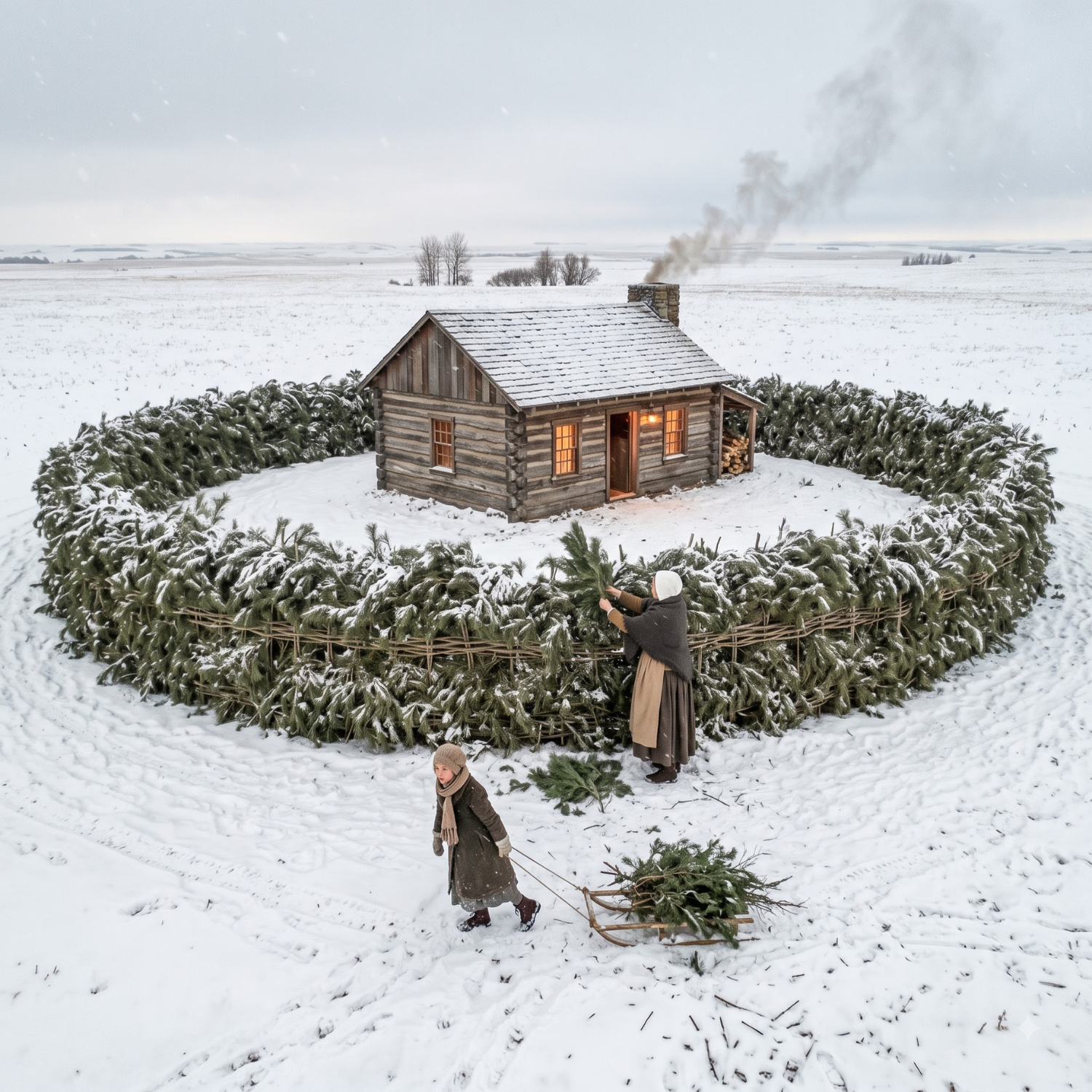
Abandoned Before Winter, She Covered Her Shack in Pine Boughs—Then the Snow Came
THE ARITHMETIC OF MEN
The lawyer slid the deed across the polished mahogany desk with the tips of two fingers, the way a man handles something he suspects might stain him.
In that single, small motion, Marin Ashby understood everything the town of Dunore had already decided about her. She had lost her marriage, her social standing, and the last shred of patience from a settlement that measured a woman entirely by whose name she carried. Now, on a raw October morning in the Montana Territory in the year 1884, she sat in a paneled office while a man in a clean celluloid collar handed her the single thing her dead uncle had chosen to leave her.
Seventeen acres of bare granite cliff and one cave at the base of it. A property the valley had laughed about for a generation. They called it Calder’s Folly.
“Mrs. Ashby,” Edmund Graves cleared his throat as though the sound might reorder the room to his liking. “The remainder of your uncle’s estate is itemized on the document before you. You may review it at your leisure.”
“Miss,” the correction left her lips without heat. She had stopped supplying warmth to men who had none to return.
Graves absorbed the word with a slow blink. “Miss Ashby, then. As you prefer.”
Beside her, on a chair too tall for him, her six-year-old son, Emmett, sat stone still. His boots did not quite reach the floor. His fingers were laced together in the exact posture she had taught him. Emmett had a slight fever. He had not spoken since they entered, had not fidgeted, not once. That stillness in a small boy was its own kind of testimony, though only a mother would know how to read it.
“The cave,” Marin said, because she wanted the details spoken aloud in the daylight where they could not hide. “Is described how, precisely?”
Graves’s pen tapped the paper twice, a soft percussion that carried more contempt than any sentence he might have composed. “A cavity at the base of the north escarpment. Your uncle was quite insistent it be listed by name in the final clause. A unique geological feature, one might say.”
She had learned that word in the mouths of men like this. Unique was what they said when they meant worthless, and wished to sound generous about it.
From the corner of the office came a sound through the nose—a laugh pressed flat before it could fully form. She did not turn her head. She knew the shape of it.
Cornelius Vane sat with his arms crossed and his inheritance already surveyed behind his eyes. Cornelius was her stepfather. He was a man who measured every loaf that came from the oven, every bucket of grain, every wool blanket, and every mouth that opened at his table. He weighed them all against one another in a ledger, and he did his arithmetic aloud.
When Marin’s marriage had dissolved, she had sought refuge under his roof. Last week, Cornelius had spread his ledger open across the kitchen table. “We’ve provisions enough to carry four through to spring,” he had addressed the room. “There are five of us.” He had looked directly at Marin. He had done the math, and he had crossed off the one figure he told himself he could spare.
Marin picked up the deed with both hands. Her grandmother had taught her to receive things that way, even things that seemed to hold no value. “Especially those,” the old woman used to say. “Because you never yet know what a thing will become.”
“Thank you, Mr. Graves,” she said.
“You’ll want a man to look the survey over. Property law, boundary lines… complicated matters for a woman managing alone.”
She rose. She turned toward him with a slowness that made him sit back in his chair.
“I am not managing alone. My son is here. He stands a full head shorter than this desk, and he already has more sense than the men who drafted these clauses. So no, Mr. Graves, I am not alone, and I will not be told that I am.”
Emmett slipped off his chair without being asked, his small boots meeting the floorboards with quiet certainty. He fell into step beside her.
She walked out into the flat gray morning. Dunore received her the way small towns always receive the newly humiliated: with a silence louder than any shout. Eyes found her, and then found somewhere else to be. From the porch of the mercantile, a woman began a sentence of gossip, then choked it off because Marin had turned her head a quarter of an inch—just enough to let the woman know she had been seen.
That was the whole of Marin’s defense. She had no wealth, no husband, no one to stand between her and the town’s icy judgment. She had only the refusal to flinch.
The walk to the rented house ran nine blocks. She counted them. The habit had been stitched into her by her grandmother, Sing Calder. “Count something, child,” Sing had said. “The mind wants work. Give it work, and it will stop devouring you.”
When she reached the house, her stepfather’s edict stood final. She packed her canvas roll: a hatchet, a whetstone, a small cast-iron pot, her few clothes. Emmett packed his own small bundle—seven smooth creek stones, a scrap of birch bark, and a wooden horse.
She went to the one door in Dunore she still felt entitled to knock upon. Tobias Ren farmed wheat four blocks east. He was a widower who had carried firewood to her porch the season her divorce was finalized, asking for nothing in return.
“I need a favor, Tobias,” she said when he opened the door. “A handcart. Two days. I’ll bring it back.”
Tobias looked at her, his face working through the argument without voicing a word of it. The disbelief, the protest, the slow recognition that she was not asking his permission.
“It’ll be on your path by dusk,” Tobias said. “And I’ll put a sack of flour on it. Don’t fight me on the flour.”
“I won’t.”
They left the next morning. Marin leaned into the handle of the two-wheeled cart, the wood biting into her palms. Inside rode everything she owned in the world: twenty pounds of seed potatoes, the iron pot, wool blankets, the hatchet, the flour, and a cracked leather notebook wrapped in oilcloth.
Emmett walked beside her. He did not complain. He had learned somewhere in the hard months behind them that asking a thing to be easier than it was only wasted the breath you needed for the doing.
The road out of the valley climbed, rougher than she had let herself remember. By late afternoon, her palms had blistered against the wood. The blisters tore, and she wrapped strips of cloth around them and took up the handle again. Emmett found the flat places where he could push from behind, his whole weight thrown into the work.
They reached the base of the escarpment in the early afternoon of the second day.
The granite rose sheer above them, higher than her memory had allowed, wide as a cathedral wall. The wind came down off the height, struck the rock face, and broke into strange, curling currents. The cave mouth sat low in the stone, no more than four feet at the opening, widening into shadow as it went back.
Marin stood at the threshold a long moment. It did not welcome her. It did not love her. The granite held no opinion about a divorced woman with a small son and twenty days before winter. And that was precisely the gift of it. It had never once cared what Dunore whispered on its porches.
She lit her small lantern, bent her head beneath the low lip of stone, and stepped inside.