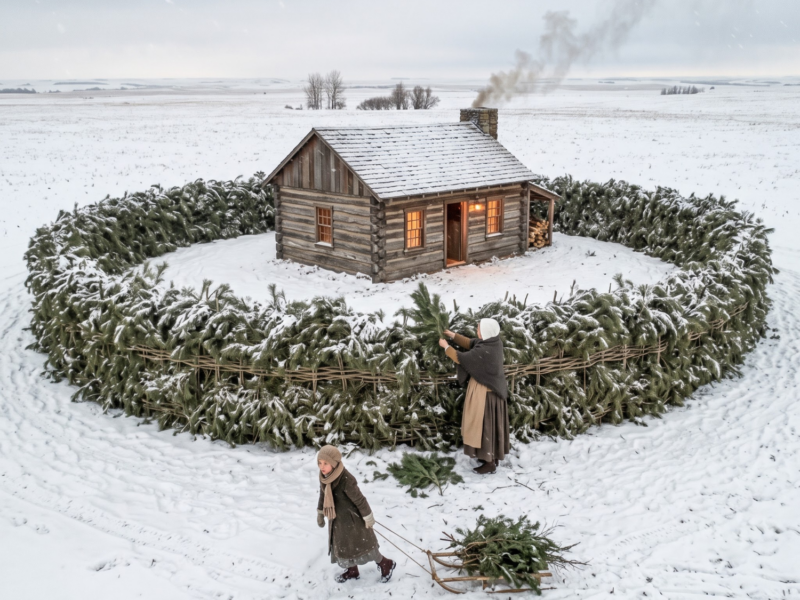
Abandoned Before Winter, She Covered Her Shack in Pine Boughs—Then the Snow Came
THE WALL OF GREEN
Moving their life into the inner hearth took three days. The ambient heat meant they would not freeze, but they still needed a defense against the paralyzing blizzards that would bury the outer entrance.
Marin began constructing a wind-break outside the cave mouth, following a sketch in Sing’s notebook. It was not a wooden wall. Wood was scarce, and thin boards bled heat.
She built a bow-wall.
She drove aspen stakes into the freezing ground in a wide arc around the entrance. Then, she began cutting evergreen boughs—thousands of them—from the dense timber belt a half-mile away. She wove the green boughs horizontally between the stakes, needle ends facing outward.
It was brutal, repetitive labor. Two hundred boughs a day. The sap stained her hands black.
The strategy was simple arithmetic: When snow does not move, it stops being wind. When it stops being wind, it becomes insulation. The woven evergreen needles would catch the blowing snow, holding it tight, transforming the wall into a solid, impenetrable windbreak of ice and timber.
One afternoon, as the sky began to take on the flat, metallic sheen of impending winter, a rider appeared on the trail.
It was Silas Drum. He was a surveyor, a man past middle age with a broad face and eyes that measured the world in practical values. He was working for the township, paid to assess the “abandoned” claims on Ironback Mountain.
He stopped his horse and looked at the half-finished wall of green branches.
“You are trying to tie a wall,” Silas called out, his voice dry. “That is brush. You cannot wrap a cave in Christmas decorations and call it insulation.”
Marin didn’t stop weaving. She took a green willow switch, warmed it between her bleeding hands to make it flexible, and locked a bough into place. “Then winter will have to come close enough to prove it.”
Silas dismounted. He walked over, examining the tension of the willow bindings. He did not mock her further. He possessed the intelligence of a man who recognized when he was looking at something he didn’t fully understand.
“I’ve been surveying this ridge,” Silas said. “There’s a seam of lignite coal running north of this creek. It’s worth a lot of money to the railroads. The men down in Dunore—Cornelius Vane and the land registrar—they know about it. That’s why they wanted you off this claim before winter.”
Marin stopped. She looked at him. “Why are you telling me this?”
“Because,” Silas said, adjusting his hat, “I am a surveyor who wants a percentage of that coal extraction if it ever happens. And I would rather negotiate a contract with a woman who builds walls with her bare hands than with a cabal of thieves in a courthouse.”
He reached into his coat and produced a folded paper. It was a contract. Access rights to the coal seam in exchange for his legal attestation as a licensed surveyor that she had fulfilled the Homestead Act’s residency and improvement requirements.
“If your claim holds in the spring,” Silas said. “We both win. If you freeze to death, it’s void.”
Marin took the paper. “I’ll need to survive six months to file.”
“I can wait six months,” Silas said. He mounted his horse. “Double your wood. That sky isn’t making idle threats.”
He rode away. Marin had just made her first alliance.









