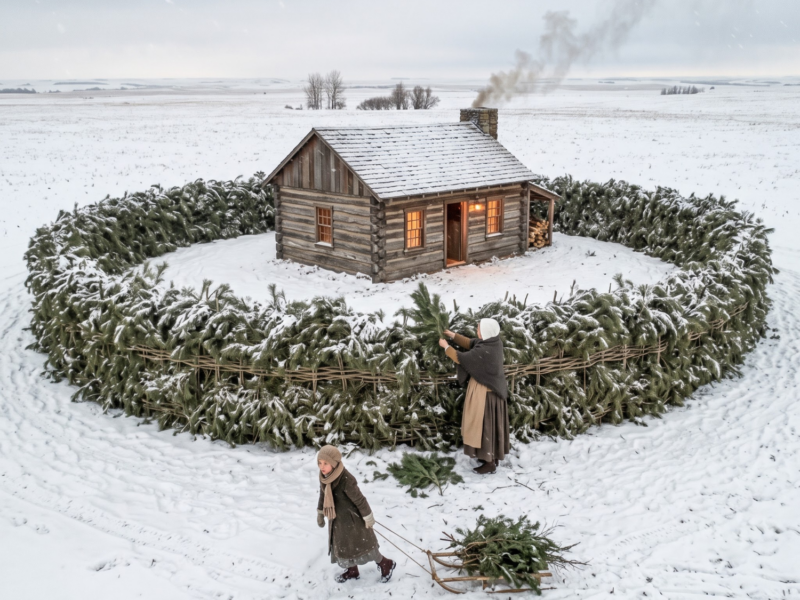
Abandoned Before Winter, She Covered Her Shack in Pine Boughs—Then the Snow Came
THE ENGINEER'S HEARTH
The floor came first, because everything else would fail without it. Marin read Sing’s leather notebook by the low glow of a small fire.
Lay the flat stones flat side up. Pack wet clay into every seam. Let it dry a full day before you trust your weight to it, or it will heave and crack the first hard freeze.
She carried the words into the daylight and began to gather stones from the creek bank. She hauled them up the slope until her arms shook. Emmett worked beside her. When she knelt to fit the broad slabs into the packed dirt, he knelt across from her and pressed the clay into the gaps with his small fingers.
By the fourth day, a functioning stone floor sealed them from the damp earth.
Then came the door. She had never built a door in her life. She found dead cottonwood along the creek. She read the notebook again: Scribe the frame to the rock. Do not fight the cave. The cave is older than your tools and it will win.
She shaped the wood with her hatchet. It stood crooked twice before it stood true. On the fifth morning, she emptied the flour sack Tobias had given her to measure out the day’s bread. Buried at the bottom, beneath the white powder, she found three heavy iron hinges, a hand-forged latch, and a turned wooden handle, wrapped in burlap.
She sat down on her new stone floor with the cold iron in her lap and wept. A man who had carried firewood to her porch three winters gone had slipped the makings of a real door into her supplies, knowing she would be too far up the mountain to refuse his charity when she found it. She hung the door before the light failed.
But the cave held a deeper secret.
On the eighth day, Marin was clearing debris near the rear of the cavern, pulling away loose rocks to expand their sleeping area. Behind a crumbling pile of shale, she noticed the draft. It wasn’t the freezing bite of the outside wind. It was a steady, upward pull of neutral air.
She cleared the shale away, her hands bleeding.
It revealed a false wall. Not a natural cave-in, but stones dry-stacked with deliberate, interlocking precision.
She dismantled it piece by piece, following a logic that felt increasingly engineered rather than accidental. When the last stone was removed, an opening four feet wide emerged. She held her lantern up and stepped through.
The chamber beyond was massive. Thirty feet across, the ceiling vaulting fifteen feet high. And running east to west across the center of the floor was a deep geological fissure. From it rose a steady column of air that was visibly, gloriously warmer than the surrounding atmosphere.
It was a geothermal vent.
She walked the perimeter of the hidden chamber. Along the north wall, heavy shelves were built from rough-milled lumber, anchored to the rock with iron brackets. On those shelves sat tinned goods in neat rows. Flour in canvas bags coated in beeswax. Salt pork in glazed crocks sealed with paraffin. Lamp oil in tins.
And on a small wooden table, a second notebook, bound in black leather.
Marin opened it. It was the handwriting of her great-grandfather, August Holt. The man who had supposedly died a crazed, penniless prospector.
He had not been looking for silver. He had been a self-taught engineer who understood the tectonic thermal channels beneath the Rockies. He had found this vent, enlarged the cavern, provisioned it, and built a subterranean refuge that maintained a temperature of sixty-eight degrees in the dead of January. He had built it, sealed it, and died of lung disease in Denver before he could return to it.
He had left it for his heirs. For her.
Marin sat on the floor of the geothermal hearth. The warmth seeped into her aching bones. The mountain had not been her adversary. It had been this, all along. She was not hiding in a hole; she had inherited a fortress.









