Betrayed by Their Own Sons — Two Widows Fled Into a Cave. 50 Feet In, They Found Her Secret
THE CROSSROADS AND THE CONVERGENCE
The two women’s paths crossed at a crossroads trading post three days later—the kind of place where anyone traveling with no clear destination eventually stopped because everyone traveling with no clear destination ends up needing supplies they hadn’t planned for.
Margaret was tying down a loose strap on her wagon when she heard a voice she had not heard in forty years say her name like a question that already knew its answer.
“Margaret Oliver? Is that you? Well, you look like you’ve had the same kind of week I have.”
They had been girls together once, in a town neither of them lived near anymore, before marriage and distance and other people’s lives had quietly filed the friendship away as something from before. Now they stood in a trading post yard with two wagons, two dogs circling each other cautiously before deciding within minutes that they were now traveling together, and two women who had each spent three weeks being told in different words by different families that they could no longer be trusted to manage what they had spent a lifetime building.
“We always said we’d end up on a porch together someday,” Margaret said, her lips twitching with the ghost of a smile. “Didn’t picture it starting like this.”
“Didn’t picture it happening at all,” Maryanne said.
Neither of them had anywhere in particular to go. For the first time in either of their lives, that felt less like a loss and more like the first honest freedom either had been handed in years.
They traveled together for four days, following old logging roads west into a country neither of them knew—because it was the only country their families hadn’t already staked a claim to an opinion about.
Then the storm caught them on the fifth day, the way storms in that country always seem to strike: completely without the courtesy of warning. One moment the sky was merely gray and heavy, the kind of gray that promised nothing more than a cold afternoon. The next, the wind had turned, and the first flakes came sideways instead of down, driven so hard they stung like gravel against exposed skin.
The wind flattened the pines sideways, bending trunks that looked like they’d stood through worse and would stand through this too—though Margaret found herself less certain of that with every gust. The temperature dropped fast enough that both women could feel it happening in real time, could feel their own breath start freezing on the wool wrapped across their mouths.
Maryanne’s mule stumbled twice on ice hidden beneath fresh snow. The second time, it went down hard enough that Maryanne was out of the wagon seat and at its head before she’d even decided to move, murmuring low and steady the way Frank used to, her hands finding the bridle by memory more than sight.
“Easy, easy now. Nobody’s in a hurry that badly.”
The mule found its feet again, but slower this time, favoring one leg just slightly—just enough that both women understood without saying it that the animal wouldn’t manage many more miles like this. Margaret’s own team fared little better, her horses’ heads hung low against the wind, ears pinned flat, walking now more from habit than will.
Both dogs pressed close against the women’s legs at every stop, refusing to range ahead the way dogs usually did. Scout, in particular, kept circling back toward Maryanne’s skirts, nosing at her hand with an insistence that had nothing playful left in it. Milo, Margaret’s old shepherd, stayed nearer the tree line, ears up, watching something neither woman could see yet through the whiteout.
Visibility had dropped to a few wagon lengths in every direction. Margaret called out to Maryanne, and even that close, the wind tore half the words away before they landed.
“We’re losing the road!”
“There isn’t a road to lose anymore!” Maryanne called back. “There’s just snow now, all the way down!”
Neither woman said what they were both thinking: that a storm like this in country this unfamiliar, with animals already faltering, was exactly the kind of afternoon that made the newspapers back home, usually as a small notice near the back page—the kind families read over breakfast and shook their heads at before moving on to something less unpleasant.
“We can’t keep moving in this!” Margaret shouted.
“We can’t stop either!” Maryanne shouted back. “Nothing to stop under!”
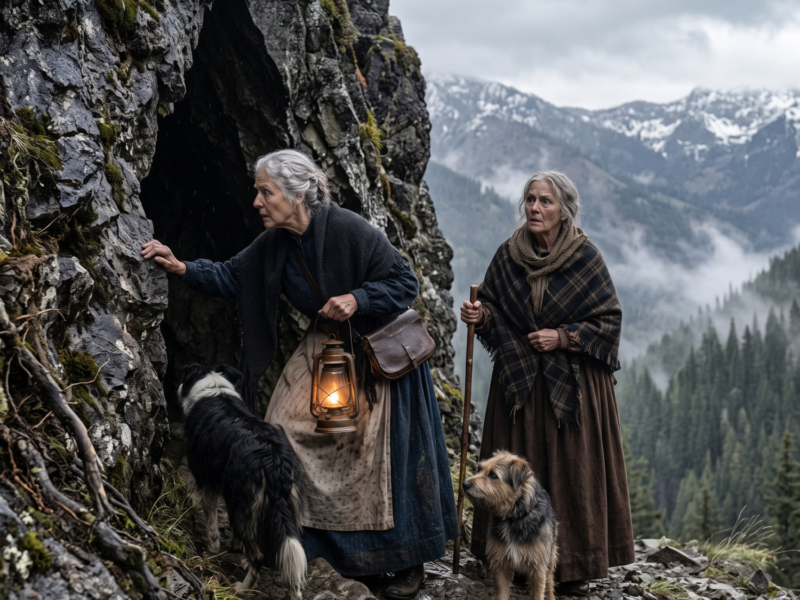
It was Scout who found it—barking suddenly, urgently at a break in the rock face nearly invisible through the blowing snow high above the narrow ravine where they’d finally been forced to leave the wagons behind. Milo was already scrambling up the slope after him before either woman had fully understood what they were looking at.
“Might be nothing,” Margaret said, shading her eyes against the stinging drift.
“Might be somewhere the wind can’t reach,” Maryanne said. “I’ll take somewhere the wind can’t reach any day.”









