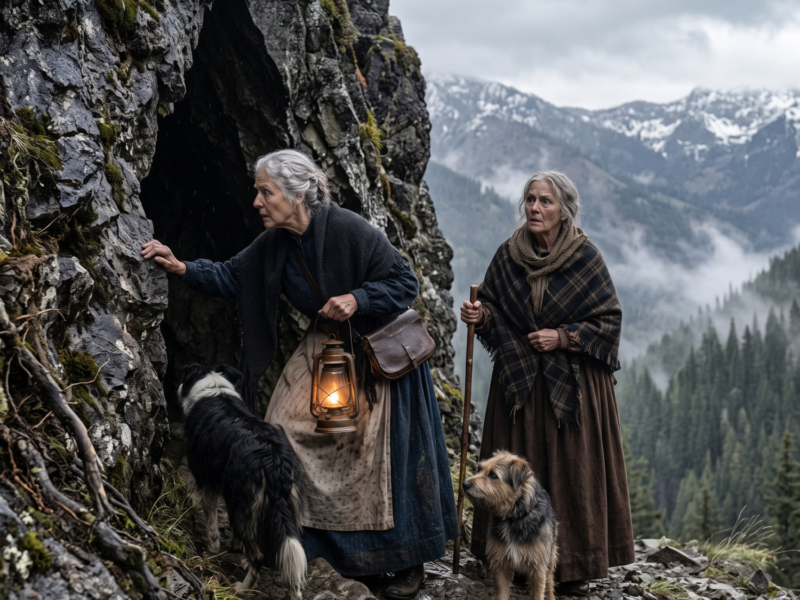
Betrayed by Their Own Sons — Two Widows Fled Into a Cave. 50 Feet In, They Found Her Secret
THE CHEST IN THE CAVE
The climb took the last of both women’s strength. Loose stones slid beneath boots not made for climbing. Twice, Maryanne reached back and steadied Margaret before she lost her footing entirely. The dogs never stopped urging them upward, circling back again and again as though herding two stubborn old women toward shelter neither could quite believe was real until they were standing inside it.
The wind vanished the moment they crossed the stone threshold. The silence after days of roaring felt almost like a held breath finally released.
They built what fire they could from dry branches trapped under the rocky overhang near the mouth of the cave and ate what little cornmeal remained between them, split evenly without either woman arguing about her share—because women who have spent a lifetime giving up their share for someone else eventually stop noticing they’re still doing it.
It was the next morning, once the worst of the storm had passed, that Maryanne went looking for dry wood deeper in the cave and found herself calling Margaret’s name in a voice that made both dogs’ ears come up sharp.
Half-buried beneath a shelf of stone sat an iron-cornered chest, heavier than either woman expected, the rust on its lock undisturbed for what looked like decades. It took a tire iron from Margaret’s wagon and both of their combined strength to break the rusted lock free.
Inside was a leather-bound journal, a hand-drawn map, and a small bundle of seed packets, each one labeled in a careful, patient hand that clearly expected someone someday to need them. The journal’s cover bore one name pressed into the leather: Constance’s Heirs.
Margaret opened it first. The first line stopped them both cold:
If you are reading this, then you are very likely a woman who has been told she cannot manage on her own. I was told the same. This is what I found instead.
Maryanne read the rest aloud by the firelight, her voice steady even as the story unfolded around them like it had been waiting forty years for exactly this audience.
Constance Hayes had come west in 1874 with a husband who left the following spring for a richer claim two counties over—and a younger wife to go with it—leaving Constance a homestead claim she had no legal standing at the time to hold alone. She would have lost it entirely; the land office did not in those years look kindly on unmarried women holding claims.
Had not a neighboring widow, Delia Marsh, arrived at her door one morning with a wagon, a milk cow, and a proposition: two women, filing together, sharing labor and risk equally, could hold what neither could hold separately. And no law on the books said outright that they couldn’t try.
They were not sisters. They were not married to one another. They were, according to Constance’s own careful accounting, simply two women who had decided that surviving on their own terms beat depending on men who had already proven, each in his own way, that he could not be depended on.
“They just decided to do it,” Margaret said quietly.
“It’s not like they had any other choice,” Maryanne said.
The map inside the chest marked a spring beyond the eastern ridge, a stand of dead pine, and ground sheltered from the worst of the northern wind—the exact same notes a prudent settler might leave, except this time addressed deliberately to whichever woman eventually needed them.









