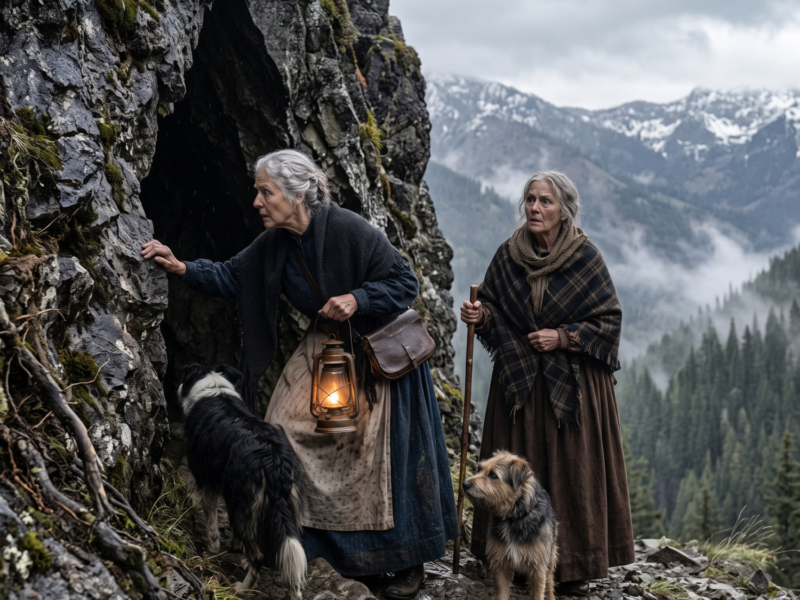
Betrayed by Their Own Sons — Two Widows Fled Into a Cave. 50 Feet In, They Found Her Secret
THE FIRST SPRING AT THE RIDGE
The snow melted the way it always did in Wyoming—not with a gentle sigh, but in a sudden, roaring rush of brown water that tore at the banks of Burnt Creek and left the lower meadows looking like a drowned world. But up on the benchland where Constance and Delia had laid their stones fifty years before, the south-facing slope shed its white burden quickly, drinking the moisture before the wind could scour it dry.
Margaret and Maryanne stood together on the unfinished threshold of what was rapidly becoming a house.
The walls were up—not the rough sod-and-mud dugout of Marin Callaway’s solitary winter two valleys over, but proper timber-and-stone masonry, chinked with clay and dry grass, solid enough to stand against whatever the plateau might throw at it next. They had traded two of Maryanne’s spare wagon wheels to a passing teamster in exchange for four bundles of milled pine planks and a pair of broadaxes. They had done the hewing themselves, blisters breaking and calluses hardening into leather until neither woman so much as flinched when the cold iron bit into oak or pine.
“Bradley’s probably still looking for that land agent,” Maryanne remarked, wiping a streak of mortar from her forehead with the back of a flour-dusted wrist. She leaned against a newly squared doorframe, watching Milo and Scout chase a stray ground squirrel across the emerging green of the meadow.
“Bradley isn’t looking for an agent,” Margaret said, not looking up from where she was sorting through Constance’s old seed packets, checking which ones had survived the half-century damp. “He’s looking for someone to blame for the taxes he had to pay on a ranch he thought he’d already sold.”
They both laughed—a dry, sharp sound that startled a hawk off a nearby pine branch. It was the laughter of women who had finally realized that the world they had spent forty years accommodating had cared very little about their comfort and even less about their consent.
The garden went in first. Then came the fences—simple, sturdy post-and-rail divisions that kept the wandering cattle belonging to larger spreads like Oaks’s operation from trampling the young shoots. Virgil Oaks had ridden past their boundary twice that spring, tipping his hat with a solemnity he usually reserved for circuit judges or funerals. He had never stopped to offer help—he knew better than to offer charity to women who were already doing the work twice as fast as his own hired hands—but his acknowledgment was there, written in the respectful nod of a man who recognized when a piece of land had finally found its proper masters.









