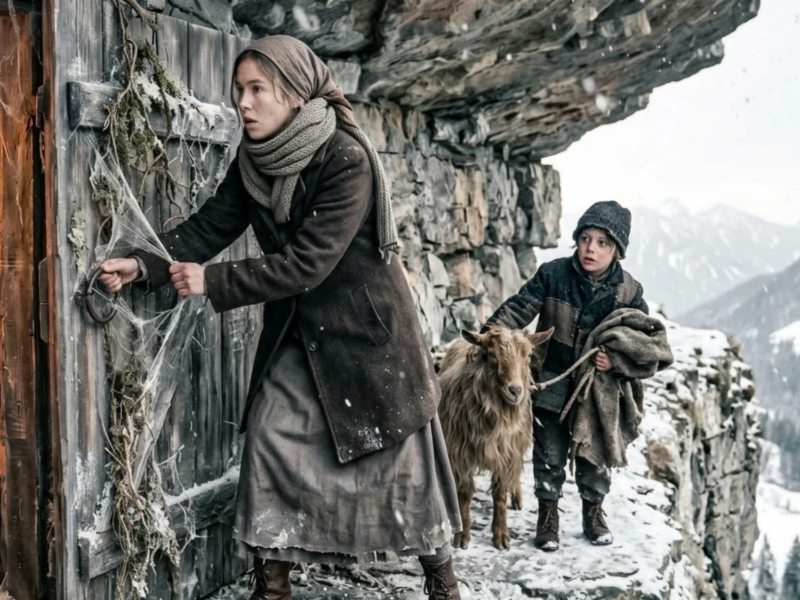
Cast Out in November, She Found an Abandoned Cellar—Then the Blizzard Drove Everyone to Her Door
Cast Out in November, She Found an Abandoned Cella…
The wind that came down from the Big Horn foothills on the 5th of November, 1887, carried the sharp, metallic smell of iron and old snow. It was the kind of wind that did not announce winter so much as deliver it, one cold hand at a time, across forty miles of sagebrush and empty sky.
Marin Alcott stood in the yard of the small pine cabin she had shared with her husband for four years, watching a man she barely knew drive three iron nails into the oak door she had opened and closed a thousand times. Each strike of the hammer landed like something being buried.
The paper he tacked up was cream-colored and official—stamped by the Big Horn Territorial Bank and Trust in the careful, unfeeling block letters of men who measured lives in columns of figures. It did not use her name once. It referred to the property, the delinquent account, and the aforementioned parcel, as though the walls, the roof, and the two crooked shutters had never belonged to anyone at all.
Barnaby Carrick was the man with the hammer, a thin figure wrapped in a heavy coat who possessed the specialized skill common to certain men who worked for banks: the uncanny ability to look everywhere except at the person he was ruining. He studied the door, the nails, and the distant horizon where the sky was turning the color of a dropped pewter plate. He did not look at Marin.
When he finished, he stepped back, studied the notice to ensure the wind wouldn’t steal it, and finally spoke. Even then, his eyes rested on a point just above her left shoulder.
“Mrs. Alcott, the bank will hold whatever furnishings you leave inside for thirty days. After that, it becomes the property of the trust. You would be well served to make arrangements before the weather turns any harder than it already has.”
Arrangements.
The word landed in her chest without breaking anything, simply because there was nothing left inside her that could still be broken by a word. She kept her hands folded neatly over her plain gray apron. She kept her chin level.
At her feet rested a small wooden crate. Inside it was everything she had chosen to keep from thirty-four years of living:
-
A cast-iron skillet blackened by four winters of biscuits and salt pork.
-
A gray wool blanket her mother had sent from Scranton the year she was married.
-
A cheap, well-thumbed edition of Seneca that Josiah had read in the evenings when his lungs were quiet enough to let him hold a book upright.
-
And the mining journal.
Above all things, the mining journal. Bound in soft brown leather that had gone the color of old honey where his thumb had rested against it for years, it was stuffed with folded scraps, pressed sketches, and handwriting so compact it looked like a distant fence line seen across a prairie.
Barnaby swung himself back onto his mare with the unhurried grace of a man who had done this work many times before. He touched the brim of his hat out of habit rather than respect and turned the horse toward the road leading down into Iron Marsh Bend. The mare’s hooves cut small, dark crescents into the frost. The sound grew smaller, fainter, and then vanished.
Marin was alone with the cabin, the wind, and the crate.
There are widows who mourn for a year, and there are widows who mourn for a morning. By the age of twelve, Marin Alcott had learned that the difference between the two was almost never a matter of feeling; it was a matter of what the day required.
The day required her to move. So she moved.
She lifted the crate. It was heavier than it looked. She turned her back on the door Josiah had planned himself four winters ago when his cough had been a small, dry thing he still swore was only dust. She did not permit herself a last look back. To look back was to make an offering to a grief that would devour every scrap she gave it and then demand her hands as well.
She began to walk, heading away from the town rather than toward it, because the town had already passed its collective judgment, and there was nothing waiting on those wooden sidewalks except pity dressed up as advice.
Related Articles

They Mocked the Widow’s Dirt Cellar—Then the Freeze Left Every Cabin Cold but Hers Warm
They Mocked the Widow’s Dirt Cellar—Then the Freeze Left Every Cabin Cold but Hers Warm…

A Homeless Veteran and His German Shepherd Inherited a Ridge No One Wanted — 35 Feet In, They Found
Chapter 1 / 7 A Homeless Veteran and His German Shepherd Inherit… A Homeless Veteran…

Neighbors Laughed When He Built A Cabin Inside An Old Barn—Until It Kept His Home 35 Degrees Warmer
Chapter 1 / 8 Neighbors Laughed When He Built A Cabin Inside An… Neighbors Laughed…

His Sod House Had No Woodpile in January – Until the Trains Stopped and the Town Came Begging
Chapter 1 / 10 His Sod House Had No Woodpile in January – Until t……

She Built Her Cabin Over the Woodshed and Never Burned Wet Wood Again
Chapter 1 / 8 She Built Her Cabin Over the Woodshed and Never Bu… She…

The Duke Abandoned Her on Their Wedding Day—Years Later, He Discovered What He Had Lost
Chapter 1 / 7 The Duke Abandoned Her on Their Wedding Day—Years… The Duke Abandoned…

He Wedged a Tiny A Frame Into a Crevice Before Winter and His Family Slept at 75°F While Town Hit
Chapter 1 / 7 He Wedged a Tiny A Frame Into a Crevice Before Win……

He Was Too Old to Ride—So He Bought the Ruined Ranch and Found the Room Behind the Fireplac
Chapter 1 / 5 He Was Too Old to Ride—So He Bought the Ruined Ran……

Settlers Laughed at His Underground Heat Recovery Duct — Until It Kept His Cabin 71°F Warmer
Chapter 1 / 9 Settlers Laughed at His Underground Heat Recovery… Settlers Laughed at His…

A Navy SEAL Built a Home Inside a Mountain—Then His Dog Warned Him Before the Storm
Chapter 1 / 5 A Navy SEAL Built a Home Inside a Mountain—Then Hi… A…