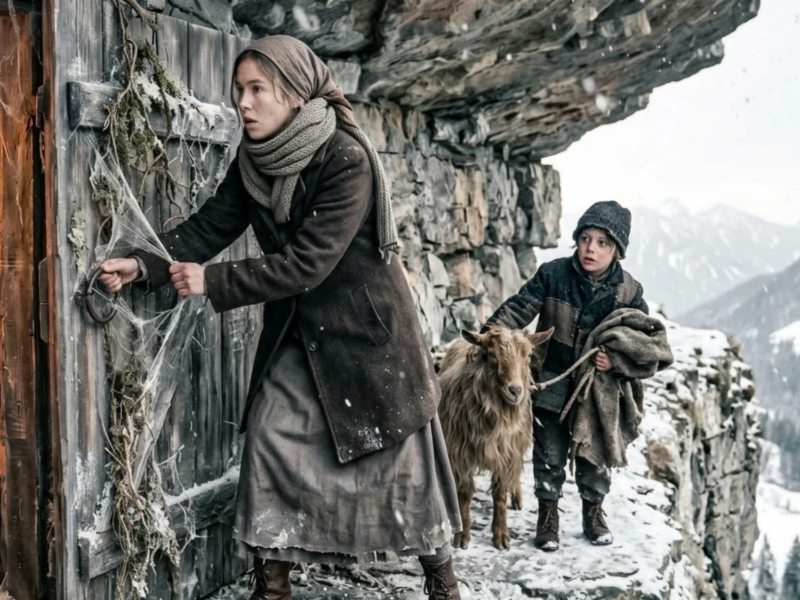
Cast Out in November, She Found an Abandoned Cellar—Then the Blizzard Drove Everyone to Her Door
The Ghost of Scranton
The road she took was not a road at all, but a set of twin ruts left by an old spring wagon running north through the low pine ridges toward a country nobody in Iron Marsh Bend bothered with anymore.
Josiah had loved those ridges. He had walked them on his Sunday afternoons—not in search of coal, for there was no proper coal seam in the Big Horns worth digging, but for the plain, honest company of the deep earth. He would come home in the long light of evening with his pockets full of quartz chips and his eyes soft in a way they never were when he came off shift from the little Wyoming pit that employed him.
Once, in the second summer of their marriage, he had taken her hand and led her up an overgrown game trail, showing her a scar in a hillside half-hidden by hawthorn and wild raspberry cane. He swore it had been somebody’s home a long time before either of them had crossed the Mississippi.
“A man tried to hold ground here once,” he had told her that afternoon, running his palm along the crumbling fieldstone arch. “He gave up the way most give up, but he built well. A cellar dug into a hillside outlives the fool who dug it, Marin. Remember that.”
She was remembering it now with every step, because the crate was heavy, her boots were thin, and the sky above the ridge line had begun to spit a fine, dry snow that sifted down like flour through cheesecloth.
She had no plan beyond that memory. No arrangements to make, no family in the territory, no money for a rail ticket back to Pennsylvania, and no place in Pennsylvania to return to. Her mother had been in the ground eleven years; her father had gone before her in the collapse at the Diamond Shaft during the winter of 1865, when Marin was twelve. In a single afternoon, she had learned that the earth could swallow a man whole, leaving nothing behind for his wife to bury except a pair of boots and a dented tin lunch box.
She had grown up in the row houses of the Scranton anthracite fields, a company town where every window looked out at the same slate-colored breaker and every child learned the steam-whistle codes before their letters:
-
Two short blasts: End of shift.
-
One long blast: Accident.
-
Three long blasts: Fatality confirmed. Come to the tipple and bring a wagon.
She had heard three long blasts twice before her sixteenth birthday. The women of that valley had taught her, without ever sitting down to explain it, that a woman intending to keep breathing after a mine took her men must learn to move through a morning like this one—the morning of the notice, the morning of the crate—without spending any part of herself she could not afford to lose.
She thought of Josiah then, because it was safer to think of him while walking than while standing still. She remembered the mission hall in Scranton in the spring of 1879, where she first saw him—a lean, quiet young miner with a bad haircut and a copy of Marcus Aurelius tucked in his coat pocket. She remembered his proposal four months later on the wooden bridge over the Lackawanna River: “I don’t have much, but I’ve got a plan to have a little more, and I’d like you in it.”
They had crossed the continent in the spring of 1883 on a train smelling of coal smoke and unwashed wool. They bought two acres from a rancher outside Iron Marsh Bend, and Josiah built the cabin with his own hands during the long summer evenings, joining timbers with the patience of a man who knew the difference between wood that held and wood that lied.
Four winters. Four winters of a cough that started dry, turned wet, and produced black spit in the basin every morning. Then the doctor from Casper who came out in the summer of 1886, closed his medical bag without opening it, and pronounced the verdict: black lung.
Josiah had died in September, when the cottonwoods along the creek were just beginning to yellow. His last full sentence to her was an instruction: “The journal, Marin. Everything I know is in the journal. Don’t sell it. Don’t lose it. Read it when you don’t know what to do next.”
She hadn’t opened it yet. Grief had a way of turning ink into a language she no longer spoke. But now, as the snow thickened, she knew the time had come.









