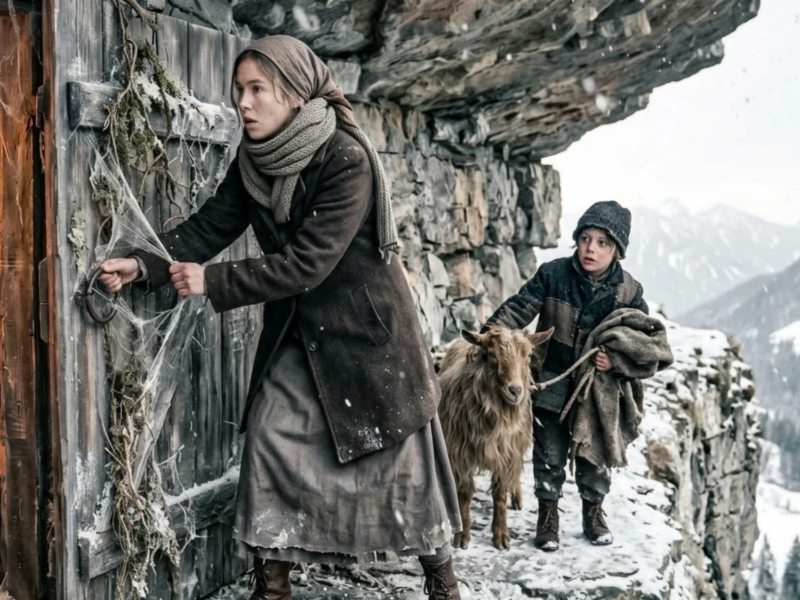
Cast Out in November, She Found an Abandoned Cellar—Then the Blizzard Drove Everyone to Her Door
Alcott’s Folly
The walk down to Iron Marsh Bend the next morning was perilous. The snow had crusted over, breaking under her boots with every third step.
She went straight to the general store owned by Ambrose Hollis, a soft-spoken widower who had respected Josiah. She set her wedding ring on the scarred wooden counter. It made a small, round sound—a sound she felt in her teeth.
“Ambrose,” she said, her voice measuring low. “I need a stove. Small, pot-bellied. Used is fine. I need twenty feet of four-inch stovepipe, elbows, collars, a shovel, a pickaxe, a pound of nails, and four feet of two-inch pipe if you have it. Take my ring, my husband’s pocket watch, and tell me what it’s worth.”
Ambrose picked up the ring, weighed it in his palm, and looked at her face with a mixture of gravity and deep respect. “The ring is worth more than what you’re asking, Mrs. Alcott. I’ll give you the supplies and put the rest on credit for flour and salt come spring.”
“Write it down,” she said.
As she turned to leave with her pickaxe over her shoulder, storekeeper Hollis gave her a sober warning: “A stove and a hole in the ground is going to smoke you out like a gopher, you know.”
“The smoke,” she replied, her chin lifting slightly, “will go where I tell it.”
Outside on the boardwalk, she crossed paths with elderly Winifred Ashcom, a woman of sixty-nine who sat on a bench wrapped in black wool. Winifred didn’t smile or offer pity; she simply lifted her chin a fraction of an inch—a silent gesture of absolute, unyielding recognition between two women who understood the terrain.
Back on the ridge, Elias Hollis—Ambrose’s fifteen-year-old son—drove a wagon up with the stove and pipe. He watched in silence as she began scratching a deep trench into the frozen hillside, extending outward from the cellar wall at a downward slope.
For six days, she hacked at the frozen earth. Her hands split and bled; her back locked into a permanent, dull ache. She lined the trench with flat stones dragged from the frozen creek below, building a thirty-foot horizontal heat-exchanger corridor designed to strip thermal energy out of the smoke before venting it outside.
On the sixth day, a bay horse clattered up the trail, carrying Wendell Thorne—the master builder of the Big Horn Foothills.
Thorne reined in his horse, stared down at her trench, and shook his head with professional exasperation. “Mrs. Alcott, what in the name of good sense are you doing? A flue goes up, not sideways. What you’ve got here is a ditch dug in the wrong direction at the wrong angle in the wrong month. You put a fire in that box, and the smoke will back up into your lungs before it finds daylight.”
Marin didn’t stop fitting her stones. She wiped her brow with a filthy sleeve and looked up at him. “The earth is a slow radiator, Mr. Thorne. The stones take the heat. The dirt drinks it. The smoke leaves the stack cold because everything warm about it has been made to stay.”
Thorne stared at her, dumbfounded by her stubbornness. “You’ll freeze in there before Christmas,” he warned, pulling his horse around. “And it will be a hard thing for the town to come up and pull you out.”
Word traveled fast through Iron Marsh Bend. Within a week, the trench had earned a cruel nickname across the town’s saloons and general store: Alcott’s Folly—or, more bluntly, The Widow’s Grave.









