Cast Out With $9, She Finished Her Father’s Hidden Dugout—Then It Saved 19 Lives in a Blizzard
Cast Out With $9, She Finished Her Father’s Hidden…
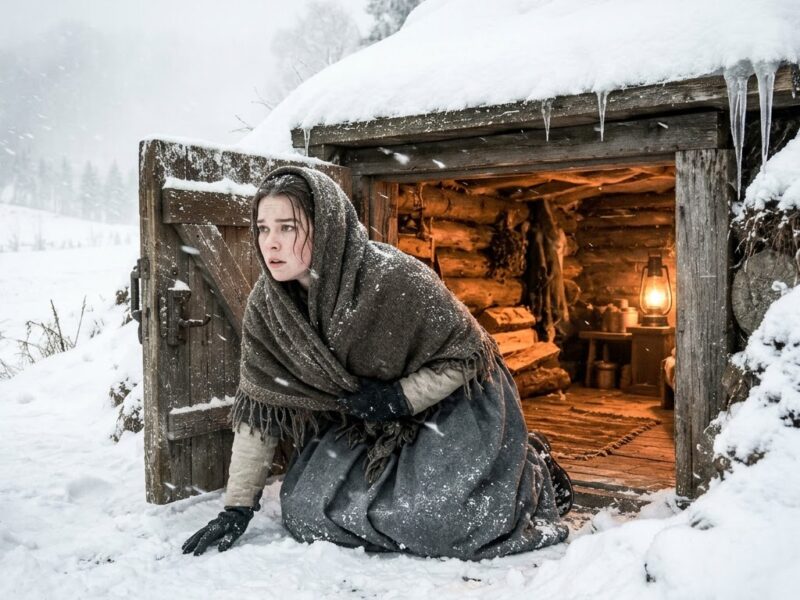
The prairie stretched white, endless, and utterly lifeless under a bruised, heavy December sky. A wind screaming across four hundred miles of erased Dakota landscape tore violently at the frozen earth, carrying with it an impossible, bone-stripping cold. Through the howling fury of the gale, a single thin threat of chimney smoke rose from a rounded mound in the earth—four feet of packed sod above a subterranean room that the storm could not reach, a small pocket of defiant warmth carved out of the wilderness.
Inside, a single candle flickered bravely inside a tin cup, casting amber shadows across damp clay walls. A dog with one ear folded flat and hackles raised stood guard near a sleeping platform, his dark eyes fixed on the heavy wood door. Beside him sat a fifteen-year-old girl in a mended wool dress. At ninety-three pounds, her blistered hands still smelled of clay, woodsmoke, and winter earth. She had spent the evening checking the tile joints, banking the small firebox, and listening to the deep, resonant heartbeat of the earth beneath her boots.
Suddenly, she lifted her head, alerting to a sound that should have been utterly impossible above the roaring fury of the blizzard: a fist, slow and deliberate, pounding against frozen pine.
Her heart skipped a beat, but her instincts, sharpened by months of absolute solitude and relentless survival, took over. She climbed the earthen ramp. Her fingers touched the cold iron latch—a hinge that a young blacksmith’s apprentice had forged for her in secret. Pulling the heavy door open, stepping past the thick, rolling plume of interior vapor, she found herself staring into the swirling white void at the last man on the northern plains she ever expected to see alive again.
Silas Whitmore stood on the threshold, his broad shoulders coated in a thick shell of ice, his beard frozen into a jagged plate of white. In his massive arms, wrapped in a stiff blanket that had gone rigid as tin, he held a small, blue-lipped child whose lips had turned the color of skimmed milk.
It was December 14th, 1883, somewhere past midnight, near Bramble Creek in the Dakota Territory. Four months earlier, Silas had stood in his own sunlit doorway, looking down with cold indifference at fifteen-year-old Beth Vangsness. He had told her plainly that she was nobody’s burden but her own, watching without a trace of pity as she walked down a dirt road with a single wool blanket and nine dollars folded in her fist.
Now, across a threshold where fifty-five degrees of interior warmth collided with twenty-five below zero outside, neither of them spoke. There was nothing left to say that the storm hadn’t already screamed.
To understand why that door opened—why the girl inside did not slam it shut and let the cold finish what pride had started—one has to look back before the dugout, before the nine dollars, to a spring morning in 1881.
A Norwegian farmer named Torsten Vangnes had knelt beside a chicken coop he was rebuilding, carefully laying clay tiles beneath its packed dirt floor. He explained to his thirteen-year-old daughter, Elizabeth, that heat, given the right channels and the proper conduits, would travel wherever a person needed it to go.
Torsten read far too much for a man farming eighty acres of thin Dakota loam. His neighbors said so; his pastor said so; even his wife, Ingrid, said so with a fond exhaustion that meant she had married him knowing exactly what she was getting. He owned dog-eared books on Roman engineering, the aqueducts of Segovia, and the intricate hypocaust systems that had heated Roman bathhouses two thousand years before anyone in Bramble Creek had ever poured a foundation.
At night by the sputtering light of a tallow lamp, when the wheat did not need him, he read aloud to Elizabeth. He described how the ancients had made stone remember warmth, tracing diagrams with a calloused finger.
“The earth never lies,” Torsten often told her, a phrase repeated so often it became the very structural anchor of her childhood. “People will weather. Banks and neighbors and priests and your own tired hopes will fail you. But the earth keeps every promise it makes.”
That promise was shattered in the spring of her thirteenth year when diphtheria tore through the county with terrifying speed. Her mother, Ingrid, died on a Tuesday morning with her hand still curled around a medicine spoon; Torsten followed her the following Sunday before the church bells had even finished ringing for the service he would not attend.
Within a month, the First Territorial Bank of Fargo foreclosed on the Vangnes farm. Elizabeth was left with three dresses, an undersized wool coat, her mother’s Bible, and a single black-and-white wedding photograph of her parents taken in a tent in Grand Forks.
Her aunt Merritt came for her in a buckboard wagon, taking her twelve miles north to a small chicken farm at the edge of a shallow, brown-water creek. Merritt was a soft woman with tired eyes and hands permanently damaged by childhood rheumatic fever. She meant well—that was the phrase Elizabeth would use later in the private courtroom of her own memory when she tried to be fair. Merritt meant well; she simply didn’t have enough spine left for two.
For two years, Elizabeth worked like a hired hand. She tended one hundred and forty laying hens, scalded pinfeathers from Sunday roosters, hauled water from the creek in heavy two-gallon buckets that raised permanent welts across her shoulders, and scrubbed floors on her knees with lye soap. In return, she slept on a straw mattress in the corner of the main room behind a curtain Merritt had strung from two nails, eating just enough to keep her upright. There were no wages, no schooling past two winter months, and no future.
In the summer of 1883, Merritt married Silas Whitmore at a picnic under the cottonwoods. Silas was a loud, certain widower with six children and a massive wheat operation. Within a week of the wedding, Silas laid out the harsh arithmetic through a thin wall while Elizabeth listened in the dark: “The girl goes. She’s fifteen. She can find work in town. My children come first. My grain bin is not a charity house.”
On the morning of August 28th, 1883, Merritt pressed nine single-dollar bills into Elizabeth’s palm, her hands shaking uncontrollably. As Elizabeth walked down the lane with her bundle and her Bible, Silas delivered his parting blow: “Your father died in debt and left you nothing. You’re nobody’s burden but your own.”
Related Articles

They Mocked the Widow’s Dirt Cellar—Then the Freeze Left Every Cabin Cold but Hers Warm
They Mocked the Widow’s Dirt Cellar—Then the Freeze Left Every Cabin Cold but Hers Warm…

A Homeless Veteran and His German Shepherd Inherited a Ridge No One Wanted — 35 Feet In, They Found
Chapter 1 / 7 A Homeless Veteran and His German Shepherd Inherit… A Homeless Veteran…

Neighbors Laughed When He Built A Cabin Inside An Old Barn—Until It Kept His Home 35 Degrees Warmer
Chapter 1 / 8 Neighbors Laughed When He Built A Cabin Inside An… Neighbors Laughed…

His Sod House Had No Woodpile in January – Until the Trains Stopped and the Town Came Begging
Chapter 1 / 10 His Sod House Had No Woodpile in January – Until t……

She Built Her Cabin Over the Woodshed and Never Burned Wet Wood Again
Chapter 1 / 8 She Built Her Cabin Over the Woodshed and Never Bu… She…

The Duke Abandoned Her on Their Wedding Day—Years Later, He Discovered What He Had Lost
Chapter 1 / 7 The Duke Abandoned Her on Their Wedding Day—Years… The Duke Abandoned…

He Wedged a Tiny A Frame Into a Crevice Before Winter and His Family Slept at 75°F While Town Hit
Chapter 1 / 7 He Wedged a Tiny A Frame Into a Crevice Before Win……

He Was Too Old to Ride—So He Bought the Ruined Ranch and Found the Room Behind the Fireplac
Chapter 1 / 5 He Was Too Old to Ride—So He Bought the Ruined Ran……

Settlers Laughed at His Underground Heat Recovery Duct — Until It Kept His Cabin 71°F Warmer
Chapter 1 / 9 Settlers Laughed at His Underground Heat Recovery… Settlers Laughed at His…

A Navy SEAL Built a Home Inside a Mountain—Then His Dog Warned Him Before the Storm
Chapter 1 / 5 A Navy SEAL Built a Home Inside a Mountain—Then Hi… A…