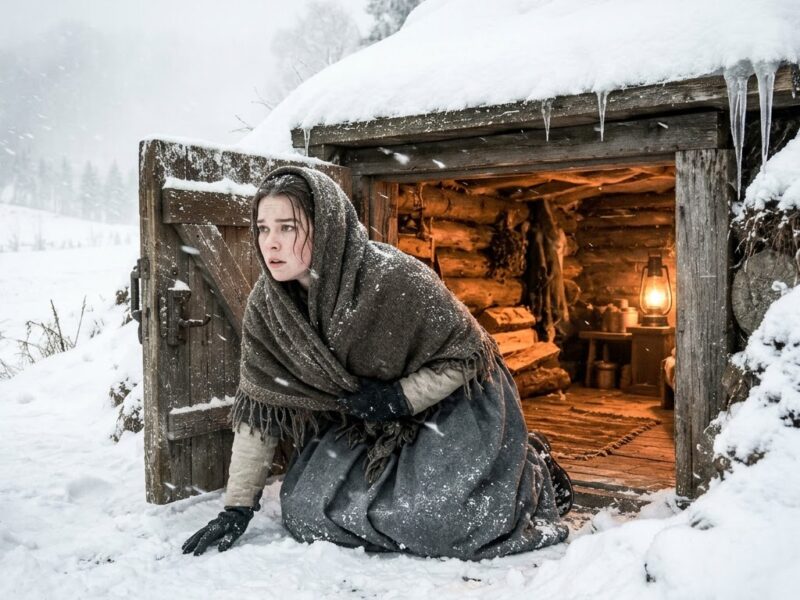
Cast Out With $9, She Finished Her Father’s Hidden Dugout—Then It Saved 19 Lives in a Blizzard
The Arithmetic of Survival
Bramble Creek in 1883 offered no mercy to a penniless orphan. Every door she knocked on—the boarding house, the hotel, the general store, nearby farms—slammed shut in her face. Everyone in town had already been fed a story about her, and none of them belonged to her.
By September 1st, she sat on a broad, flat sandstone four miles southwest of town at the base of Crowfoot Ridge—a quarter-section of unbroken, unwanted prairie that nobody had bothered to file on in nine years because the soil looked thin and the location was isolated.
With nine dollars, a wool blanket, her mother’s Bible, and blistering heels, she began her calculations. A spade cost two dollars at the mercantile. Twenty clay drainage tiles ran three dollars at the Norwegian co-op. A small iron cooking grate cost a dollar. That left three dollars for cornmeal, salt pork, and matches. Renting a handcart from a sympathetic boy named Ali cost twenty-five cents.
By evening, her materials rested in the tall grass at the base of the ridge. “This is my home,” she told the meadowlarks, and she meant it.
The digging was brutal. The prairie sod was matted a foot deep with roots that had choked each other for a thousand years. Her hands bled by noon; she tore strips from her skirt to wrap her palms and kept going. On the second day, her spade struck something hard buried eighteen inches deep—a rusted tin box wrapped in rotted oilcloth.
Prying it open with a thumbnail, she found a single sheet of paper covered in her father’s slanted handwriting, detailing the cross-section of a subterranean shelter and a heating channel. Her father had walked this exact ground before her, burying a message in the earth like a seed. Death had not been able to reach far enough to unmake his choice.
For weeks, Elizabeth dug. She hauled thousands of spadefuls of earth, sinking the pit five feet deep across a hundred and forty square feet.
Old Holda Bjornstad, a stubborn seventy-one-year-old Norwegian widow living three miles east, walked over to inspect the progress. Recognizing the Roman hypocaust design, Holda offered gruff, invaluable advice: “Clay mud will not hold in that gap without sand mixed in. Two parts clay to one part sand. And it needs three days to cure.”
Elizabeth worked with relentless precision. She laid the clay tiles from the northwest firebox corner, running them fourteen feet along the north wall, around the sleeping platform, and back to a southwest chimney. She covered the tiles with flat creek stones, packed earth, and three hundred pounds of river rock hauled from a distant seep—acting as a thermal battery to store heat long after the fire died.
She framed the roof with salvaged cottonwood poles, matted prairie grass, and thick layers of sod. To anyone passing on the ridge, the dugout looked like a natural swell in the prairie.
When she fired the system for the first time on October 8th, the draft took instantly. Two hours later, pressing her cheek against the sleeping platform boards, she felt the deep, radiant warmth rising from beneath. The earth was keeping its promise.
As autumn waned, Bramble Creek took notice. Wilkins, the general store owner, pinned a little cross on his wall map, labeling her claim “Whitmore’s Grave” or “The Folly.” Pastor Halverson and the Ladies Aid Society rode out to condemn her living in a “grave,” urging her to accept charity work in town. Elizabeth politely refused them all, trusting the engineering her father had left behind.
Even a local blacksmith’s apprentice, a seventeen-year-old named Rasmus Kelland, began silently aiding her, dropping off iron hinge brackets and checking on her progress with reddened ears and a quiet, steadfast gaze.
When winter’s chill deepened, Holda brought grave news: Silas Whitmore had written to the county land office, petitioning to condemn her habitation as a hazard so he could seize the land. Territorial inspector Barnaby Crane was dispatched to investigate.
When Crane arrived on December 10th, expecting a wretched hovel, he stepped down into a meticulously crafted, fifty-five-degree subterranean home. Kneeling by the firebox and touching the warm sleeping platform, Crane jotted notes in his ledger. He filed a report observing that Elizabeth’s dugout was warmer and far more fuel-efficient than any home in Bramble Creek. Silas’s attempt to crush her had failed.









