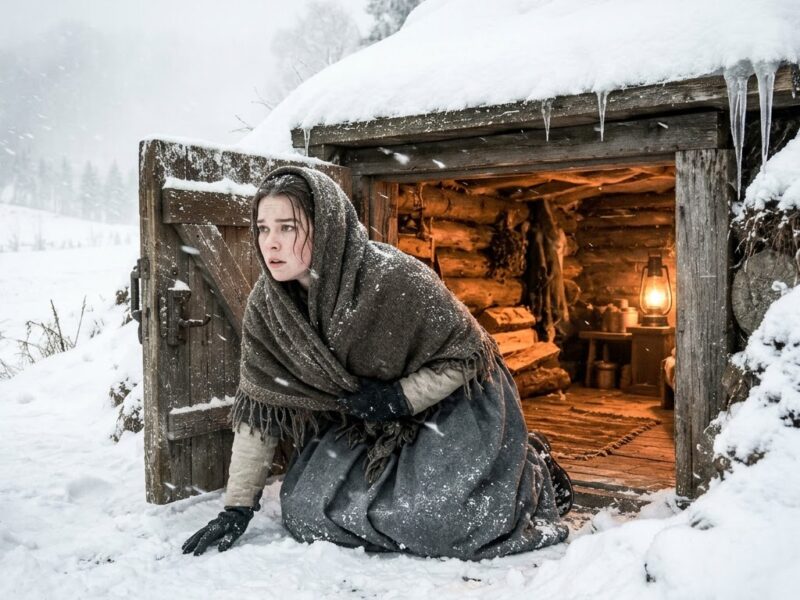
Cast Out With $9, She Finished Her Father’s Hidden Dugout—Then It Saved 19 Lives in a Blizzard
The Great Blizzard of December '83
On December 13th, the sky turned a bruising yellow-green, and barometric pressure plummeted. Animals fled; the air grew heavy with impending doom. Elizabeth walked into Bramble Creek, desperately warning Wilkins, Dr. Holbrook, Pastor Halverson, and various townsfolk that a catastrophic storm—reminiscent of the legendary blizzard of ’73—was bearing down.
They laughed her off. Old Ezekiel Thorne sat proudly on his porch, scoffing at a fifteen-year-old girl offering weather advice.
Returning to her dugout just as the cold locked in, Elizabeth secured her food, water, and firewood, anchoring her dog, Ember, by her side.
Midnight brought the monster. Winds rose past seventy miles per hour, driving horizontal snow like white sand across the plains. Above ground, the world ceased to exist. Below, wrapped in fifty-four-degree baseline warmth driven by the buried tiles, Elizabeth and Ember weathered the initial fury in silence.
Two miles away, the Whitmore homestead was freezing. Silas’s house plunged to forty-one degrees; his youngest daughter, Cassie, began losing color, her lips turning skimmed-milk white. Realizing his family would not survive a second night, Silas made the agonizing choice to march them through the blinding whiteout toward the Vangnes claim.
Clutching Cassie to his chest, Silas led his family through a hellish ninety-one-minute whiteout, guided only by memory and the wind’s pressure. When they finally stumbled upon Crowfoot Ridge, Silas hammered his fist against the frozen pine door.
The door swung open. A column of warm vapor rolled up the ramp. Standing in the light of a candle held in a tin cup was the girl he had cast out into the cold four months prior.
“Come down, all of you. The children first,” Elizabeth said cleanly, showing no triumph, only swift practical execution.
Over the next few hours, as the storm raged on, more refugees arrived: Prudence Ashcraftoft and her husband carrying their catatonic four-year-old son, Isaiah; Pastor Halverson and his family; and young townsfolk whose homes had failed. In total, seventeen souls, along with Ember the dog, crammed into the one hundred and forty square feet of the dugout.
Elizabeth worked tirelessly. She fed the firebox with six logs at once, maximizing the hypocaust’s thermal storage, while opening the small chimney vent to supply fresh air to seventeen pairs of lungs.
Late in the night, a second wave arrived. Rasmus Kelland, braving the blinding blizzard with a heavy rope tied to the town smithy, had rescued seventy-one-year-old Holda Bjornstad, carrying her miles across his shoulders to the sanctuary of the ridge.
As the second night stretched on, shared terror and the intimate warmth of the earth melted away old hatreds and cruel prejudices.
Pastor Halverson openly confessed his pride in church pulpits; Nathaniel Prior and Josiah Denning wept, confessing the cruel bets they had laid against her survival. Even Silas Whitmore sat in silence against the north wall, unable to meet the eyes of the girl whose life he had tried to extinguish.
When the storm finally broke on December 16th, the prairie was buried under massive twenty-foot drifts. Bramble Creek had suffered catastrophic damage; several elderly residents, including Ezekiel Thorne in his rocking chair, had frozen to death in their inadequately heated homes.
As the survivors emerged to dig their way out, Silas Whitmore stared blankly at the ruined landscape before leading his family away toward a new start in Kansas. They never saw him again.
In the weeks that followed, official recognition arrived. Land inspector Barnaby Crane delivered a formal certificate of land improvement, legally granting Elizabeth the quarter section under territorial squatter’s rights.
When spring finally unlocked the frozen earth at the northeast corner of her claim, Elizabeth and Rasmus drove a spade twelve paces from the twin sandstone “fists.” They unearthed a second tin box containing two hundred shares of Northern Pacific Railway stock purchased by her father in 1879—worth over $1,800. The precise financial independence her father had intended for her.
Elizabeth used the funds to build a proper frame house above ground—complete with real glass windows and a bedroom floor heated by clay tiles connected to the kitchen stove.
In the spring of 1887, Elizabeth married Rasmus Kelland inside the historic dugout at Holda’s suggestion, surrounded by sixteen candles and a community forever transformed by her courage.
Decades later, sitting on her porch as a grandmother watching her own kin play in the Dakota sun, Elizabeth would often look back toward the low sod mound of the original dugout. She lived by the core truth her father had planted in her soul: The earth never lies. People will. Weather will. Banks and neighbors and hard winters will. But the earth keeps its word.









