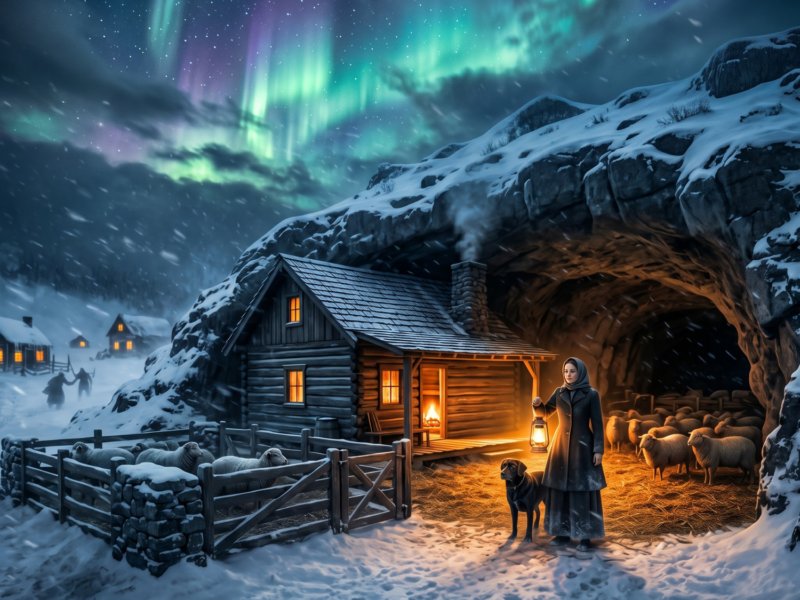
Everyone Mocked Her Sheep Shelter—Until the Blizzard Buried the Entire Territory ❄️
Everyone Mocked Her Sheep Shelter—Until the Blizza…
The wind that moved through the Wyoming territory in the autumn of 1884 was not the kind that bent grass and moved on. It was a scouring, deliberate thing carrying grit and cold from somewhere north of reason, stripping the last color from the hillsides with the patience of a process that had no opinion about what it destroyed.
Marin Callaway stood on the rise of land she now owned.
If ownership could describe the relationship between a woman with four silver dollars and a steep, granite-stubbled slope that the rest of Laramie County had collectively decided was worth nothing. She felt that wind move through her coat as though the coat were decoration rather than protection. Below her, in a pen of lash-saplings she had built in three hours the morning before, twenty-two sheep stood in a loose cluster, their wool flanks pressing together in a communion of warmth that was already, in the first week of October, a matter of survival rather than preference.
She had been twenty years old for six weeks. She had been without a home for nine days.
The slope her father had deeded her faced south, which was the one accident of generosity in the entire transaction, though Thomas Callaway had not intended it as generosity. He had intended it as a lesson. The south face meant the thin autumn sun reached it longer than the flat meadowlands below, meant the snow would melt faster when March arrived, meant the granite outcroppings that made farming impossible also broke the worst of the northwest wind before it reached the hollow where a person might conceivably make a shelter of some kind.
These were things Marin knew because her grandfather, Silas, had taught her to read a hillside the way other men read a ledger—not for what it declared on the surface, but for what the numbers underneath were actually doing. Silas Callaway had been dead for three years. The things he had placed inside his granddaughter’s mind were very much alive.
Marin did not look at the sheep as livestock, though they were. She looked at them as the arithmetic of her situation made visible and breathing: twenty ewes, two rams, all healthy, all young enough to have productive years ahead. Her mother, Norah, had begun that flock from four animals purchased at considerable sacrifice in 1876, the year Marin was twelve, the year Norah had already begun coughing in a way that Thomas pretended not to hear.
The flock had been Norah’s project, her small economic argument against the uncertainty of ranching on marginal land. When Norah died in the winter of 1878, the sheep passed to Marin without ceremony or discussion, because everyone in the household understood without saying that the sheep had always belonged more to Marin than to anyone else’s. What Marin had not understood until nine days ago was that the sheep were the only part of her mother that Thomas had allowed her to keep.
The argument about the ham had not been about the ham.
This was what she turned over in her mind as the wind pushed at her back and the sheep below shifted against each other with their small, trusting sounds. Lillian Callaway Ney Marsh of Cheyenne had come into the household fourteen months ago with a trunk of city clothes, opinions about the proper management of a kitchen, and a pregnancy she disclosed to Thomas three weeks after the wedding in a conversation Marin was not meant to overhear.
Marin had stood in the hallway for a long time after that, not moving. She understood then what she had been in that house for the fourteen months of Lillian’s residence: she had been a reminder not of anything she had done, but of everything she represented. Norah’s hands in the way she turned a piece of work. Norah’s eyes when she looked at the mountains. Norah’s particular silence when she disagreed with something but chose not to spend the breath.
Lillian was not a cruel woman. Marin had examined that question with the same methodical honesty she brought to everything, and her conclusion was consistent. Lillian was simply a woman who needed, for the coherence of her new life, for the child she was carrying to be born into a house that belonged to her, not to the ghost of the woman before her. Thomas had needed the same thing. He just hadn’t been able to say it.
The argument about the ham had given everyone a reason that was easier to speak aloud. Marin had defended her mother’s curing method—salt-heavy, slow, the way Norah had learned it from her own mother in County Clare before the crossing, a method that produced a different flavor than Lillian’s preference, but was by no measure inferior—and in defending it had been seen to be defending something larger, which she was.
The ultimatum had followed within the hour. Marin had not yielded. She was not built for yielding on questions of substance dressed as questions of preference. Thomas had handed her the deed to the south-facing slope the following morning with the expression of a man performing a surgery he believed was necessary, and pointed the direction off his land with a hand that was not entirely steady.
She had taken the deed. She had taken the sheep. She had taken the tools that had been Silas’s, which Thomas had kept in the barn for eleven years out of some combination of sentiment and superstition. She had not taken anything that was not unambiguously hers, because she understood even in that morning’s cold fury that the terms of her departure would become the foundation of whatever she built next, and a foundation laid in resentment was no foundation at all.
She had four silver dollars, a mattock, a long-handled shovel worn smooth by decades of use, a wheelbarrow with a wheel that squealed on every rotation like a small animal in mild distress, her mother’s recipe book with the water-damaged corner on the third page, two wool blankets, a change of clothes, a week’s worth of dried meat, flour, salt, and twenty-two sheep who did not know anything had changed and were mildly annoyed about the new pen.
The problem presented itself with the clarity of mathematics. Winter in this territory was not a season to be managed. It was a force to be survived.
Related Articles

They Mocked the Widow’s Dirt Cellar—Then the Freeze Left Every Cabin Cold but Hers Warm
They Mocked the Widow’s Dirt Cellar—Then the Freeze Left Every Cabin Cold but Hers Warm…

A Homeless Veteran and His German Shepherd Inherited a Ridge No One Wanted — 35 Feet In, They Found
Chapter 1 / 7 A Homeless Veteran and His German Shepherd Inherit… A Homeless Veteran…

Neighbors Laughed When He Built A Cabin Inside An Old Barn—Until It Kept His Home 35 Degrees Warmer
Chapter 1 / 8 Neighbors Laughed When He Built A Cabin Inside An… Neighbors Laughed…

His Sod House Had No Woodpile in January – Until the Trains Stopped and the Town Came Begging
Chapter 1 / 10 His Sod House Had No Woodpile in January – Until t……

She Built Her Cabin Over the Woodshed and Never Burned Wet Wood Again
Chapter 1 / 8 She Built Her Cabin Over the Woodshed and Never Bu… She…

The Duke Abandoned Her on Their Wedding Day—Years Later, He Discovered What He Had Lost
Chapter 1 / 7 The Duke Abandoned Her on Their Wedding Day—Years… The Duke Abandoned…

He Wedged a Tiny A Frame Into a Crevice Before Winter and His Family Slept at 75°F While Town Hit
Chapter 1 / 7 He Wedged a Tiny A Frame Into a Crevice Before Win……

He Was Too Old to Ride—So He Bought the Ruined Ranch and Found the Room Behind the Fireplac
Chapter 1 / 5 He Was Too Old to Ride—So He Bought the Ruined Ran……

Settlers Laughed at His Underground Heat Recovery Duct — Until It Kept His Cabin 71°F Warmer
Chapter 1 / 9 Settlers Laughed at His Underground Heat Recovery… Settlers Laughed at His…

A Navy SEAL Built a Home Inside a Mountain—Then His Dog Warned Him Before the Storm
Chapter 1 / 5 A Navy SEAL Built a Home Inside a Mountain—Then Hi… A…