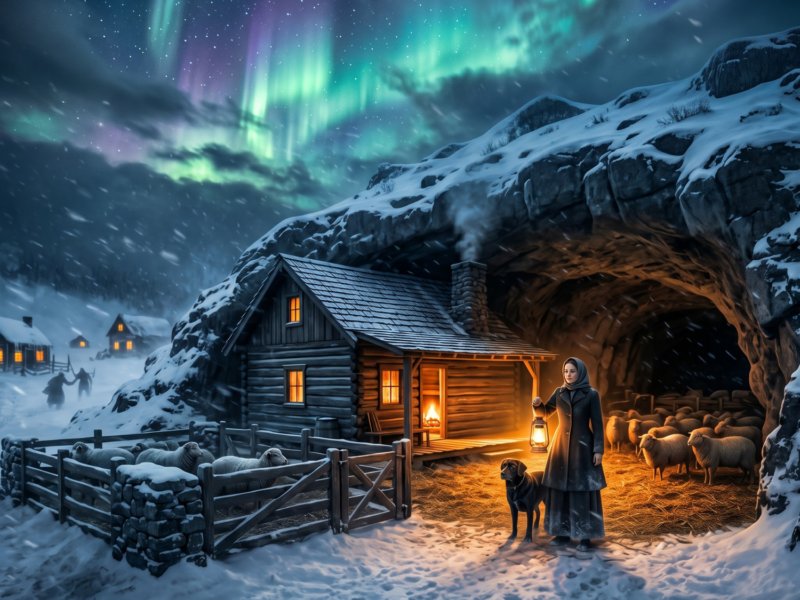
Everyone Mocked Her Sheep Shelter—Until the Blizzard Buried the Entire Territory ❄️
THE LEXICON OF THE FOX
Marin had lived her entire life in the shadow of that fact. She had watched her mother stack firewood in configurations that maximized density. She had watched Silas check the joints of the barn each October with the focused attention of a man who understood that the difference between a sealed structure and a drafty one was the difference between animals that lived and animals that didn’t. She knew what a Wyoming blizzard did to livestock in the open; she had seen the aftermath once in the winter of 1880, when a rancher named Corrian, who had arrived from Ohio the previous spring, had not understood what the sky was telling him and had lost forty head of cattle in a single night.
A barn required lumber. Lumber required money. The nearest mill was in Laramie, and the freight cost alone for enough mill planks to shelter twenty-two animals adequately would consume everything she had three times over. She had walked the arithmetic forward and backward in the nine days since leaving her father’s property, and it arrived at the same place each time: a timber structure was not possible. Not this season. Not with what she had.
The conventional response to this arithmetic was to sell the sheep, accept defeat, return to her father’s house under whatever terms Lillian set, and wait for circumstances to shift. Marin was aware of this response. She was also aware that it would mean the end of the only economic inheritance her mother had managed to leave her, the end of any independent future she might construct, and the end of something less tangible but no less real: the sense that the knowledge Silas had given her was worth something, that seeing the world the way he had taught her to see it was a tool rather than merely an eccentricity.
So she turned her attention instead to the hillside.
Silas had taken her out in November of 1877 on a morning so cold the air itself seemed reluctant to move. She had been thirteen. They were following a fox’s track across a field of crusted snow, and Silas had suddenly stopped, pointing with one gnarled finger at a place where the track disappeared into a shadow at the base of a granite outcropping. The entrance to the den was invisible until you were directly in front of it—a narrow gap angled into the rock face so that the prevailing northwest wind passed entirely over it.
“The fox isn’t fighting the winter,” Silas had told her, his voice carrying the particular roughness of a man who had spent decades talking mostly to himself and to landscapes. “It isn’t building a fortress. It found the one place winter can’t reach, and it went there. The earth below the frost line sits at a temperature that doesn’t vary by more than a few degrees, regardless of what the sky decides to do overhead.”
She had thought about that fox intermittently for seven years. Standing on her slope with the wind at her back and the sheep making their small sounds below, she thought about it with the focused intensity of a person who has just recognized that a memory they have been storing is not a memory at all, but an instruction.
There was a second memory. She was fifteen, and Silas had taken her twenty miles north of the home ranch to a location he had known since his trapping years, where an old line cabin sat half-buried in a hillside, its roof a living mat of grass, and its entrance so low you had to duck to enter. Inside, a single tallow lamp revealed a space that was cool in the way of a root cellar, but not cold in the way of the outside world.
“Put your hand to the wall,” Silas had said.
She did. Cool, but not frozen, not damp.
“The earth below the frost line holds the warmth of the season that just passed,” he told her. “It doesn’t forget. Long after the snow comes, the ground six feet down still remembers August. You give animals a space where that memory is the temperature they’re living in, you’ve done more for them than any timber barn with gaps in its boards.”
Standing on her slope at twenty years old with winter coming and four dollars in her coat pocket, Marin Callaway arrived at the conclusion that she was not going to build on this land. She was going to build into it.
She began the survey that same afternoon, moving along the contour of the slope with the unhurried attention of a person doing a thing they will not get a second chance to do correctly. She found it in the late afternoon light when the shadows lengthened: a slight concavity in the slope roughly forty feet from the granite spine that ran along the ridge, where the angle steepened slightly and the soil was noticeably darker, indicating greater depth and better moisture retention.
She knelt and pushed the mattock handle straight down into the earth. It went eighteen inches before meeting significant resistance.
She was standing in the place she would make her stand.









