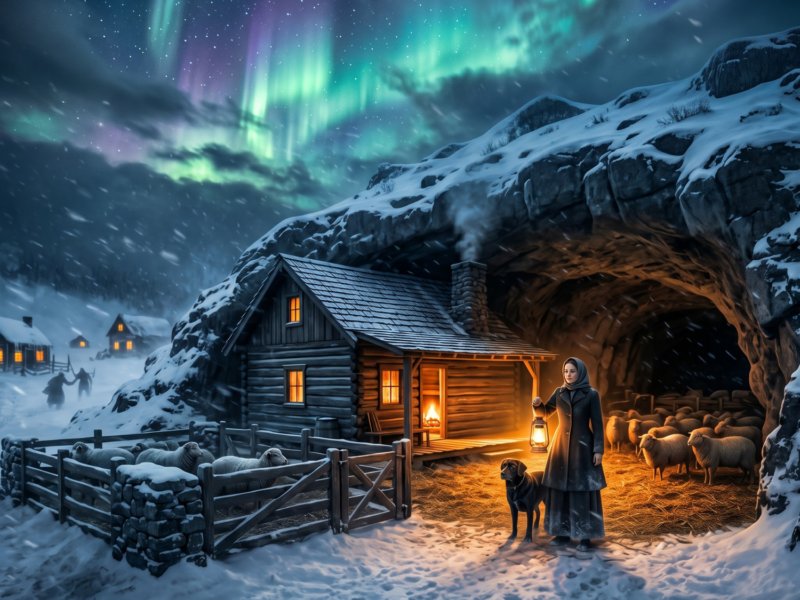
Everyone Mocked Her Sheep Shelter—Until the Blizzard Buried the Entire Territory ❄️
THE LANGUAGE OF THE LAND
Thomas Callaway came a week later, aged by a winter that had cost him three cattle and two sections of fence. He stood at the edge of the cleared area, looking at the twenty-two sheep moving in the bright cold air with absolute aliveness.
“Lillian asked me to come,” he said, his voice carrying the difficulty of rehearsed words. “She said if the child is a girl, she should know there are women who know how to make something out of what they’re given. She said that’s not something she can teach her, but maybe…”
He didn’t finish the sentence. Marin looked at her father across the cleared ground, feeling neither warmth nor cold, but something far more patient.
“If it’s a girl,” Marin said, “name her Norah.”
Thomas nodded once—a small motion containing more paragraphs than most men managed—turned his horse, and rode back toward the ridge.
In the weeks that followed, the Callaway dugout became the most visited structure in the territory. The conventional wisdom had failed the local ranchers in the countable way of dead animals, and they needed to understand how Marin had survived. Oaks organized the first group of desperate homesteaders.
Marin taught what she knew in the only form she believed worked: she showed the land, named the logic, and let them draw their own conclusions. She charged for her time in labor and materials, ensuring the knowledge was received with seriousness. Webb, the young ranch hand who had lost his herd, paid in fence timber. Two homesteader families paid in spring labor, building a fence line and a root cellar of their own before summer.
When the spring deed signing took place in Laramie, the property clerk accepted Marin’s price without negotiation. She signed her name in the clear, careful script Norah had taught her at the kitchen table, feeling the paper change character under her hand from document to foundation.
Three weeks into the thaw, Agnes Puit arrived with an eight-year-old girl whose eyes were the gray of a winter marsh and whose hair was the color of creek mud.
“My brother’s girl,” Agnes said simply. “Her mother didn’t make it through the winter. He’s in no condition. I can take her through spring, but she needs someone who can show her something… something useful.”
Marin came down from the roof where she was inspecting the sod, set her tools on the ground, and crouched to the child’s eye level. The girl met her gaze without flinching.
“Do you want to learn how to read the land?” Marin asked, her voice direct and honest. “Not farming, not homesteading—reading the way you read a face, except the land tells the truth every time.”
The girl looked at the slope, at the dugout’s half-visible form, at the sheep in their pen, and then back at Marin.
“Yes,” the girl said.
Marin stood and looked at Agnes, who received the look with a subtle shift in expression that was her equivalent of a full smile.
The slope held the morning light at its particular angle—the south face catching the sun an hour longer than the valley floor, warming earlier, reading the season’s change before everything around it. The dugout sat in the hillside with the settled quality of something that had always been there.
Silas had taught her that the most durable things were the things that worked with the given rather than against it, and that a mind trained to see the land’s logic was a tool no one could take from you.
The girl followed Marin up the slope, not asking where they were going, trusting that the destination would become clear when they reached it. Below them, the sheep moved in their pen. Above them, the Wyoming sky held its enormous, indifferent blue. Somewhere between the two, in the specific warmth of a south-facing hillside in early spring, a thing that had been given as punishment had become the ground everything else was built on.









