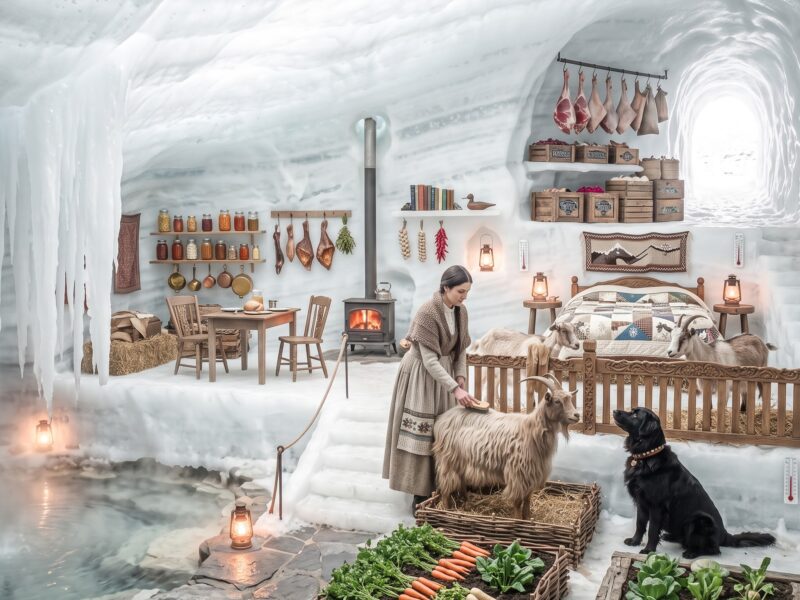
Exiled at 13 She Built a Hidden Farm Inside an Ice Mountain While the Town Froze Below
THE ARITHMETIC OF PROVIDENCE
Two years and five months earlier, the town of Providence Falls had buried Wren’s parents in simple pine boxes on a Thursday morning.
Her father, a brilliant geologist, and her mother, a botanist who could name every wildflower on the eastern slope, had been swallowed by a shale collapse on the North Face while running a survey. Wren had been thirteen, gaunt as a January fence post, wearing a funeral dress two sizes too large.
By Friday afternoon, she understood that charity in Providence Falls carried conditions an orphan girl could not meet.
She had been standing outside the Vance Mercantile, the grandest structure in the settlement. Silas Vance, the founding citizen, owned sixty percent of the land within ten miles of the church steeple and never permitted anyone to forget the arithmetic.
A wooden barrel sat by the door, filled with shriveled, frost-bitten apples marked: For Livestock. Two cents the lot.
Hunger had long ceased being an event for Wren; it had become the geography of her body. Her hand moved before her mind could catch it. She snatched an apple.
“Thief!”
The word cracked like a rifle shot. Silas Vance stood on the boardwalk, his charcoal wool suit immaculate, his gold watch chain gleaming. He descended the steps with theatrical slowness, plucking the shrunken apple from her grasp.
“Just like your vagrant parents,” Vance sneered loudly, drawing a crowd. “Taking what is not yours.”
Within the hour, Wren stood inside the mercantile’s back room, facing the town’s weak-spined mayor and Silas Vance.
“She has no family, Mr. Vance,” the mayor stammered, sweating. “No means of support.”
Vance leaned across the desk, a cold calculation clicking behind his eyes. “Then let us settle both matters. Her parents filed a mineral claim on that worthless bench along the North Face before the mountain took them. Let her have it. Exile in exchange for the crime.”
The mayor paled. “The North Face? She is a child. It’s a death sentence.”
“Let her go there and fend for herself,” Vance snapped. He turned to Wren, his voice dropping to a vicious whisper. “Take the horse your parents left. Take their tools. Be gone by sunrise. Set foot inside Providence Falls again, and you will be remanded to the territorial jail in Rawlins.”
Wren hadn’t looked at Vance. She looked past him, to the survey map pinned to the wall. She remembered her father’s voice by a campfire, pointing to the North Face. Geothermal anomalies, Wren. The mountain’s warm breath escaping through fissures. You just have to know how to read the rock.
“I can survive there,” Wren had said, her voice dropping like a stone into a still pond. “There is warmth inside that mountain.”
Vance barked a laugh. “The girl has gone simple with grief. Go find your warmth, little thief.”
The town had turned out to watch her leave. They whispered as she loaded her father’s pickaxe, her mother’s seed sacks, and three leather journals onto a sled pulled by her gray mare, Ember.
“Going to build a gopher’s palace,” one of the men had mocked.
“Going Halloway,” another laughed. It became the town’s favorite phrase for stubborn, suicidal stupidity.
They thought she would die within a week. They didn’t know she possessed her father’s meticulous survey notes and her mother’s botanical genius.
For two years, Wren had waged a brutal, exhausting war against the granite. She followed the geothermal fissure deep into a lava tube, widening it with pickaxe and black powder. She diverted a bubbling hot spring into a carved channel that warmed the entire cavern to fifty-five degrees, even when the outside temperature plummeted to twenty below. She mounted salvaged mirrors and sheets of split mica to reflect the diffuse northern light deep into the cave, illuminating terraced beds where she grew kale, chard, and mushrooms.
She had built a sanctuary. A living, breathing machine inside the stone.
And she had been entirely alone, until Isaac Ackerman dragged his dying body through her tunnel.
Isaac woke thirty-six hours later.
Wren was sitting on a log beside him, holding a wooden bowl. He blinked, his eyes tracing the mica-lit ceiling, the steaming water channel, the green plants thriving in the dead of winter.
He looked at the girl in the buckskin shirt. “You’re the Halloway girl.”
“Drink this,” Wren said flatly, pressing a spoon of rabbit broth to his cracked lips. “Slow sips. Your stomach doesn’t remember what to do with food.”
Isaac swallowed, tears leaking from the corners of his eyes. “Where are the other two?”
Wren’s face remained a mask. “The storm has been raging for three weeks. It’s been four days since you crawled in here. I went out looking. I found them two miles down the slope. I built a cairn.”
Isaac squeezed his eyes shut, his jaw trembling. He had walked ninety miles through a killing cold, watching his two friends freeze to death, sustained only by a childhood rhyme about a crazy girl in a mountain’s womb.
When he finally opened his eyes, the grief hardened into desperate urgency.
“They’re dying, Wren,” Isaac rasped. “Emma—my little sister—she weighs about sixty pounds. Old Mr. Holstead died in his chair last week. My mama is giving me her portion of food when she thinks I’m not looking.”
Wren set the bowl down. Her hands, rough and calloused, rested on her knees. “How much wheat is left in the town?”
“Enough for maybe six weeks. But Silas Vance… he’s holding a quarter of the salvaged wheat back for the council houses.”
The coal that Wren had kept banked behind her ribs for two years suddenly flared white-hot.
“Vance built the new storehouse this summer,” Isaac continued, his voice thick with disgust. “He used unseasoned green pine to finish it early. When the storm hit, the snow packed against the walls. The moisture seeped right through the green wood. The wheat went to rot. Seventy percent of the town’s food is black paste.”
Wren stood up. She walked the length of the main chamber, her arms folded tightly across her chest. The mica panels caught the pale light, casting silver reflections across her braided hair.
She turned to face him, her voice devoid of any childhood softness.
“I can’t save them all, Isaac. I want that understood before I say the next thing. This chamber feeds me, my horse, and my goats with careful surplus. It might feed ten people through winter. Twenty, if they were willing to go half-hungry. A hundred and eighty people would strip this place bare in seven days, and then we would all be dead together.”
Isaac swallowed hard. He knew the arithmetic. It was the same brutal math his mother was doing at the dinner table.
“You go back,” Wren commanded. “You tell your father exactly what you saw here. Bring back only those who can walk the ninety miles under their own power, or who can be carried by someone who can. Leave the ones too weak.”
“Wren, please—”
“That will kill me to say, and it will kill you to hear!” Wren snapped, her voice finally cracking like a whip. “But the alternative is that everyone dies. I will ration. I will teach them how to work this system. But every soul who cannot make the walk is a soul I cannot save.”
Isaac looked at her. He saw the terrible, clean edge where mercy and arithmetic met.
“What about Vance?” Isaac asked quietly.
Wren’s eyes darkened like a storm front. “He makes his choices. I make mine. He can come, or he can stay. But I do not owe him a horse to sit on for the trip up.”









