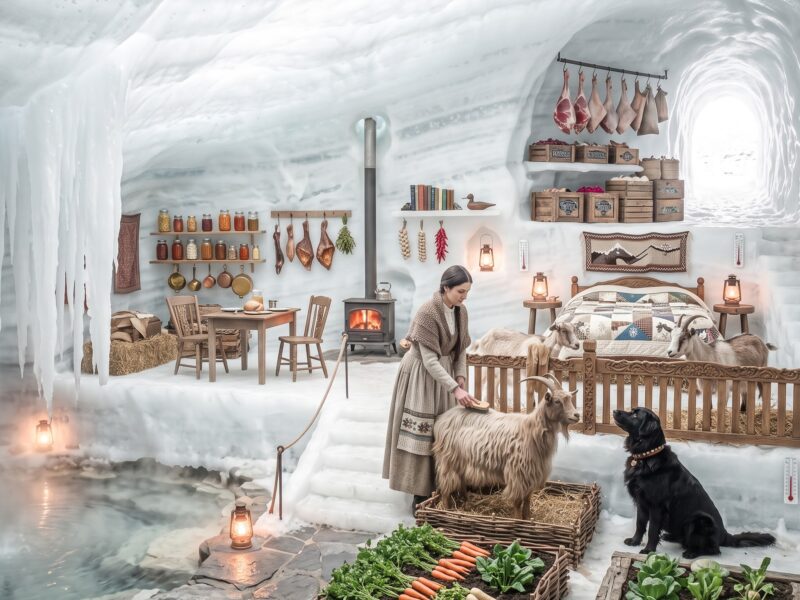
Exiled at 13 She Built a Hidden Farm Inside an Ice Mountain While the Town Froze Below
THE THAW AND THE TRUTH
The remaining eight weeks of winter passed in a fragile, highly engineered rhythm.
Not a single person under the age of forty died after the cave doors closed. Every child survived. Wren’s meticulous rationing, cross-referenced with her mother’s botanical notes on caloric needs, held the line against starvation.
Wren found herself watching a young orphan girl named Ruthie. She was eight years old, fiercely protective of her younger brother, Levi. Ruthie would stand near the cave entrance on bright mornings, looking out at the snow with a patient, unshakeable waiting that resonated deep in Wren’s chest. Wren didn’t act on the feeling—attachment was a bill she wasn’t ready to pay—but she cataloged it.
The thaw came on the 23rd of March.
The ice cracked across the ridge lines with a noise like distant artillery. The survivors emerged from the tunnel in small groups, blinking in the blinding sunlight, looking like refugees from a war fought in a forgotten country.
Josiah Ackerman spoke the words they were all dreading. “We need to go down and see what’s left.”
Wren rode Ember down the slope with the second party. What they found in Providence Falls wasn’t damage; it was cancellation. The church steeple lay in three pieces across Main Street.
As the snow melted, the bodies emerged. Forty of them.
The survivors spent six days digging graves in the semi-frozen earth. The town preacher spoke over the dead in a quiet, broken voice. Wren watched the burials from the back of her gray mare, realizing that Providence Falls was over.
The grand storehouse, however, still stood. Intact.
Josiah shoved the heavy pine door open. The smell that rolled out was a physical wall of rot. The green pine had shrunk, allowing snow to pack into the seams. Moisture had reached the weevil larvae dormant in the crop. The grain was a shifting, gray-brown paste.
Vance walked in behind Josiah. He stared at the ruined wheat. He turned and walked out without saying a word, every step pulling him further away from the man he used to be.
On the 6th of April, the 101 survivors gathered inside the roofless shell of the church. The pews had been dragged into rough rows.
Wren rose from the second row. She walked to the front, carrying her leather satchel. She pulled out a small, worn green journal—her father’s survey log.
She opened it to a page marked with a red ribbon and read aloud.
“2nd of February, 1886. Confirmed extensive mica deposit along the North Face bench. Quality suitable for industrial glazing and electrical insulation. Thickness of principal seam estimated at four to seven feet. Preliminary market value conservatively projected at $80,000. Preparing extraction permit paperwork for filing.”
Wren snapped the journal shut. She looked directly at Silas Vance in the third row.
“You didn’t send me to that mountain for a stolen apple, Silas Vance,” Wren said, her voice ringing clear against the ruined walls. “You sent me to that mountain for the seam my father had measured. You read this journal when you did the tax valuation on my parents’ estate. I know, because you left a fingerprint of ink on the margin.”
The silence in the church was absolute.
“You sent a child of thirteen to freeze on a granite bench because you wanted the claim to revert to the territory when she died,” Wren continued, relentless. “That is the shape of what you did. And every soul in this room deserves to know it before we decide what happens next.”
Vance sat with his hands flat on his thighs. He didn’t look away. When he spoke, it wasn’t the booming voice of a mayor. It was the hollow truth of a broken man.
“She is telling the truth,” Vance said quietly. “Every word. I engineered the exile because I wanted the seam. I calculated that a girl on that face in winter was a problem the mountain would solve for me at a cost I could afford.”
He looked around the room at the gaunt, haunted faces of his former town. “I owe every soul who buried a child in the last month a debt I cannot pay in a single lifetime. I am willing to spend what remains of mine trying, if this community will permit me to stay. If not, I will walk south in the morning.”
Josiah Ackerman stood up. He looked at Vance, the man who had ordered him to build a faulty storehouse. Then, he looked at Wren.
“The girl saved my son from a snowdrift,” Josiah said loudly. “She fed a hundred of us from a pantry meant for one. She held back nothing. And when the man who sent her to die crawled to her door, she opened it.”
Josiah turned to the congregation. “I say the man stays. I say we bind him to us with work and time. I say we do not send anyone away who is willing to spend a life earning the right to remain.”
Sarah Ackerman stood up. Then the widow. Then the preacher. One by one, the survivors rose to their feet, casting their vote for mercy over vengeance.
Wren watched them rise. She didn’t smile. She just nodded.
“Good,” Wren said, taking command of the room. “Then we begin. We do not rebuild here. This valley killed forty souls with houses built wrong for the climate. We move to the base of Iron Ridge. We anchor to the geothermal sources. We build into the hillside, using the earth as insulation. We do not repeat Providence Falls. Providence Falls is over.”









