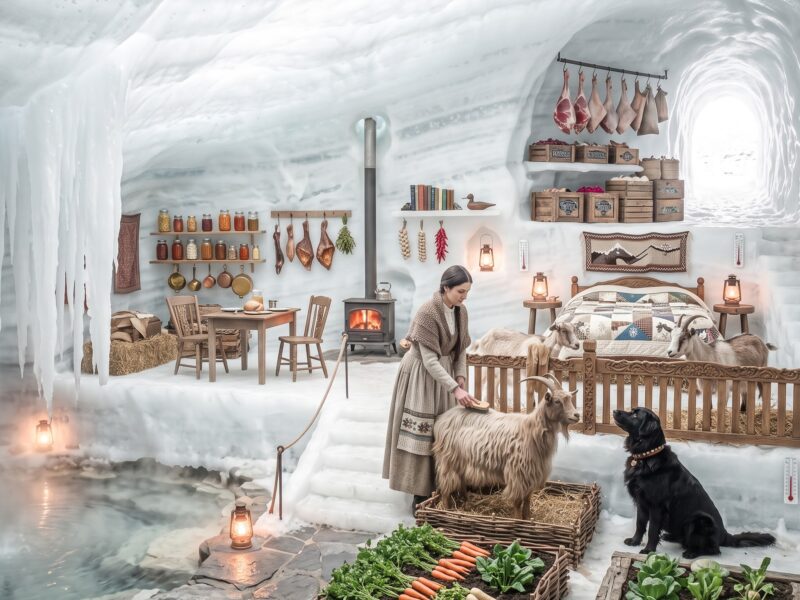
Exiled at 13 She Built a Hidden Farm Inside an Ice Mountain While the Town Froze Below
THE STATE OF WYOMING
On July 10th, 1890, Wyoming officially became the 44th state in the Union.
Isaac brought the newspaper up from Cheyenne, grinning as he handed it to Wren. She unfolded it, reading the headline. But it was the second page that caught her eye.
The territorial legislature had formally approved her petition, striking Providence Falls from the map entirely. The new settlement was officially registered as Halloway’s Hollow, with Wren Halloway listed as the founder.
She didn’t care about the glory. She cared about the strike-through of the old town. It was an honest end to an honest failure.
The summer of 1891 arrived warm and prosperous. The terraced gardens produced massive surpluses, which Isaac sold in Cheyenne along with the cut mica. Money circulated, distributed by the hours-worked ledger Sarah Ackerman meticulously maintained.
One afternoon in mid-July, Silas Vance walked with Wren to the base of the ridge. They stopped at a low granite bench where Wren had set two headstones for her parents.
Elias Halloway. Margaret Halloway. The mountain taught me to listen.
Vance stood with his hat clutched to his chest. He looked at the names for a long time.
“I am not going to live long enough to repay what I took,” Vance said, his voice carrying a flat, brutal honesty. “I know that as clearly as I know my own hand. I want you to hear me say it at your parents’ feet, so neither of us is confused about the arithmetic.”
Wren looked at the man who had once sentenced her to die.
“No one who does real harm gets to repay it in a single lifetime, Silas,” Wren said quietly. “That is not a mercy the universe extends. The most any of us can do is spend our remaining years walking in the direction of the debt, rather than away from it.”
She met his gaze. “You are walking in the direction. That is not nothing.”
“It is not enough, either,” Vance replied.
“Both things can be true. I have made my peace with both of them being true.”
They stood together in the sun for another minute—two people bound by a history neither would ever pretend was anything else.
Then, they turned and walked back toward the Hollow.
Ruthie and Levi came running up the path to meet her, breathless with news about a meadowlark they had found. Ember lifted her gray head from the pasture grass. The mica windows of the earth-sheltered homes caught the golden late-afternoon sun, and the smoke from the community hearth rose in a patient, unshakeable column into the Wyoming sky.
Wren stopped at the crest of the rise. She looked back at the cold face of Iron Ridge. The small tunnel entrance she had carved at thirteen was still visible high on the granite wall—a doorway to a story she had survived, and had not, in the end, needed to walk back into.
She lifted her hand toward the mountain. Not in farewell, but in the way a student lifts a hand to a teacher who has finished the lesson and left the room.
They built for the world they wanted, Wren thought, looking down at the thriving, unshakeable settlement. I built for the world as it is.
She took Levi’s hand in her left, and Ruthie’s hand in her right, and walked down into the Hollow, where the evening meal was already being ladled from the community pot, exactly as she had always meant it to be.









