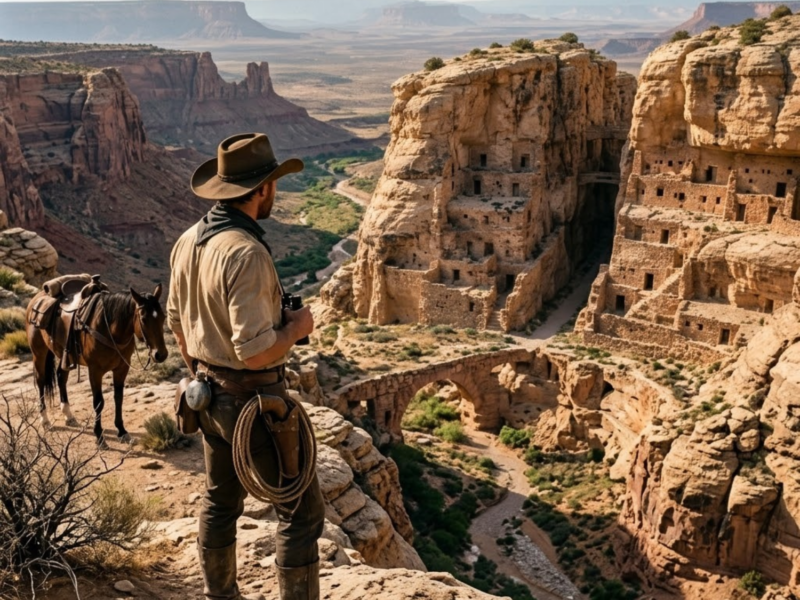
He Followed an Ancient Road Across the Mesa—It Ended at a City Cut Into the Stone
The Worthless Rock
The call from the county clerk came the following morning, delivered by a freckled boy on a sweating mule who couldn’t have been more than ten years old. The county had a package for Mr. Joseph Tanner—left in trust years ago and finally dragged out into the light during a routine shelf-clearing.
Joseph walked up to the courthouse through a thin skin of frost that glazed the boardwalk planks. The clerk slid a rusted tin box across the scarred counter with the practiced air of a man eager to rid himself of a nuisance.
Inside the tin were three things:
-
A folded square of oiled paper, creased so many times the folds were worn down to gossamer threads.
-
A deed, officially stamped and sealed, for a quarter section of ground on the eastern lip of Red Mesa, filed under the name of Thomas Reed.
-
A short note written in pencil in a careful, lopsided hand:“If anything happens to me, Joe, this goes to you. You were the only one who ever took me at my word.”
Joseph stood motionless for a long time, the pencil-marked paper heavy in his fingers. Thomas Reed. The thin, quiet ranch hand who had worked a single summer at the old Tanner place, sleeping in the hayloft, speaking only when spoken to, and vanishing one Tuesday morning without a word of farewell. Everyone in Dry Fork had assumed he drifted south; everyone had forgotten him within a year.
The clerk cleared his throat, breaking the silence. “That land ain’t worth the paper it’s printed on, Tanner. Nothing grows up on the Mesa. No water. Just rock.”
Joseph didn’t answer. He folded the oiled square carefully, slipped the deed beneath his coat, and walked back out into the cold.
By noon, the story was loose in the saloons. Harlan Boone stood at the long mahogany bar with two of his hired hands, laughing loudly until he had to set down his whiskey glass. “Tanner’s inherited a cliff!” Boone announced to the room. “Reed left him a slab of granite to starve on. Lord, I’d pay good money to watch him try to run a cow up a sheer wall.”
The laughter followed Joseph down the street. He didn’t turn his head. He didn’t quicken his pace.
He went to the mercantile, bought a sack of cornmeal, a quarter-pound of coffee, a tin of lucifers, and a short coil of light rope with his last four dollars. He counted out the copper coins on the counter without looking up. The storekeeper counted them twice to be sure, then slid them back across the wood with two fingers.
“On the house,” the storekeeper murmured, staring fixedly at the wall behind Joseph. “For your father’s memory.”
Joseph touched his hat brim and walked out.
Outside, the October sun had slipped behind the hills, leaving a silver rime across the wagon roofs. As he tied his sack behind Pike’s saddle, a dry, papery voice spoke from the shadows beside the water trough.
“Boy,” it said.
Joseph turned. It was old Mose Pelletier, a man who had been ancient when Joseph was a child, sleeping wherever the weather permitted him to drop his bones. Some claimed he had scouted for the army before the territory even had a name. He sat now with his hands folded over a willow walking stick, his eyes the color of weak tea, watching Joseph the way a hawk watches a distant field.
“Boy, come close.”
Joseph stepped over. Mose didn’t look up at him; he kept his gaze fixed on the dust between his boots. “The road out there was walked before,” the old man rasped. “By people who knew what the stone would give. If you go up, go slow. The mesa keeps what it is owed.”
Joseph waited, but more did not come. The old man closed his eyes as though the effort of speech had drained his marrow, and within a heartbeat, his breathing settled into the shallow regularity of sleep.
Joseph mounted Pike and rode two blocks before Harlan Boone stepped out from the swinging doors of the saloon, planting himself squarely in the middle of the street with his thumbs hooked in his belt.
“Tanner,” Boone called out, grinning. “I’ll give you ten dollars for that paper. Save you the long ride to your grave.”
Joseph didn’t pull the reins. He steered Pike around them at a slow, steady walk.
“Twelve,” Boone shouted louder, his pride prickling at the silence. “Twelve and a bottle of rye. You hear me, Tanner? That’s charity. That’s more than Reed’s bones were ever worth.”
Joseph rode on. Behind him, the laughter started up again, echoing down the empty street until the wind off the flats caught it and tore it into pieces.









