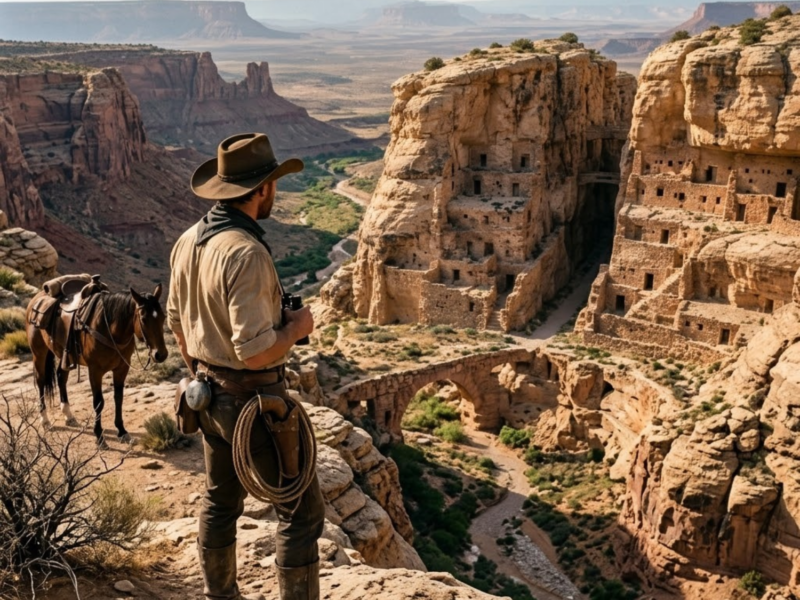
He Followed an Ancient Road Across the Mesa—It Ended at a City Cut Into the Stone
The Singing Stone
That night, Joseph lay awake on his narrow cot in the dark kitchen. The deed rested safely under the tin of salt beside his brother’s note, and the oiled map lay spread upon the table where he could see it by the dim light of the cooling stove.
Pike shifted restlessly in the corral outside. The iron stove ticked as its metal plates contracted in the midnight chill. Joseph stared up at the whitewashed ceiling timbers his father had hewed, thinking of a thin eighteen-year-old boy stacking hay in the loft who had never once asked for anything he hadn’t earned.
Before the first pale streak of dawn touched the horizon, Joseph was in the saddle.
The ancient road showed itself only after an hour’s ride across the desolate flats, and only to a man who was actively looking for its ghost. It wasn’t a road in the sense of the freight tracks leading down to the river; it was a faint, thinning indentation in the brush, a long, shallow groove in the caliche where no natural runoff had any business carving a path. It ran northeast, straight toward the pale, towering wall of Red Mesa that rose out of the prairie like the rusted hull of an ironclad ship beached a thousand years ago.
Unfolding the oiled map, Joseph matched a faint mark to a notched, wind-scoured boulder leaning off the trail. The map had been drawn with meticulous care; every crease and fold aligned with the harsh geometry of the land.
He rode all morning in absolute silence, broken only by the rhythmic crunch of Pike’s hooves and the screaming wheel-turn of a hawk riding a thermal above the cliffs.
By noon, the mesa dominated the entire eastern horizon, its sheer red face shadowed by long, vertical cuts that looked like the soaring buttresses of a cathedral left out in the desert to bleach and die. He stopped once to let Pike drink from a canvas bucket filled from his dwindling canteen. The old dun horse lipped the water, lifted his gray muzzle, and stared up at the towering rust-colored stone with the instinctive wariness of an animal facing a predator.
The road began to climb. And as it climbed, Joseph noticed something that quickened his pulse: the stone beneath Pike’s hooves had been worked.
Under a century of windblown sand and caliche grit lay unmistakable tool marks. Straight, deliberate edges where no natural erosion belonged. A wide ramp had been notched directly into the living rock at a steady, manageable grade that a heavy freight wagon could have negotiated with a stout team.
He didn’t stop. The sun was copper-low on his left shoulder when the trail finally crested the lip of the mesa.
Joseph reined in Pike and sat frozen in the saddle.
Before him, the top of the mesa opened out into a wide, flat, windswept plateau of red dust. At its far eastern edge, where the stone abruptly plunged away into a deep, hidden chasm, there stood… nothing.
No homestead cabin. No livestock corral. No sign that any human being had ever intended to dwell in this barren sky-realm. Just red earth, scouring wind, and the skeletal shadow of a cottonwood tree that had died standing upright centuries ago.
The clerk’s mocking words echoed in his skull: Nothing grows on the mesa. No water. Just rock.
Joseph made camp against the dead cottonwood trunk, building a small ring of flat stones to contain a fire of dry brush. He watered Pike from his last canteen, which felt frighteningly light, and ate a meager supper of cornmeal softened in bitter coffee.
As darkness swallowed the plateau, the wind died down, and the true voice of the mesa emerged.
Out past the lip of the precipice, deep down in the hidden gorge where the shadows pooled, Joseph heard a sound that defied the desert silence. It wasn’t the wind, nor was it the rustle of dry brush. It was a low, steady, resonant musical note held deep within the bowels of the earth—the exact sound of a heavy ceramic jug held beneath a rushing stream of mountain water.
He listened for hours. The note never wavered. He pulled his hat down over his eyes and slept with that ancient, subterranean hum vibrating beneath his back, as if the mesa itself were breathing in its sleep.









