He Followed an Ancient Road Across the Mesa—It Ended at a City Cut Into the Stone
The Key of Thomas Reed
With the first gray light of dawn, Joseph walked to the edge of the plateau and peered down into the gorge.
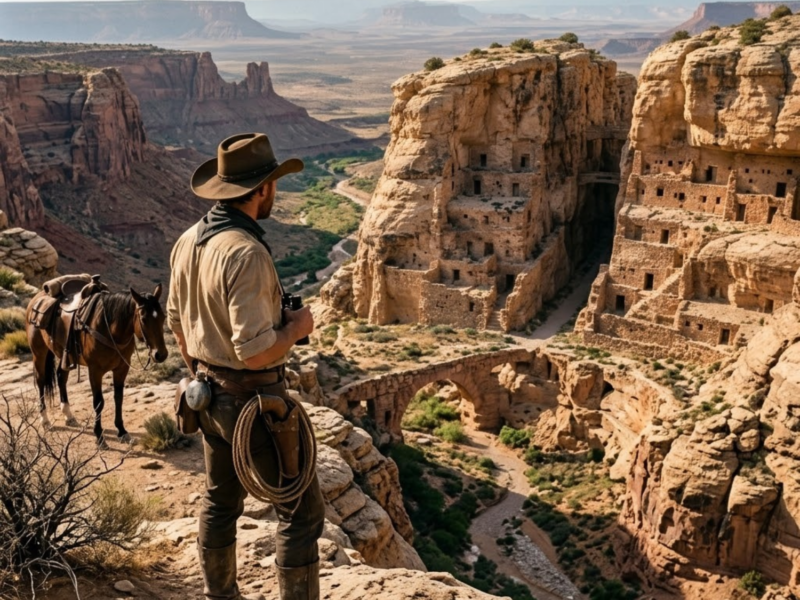
It wasn’t a natural gorge at all. It was a colossal, man-made fracture in the stone that curved inward like a half-closed hand, and the far wall of that massive stone amphitheater was architectural.
Even in the cold morning twilight, sharp geometric shadows lay across the cliff face. Rectangles. Door lintels. A neat, disciplined row of square window openings cut at uniform heights. A grand stone staircase was chiseled diagonally down the sheer face in a grand descent that no flash flood or glacial slide could ever accidentally carve.
High above the doorways, deeply pecked into the red sandstone, was a massive symbol the size of a wagon wheel: two concentric circles crossed by a rigid vertical line, framed by radiating sun-spurs.
The memory surged up through Joseph’s chest like cold well water. Twelve years ago in the Tanner hayloft, Thomas Reed had been idly scratching that exact mark into a cedar shingle with a horseshoe nail. “A door my people used to know,” Reed had murmured.
Joseph walked back to camp slower than he had come. Pike watched him approach, ears flicking forward. Joseph patted the horse’s neck, gathered his gear, and approached the head of the stone staircase.
He didn’t run. A man who rushes blindly into mysteries usually leaves his wits behind on the trail.
Tying Pike securely to a stout iron ring sunk directly into the living rock—an iron ring thin as paper with age, but immovable—Joseph checked his pistol, took a length of light rope, and began his descent down the ancient steps.
The sandstone treads were worn smooth, deeply cupped in the center by the passage of countless boots across generations. Halfway down, he looked back; the plains below looked like an ocean seen from the crow’s nest of a ship.
At the bottom, the stairs emptied onto a wide, perfectly level stone plaza. Dark, silent doorways yawned off into subterranean blackness in three directions. Above the central portal, the sun-wheel emblem watched him with unblinking permanence.
Joseph struck a match, ignited a short pitch-pine torch, and ducked inside.
The corridor ran straight for ten paces before expanding into a vast, pillared hall with stone benches carved natively from the floor and soot-stained wall sockets where resin torches had once burned. There were no human bones, no signs of violent destruction, no scattered wreckage of hasty flight. Whatever civilization had built this place had abandoned it deliberately, leaving behind only the husks of their masonry.
Following the low, watery humming sound, Joseph navigated a series of smaller chambers—storerooms that still smelled faintly of ancient grain husks—until he stepped through a low portal into a vaulted, cathedral-like cavern.
In the center of the chamber lay a dark, perfectly still pool of crystal-clear water, fed by a gentle, underground spring bubbling from the far wall.
Kneeling on the stone ledge, Joseph cupped his hands and drank. The water was icy, pure, and rich with the clean taste of iron and deep stone.
On a narrow rock shelf directly above the pool rested a small, flat metal tin wrapped securely in oilcloth.
Climbing the ledge, Joseph lifted the tin down. Inside, resting beneath a brittle, fossilized sprig of sagebrush, lay a leather-bound notebook, a spare map identical to the one in his shirt, and a final letter from Thomas Reed.
The notebook was an agricultural and hydrological ledger. Reed had meticulously recorded the pool’s water levels through four consecutive seasons, mapping every room, noting which chambers were suited for sleeping quarters, kitchens, or grain storage.
And the letter… the letter said everything the dry court clerk could never understand:
Joe, I never had a real brother. You sat me down for a hot meal when I had no coin, and you called me by my name when the rest of the county treated me like a stray dog. The water here is pure, the stone is sound, and there is rich grama grass down on the lower river bench if a man knows how to drive cattle through the draw. I meant to show you this place myself. Since I couldn’t, I’m giving it to you. The mesa keeps what it is owed, Joe. And it owes my people a hand that will not sell out. I believe that hand is yours. — T. Reed
Joseph folded the paper, his vision blurring slightly. He sat in the silence of the underground spring, the torch guttering low in his fist, and realized he hadn’t inherited a worthless rock.
He had inherited a kingdom.









