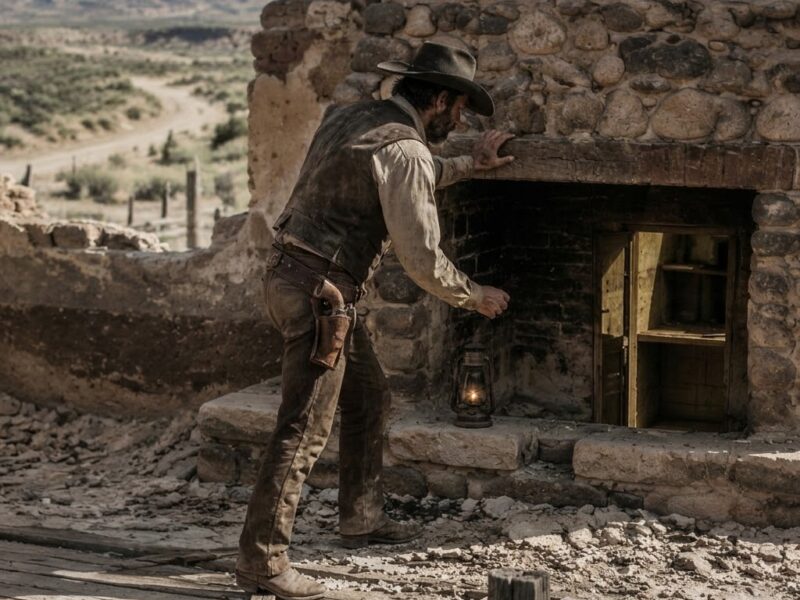
He Was Too Old to Ride—So He Bought the Ruined Ranch and Found the Room Behind the Fireplac
The Valley of Cold Creek
The valley opened before him like a hand uncurling.
It was quiet with an ancient, heavy silence. The pines stood dark and shoulder-to-shoulder on the steep ridges, while Cold Creek itself ran a gray-green course down the center of the bottomland, spilling over pale, water-rounded stones. Half a mile up a low rise, sitting with its back hard against the timberline, was the cabin.
Even from a distance, Walter could see the structural betrayal of time. The ridge of the roof sagged in the middle where two internal poles had snapped under an ancient snow load. A plank shed leaned drunkenly toward the earth, propped up by a dead pine trunk, and the corral rails had spilled into the high grass like broken bones.
Yet, as he drew the buckskin to a halt and sat studying the layout with the critical, unforgiving eye Anel Puit had beaten into him decades ago, he saw what others had missed.
The main walls were solid—thick lodgepole pine, saddle-notched at the corners, nine courses high. The massive chimney of creek stone at the north gable stood as straight and proud as a monument. The soil in the bottomland was dark, rich with decades of rotted leaf-mold and alluvial silt. There was water within a fifty-yard carry, and the winter wind, though fierce, would break harmlessly against the granite wall of the mountain behind the structure.
“Well,” Walter said softly to the buckskin.
He rode down into the yard, dismounted with a careful favoring of his bad knee, and walked the perimeter. Inside, the cabin smelled of damp earth, mouse nests, and long abandonment. The puncheon floorboards were cupped and rotting where the roof had leaked, and a drift of dry pine needles lay pillowed in the southern corner.
He walked to the massive stone fireplace at the north gable. It was six feet across at the base, its hearth worn smooth by generations of unknown footsteps. The firebox was choked with old ash and soot, and running vertically down its back wall was a jagged, angry crack from the lintel to the hearthstone—the calling card of an old fire built too hot against freezing rock.
Walter squatted on his good knee, pressed his palm against the mortar, and tested the stone. It felt cold, ancient, and unyielding.
“This will do,” he muttered.
The next morning, he rode down to the county seat, counted out two hundred and eighty-seven dollars and forty cents in hard coin and crumpled bills onto the wooden counter of the courthouse, and signed his name to a brittle sheet of paper. When he walked back out into the noon sun, he had twenty-three dollars and sixty cents left in his pocket, a pocketful of nails, a cross-cut saw strapped behind his saddle, and a piece of ground with his name on it for the first time in his forty-two years on earth.









