He Was Too Old to Ride—So He Bought the Ruined Ranch and Found the Room Behind the Fireplac
The Secret Behind the Hearth
Back at the cabin, Walter set about the grueling labor of reclamation. Before he could sleep under a tight roof, before he could cook a rasher of bacon over a steady blaze, he had to clear the hearth.
In the fading amber light of his second evening, he knelt before the stone firebox with a piece of split shake for a scraper and an old feed sack for a dustpan. He scooped out the ash, cleared the remnants of an ancient bird’s nest from the throat of the flue, and exposed the full length of the crack running down the back wall.
Curious, he pressed his thumb into the fissure. The stone gave slightly—not by much, perhaps the thickness of a fingernail, but enough to signal a void behind the masonry.
Frowning, Walter pulled the bone-handled Barlow knife from his trouser pocket, flipped open the main blade, and carefully traced the jagged line of the crack. Old lime mortar, turned chalky and soft by decades of temperature swings, crumbled away in a dry gray cascade.
Behind the mortar was not more stone. Behind the mortar was air.
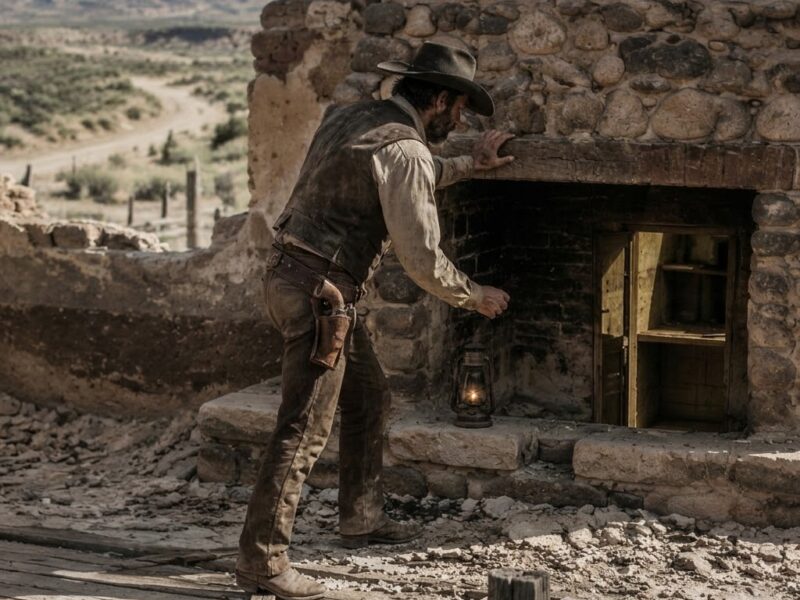
Working quickly by the flickering, yellow light of a kerosene lantern, Walter began to dismantle the back wall of the firebox. He removed the stones one by one, laying them out in a precise, numbered sequence on the puncheon floor just as Anel Puit had taught him to lay out the parts of a disassembled bridle.
There were seven dressed stones in the inner course. Behind them lay a secondary backing of dry-laid granite, and behind that was a cavity—a small, dark chamber hollowed out of the massive thickness of the chimney base and the earthen bank behind it. No bigger than a wardrobe, no taller than a crouching man.
Walter held the lantern forward.
Resting on a clean floor of dry cedar shakes sat three distinct items: First, a tin box the size of a family Bible, painted a mossy green that had long since oxidized. Second, a folded quilt pieced together from small squares of blue and brown cotton. Third, resting squarely on top of the quilt, a small wooden box tied shut with common brown hemp string, accompanied by a folded sheet of paper.
He did not rush. He pulled the paper out first, unfolded its stiff, browning creases under the lantern light, and read the faded ink.
To whoever finds this,
My name is Hetti Anne Marlo, and I lived in this cabin twenty-two years. My husband John Marlo built it in the spring of the year we came into this valley, and he died in the second winter of a lung fever, and I stayed on. I kept a milk cow and a garden, and I took in sewing for the freighters, and later I was midwife to the women on this side of the divide…
We had one child, a boy named Thomas, who was born in this cabin and died in it in his fourth year of a fever I could not turn. He is buried under the biggest pine behind the house where the ground is soft in April.
I am writing this in my sixty-eighth year, and I am going down to my sister in Kansas because I cannot cut wood any longer, and I will not be a burden on the neighbors… I am leaving this cabin to whoever comes and stays. I have hid it because the county will come and take it if they know, and I would rather it went to a person than to a paper.
In the tin box is one hundred and forty-two dollars in coin and bills which I saved out of the sewing and the midwiffery over many years, and which I meant for Thomas when he grew. And since he did not grow, I am leaving it for you. In the wooden box is a ring that was my mother’s… If you are reading this, I hope you are tired, and I hope this is a place to be tired in.
— Hetti Anne Marlo, this 17th of October.
Walter sat back against the warm-smelling brick of the outer chimney, the letter resting on his knees. He looked into the dark recess of the hidden room for a long time, listening to the wind sighing through the pine boughs outside.
When he finally opened the tin box with the tip of his Barlow knife, the money was there—exactly as she had written, one hundred and forty-two dollars counted out in clean, folded bills and cloth-wrapped coin rolls. In the small wooden box lay a plain silver ring, worn thin at the band.
Walter reached into his pocket, pulled out his own knife, and laid it gently on the hearth beside Hetti Anne’s relics. Two lives separated by decades, bound by the simple, stubborn geometry of survival in an empty valley.