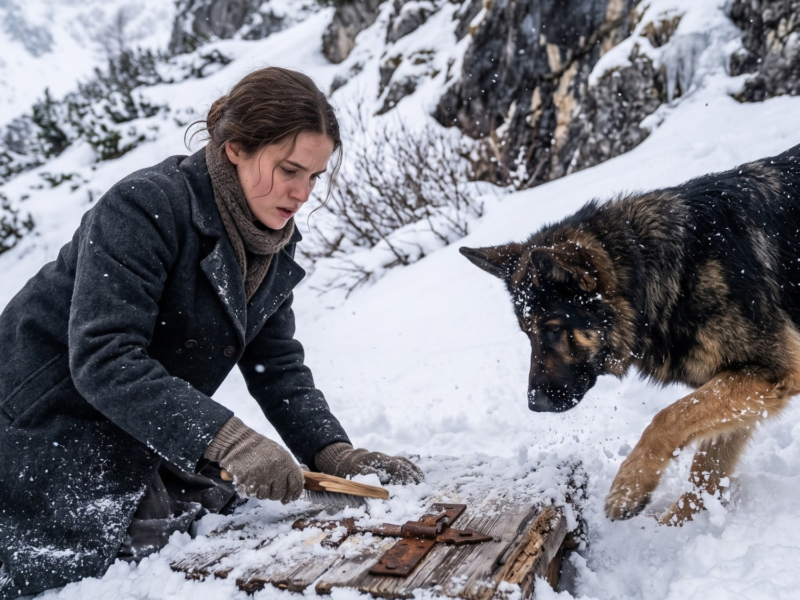
Her Dog Stopped Cold At The Hillside — Then She Found A Hidden Shelter Stocked With Enough Food…..
Her Dog Stopped Cold At The Hillside — Then She Fo…
Her Dog Stopped Cold At The Hillside — Then She Found A Hidden Shelter Stocked With Enough Food…..
The wagon rut cut deep through the frost-hardened road that ran along the eastern edge of Sweetgrass Hollow. Any rider passing through the Wyoming Territory in the last week of October in the year 1886 had good reason to slow his horse when he came within sight of the Ainsworth place.
From a distance, there was nothing outwardly wrong with the homestead. It stood as it had stood since the days when Silas Ainsworth’s father drove the first cottonwood post into the black earth: forty feet long, twenty-eight feet wide, its gambrel roof weathered to the comfortable, dusty color of an old saddle.
What made a man pull his reins, however, was what waited inside those wide-open barn doors.
Something curved, something metal, a dull silver arc catching the last of the autumn sunlight like the back of a Leviathan half-buried in shadow. It looked, to the eye of any decent Wyoming rancher, like a strange, metallic structure had been swallowed whole by a wooden one, and neither could quite decide which was meant to be the house.
A cattle driver from Buffalo slowed his horse at that gate one afternoon, tipped his hat back on his head, spat a stream of tobacco juice into the dry ditch, and laughed out loud before riding on. A schoolmaster passing through toward the territory line stared for a full minute before shaking his head like a man rejecting a desperately bad hand of cards.
Neither of them knew—nor could have possibly known—that what stood inside that barn was the precise difference between a family walking out of the coming winter alive, and that same family being pulled from the ruins of a frozen, collapsed cabin come April. The people who laughed on that road in October would not be laughing in January. Some of them would not be laughing ever again.
Hattie Ainsworth was thirty-four years old that autumn, and she had been a widow for exactly six months. Silas had died on the eleventh of May while helping a neighbor drag deadfall pine from a draw north of the property. There had been a frayed rope, a massive log that rolled the wrong way, and a man crushed against the frozen ground before he could draw breath enough to shout.
The neighbor had ridden in with the news around dusk, hat twisting in his hands, his face as pale as skimmed milk. Hattie had taken the words the way she took most hard things: standing very still, one hand braced tightly against the log doorframe so her daughters wouldn’t see her knees give way.
She buried her husband in the small, windswept plot behind the cottonwood trees. She paid the undertaker in Ember Creek with the last of what Silas had put aside for spring seed, and walked back to the homestead with two little girls clutching her skirt and a crushing mortgage from the First Territorial Bank at Fort Custer that did not care in the slightest that she was now the only Ainsworth left standing over the age of ten.
The cabin was the primary trouble. The cabin had always been the trouble.
Silas had thrown it up in a frantic hurry in the summer of 1878 when they were newly married, working entirely alone because he was too proud to ask his father for a second pair of hands. As a result, the stone footings on the northeast corner had never sat true. A minor earthquake in July of ’81—one that most folks in the territory hardly noticed—had cracked the northeast pier clean through, and the wooden wall above it had begun to lean inward like a tired man about to fall asleep on his feet.
Worse still, the chinking had separated from the logs. There was a gap now—two full inches wide at its widest point—that let the wind come sweeping through the parlor with such enthusiastic violence that Hattie could hold a burning candle six feet from the wall and watch the flame lay itself completely flat against the wick.
A proper fix—the kind a man like Wendell Ashby would call proper—meant tearing out the broken pier, jacking up the sagging wall, laying brand-new stone footings, and completely re-chinking the entire northeast side. The professional estimate she had secretly obtained from a mason in Ember Creek came to four thousand dollars.
There was three hundred and forty dollars sitting in a rusted tin box under her bed.
She had counted it twice, in the weary way a person counts what they already know the answer to, hoping against hope that the arithmetic might miraculously be kind. It wasn’t.
The barn was the absolute opposite of the cabin. The barn was sound in every single joist and rafter. Silas’s father had built it in the 1840s out of the kind of white pine you simply could not buy anymore—seasoned timber that had already stood four brutal Wyoming winters before the first nail was driven. At the time he laid the first sills, he used wood so tight and hard that a fresh-driven steel nail rang against it like a struck church bell. It was post-and-beam construction, mortise-and-tenon joints at every intersecting meeting, and a gambrel roof that had successfully shed forty heavy snowfalls without so much as a millimeter of sag in the ridge line.
The only trouble with the barn was that it was a barn. It had forty-foot-by-twenty-eight-foot dimensions, with towering ceilings that vanished into the dim shadows above the hay loft, and wide-slat siding that let a man see daylight right through the gaps if he stood in the wrong place after supper.
You could no more heat that cavernous barn with a small cast-iron stove than you could heat an entire mountain pass with a single burning candle.
The dry, hacking cough started in the second week of October, and Hattie recognized it the microsecond it came out of her older daughter.
Winnie was nine years old, thin in the way children who love to run are thin, with her father’s straight brown hair and her mother’s sharp, gray eyes. The cough she brought back from the outdoor water pump one cold Wednesday morning was the exact same chest cough that had killed the Howerin boy the winter before last: deep, wet, and rattling from somewhere dangerously below the ribs. It was the kind of hollow cough a mother hears in the dark hours of the night and knows, without hearing anything more, that winter had brought a weapon.
Winnie tried desperately to hide it. She would clamp both small hands over her mouth and turn her face fiercely into her feather pillow, and Hattie would lie awake on the pallet across the room, listening to the muffled break of it, staring at the dark ceiling with her jaw set so hard her back teeth ached.
By morning, June was sick. June was still round in the face, still asking impossible questions that had no answers, and though June had not started coughing yet, Hattie knew the anatomy of contagion. The terrifying word yet sat in Hattie’s chest like a live coal that would not quite go out.
Related Articles

They Mocked the Widow’s Dirt Cellar—Then the Freeze Left Every Cabin Cold but Hers Warm
They Mocked the Widow’s Dirt Cellar—Then the Freeze Left Every Cabin Cold but Hers Warm…

A Homeless Veteran and His German Shepherd Inherited a Ridge No One Wanted — 35 Feet In, They Found
Chapter 1 / 7 A Homeless Veteran and His German Shepherd Inherit… A Homeless Veteran…

Neighbors Laughed When He Built A Cabin Inside An Old Barn—Until It Kept His Home 35 Degrees Warmer
Chapter 1 / 8 Neighbors Laughed When He Built A Cabin Inside An… Neighbors Laughed…

His Sod House Had No Woodpile in January – Until the Trains Stopped and the Town Came Begging
Chapter 1 / 10 His Sod House Had No Woodpile in January – Until t……

She Built Her Cabin Over the Woodshed and Never Burned Wet Wood Again
Chapter 1 / 8 She Built Her Cabin Over the Woodshed and Never Bu… She…

The Duke Abandoned Her on Their Wedding Day—Years Later, He Discovered What He Had Lost
Chapter 1 / 7 The Duke Abandoned Her on Their Wedding Day—Years… The Duke Abandoned…

He Wedged a Tiny A Frame Into a Crevice Before Winter and His Family Slept at 75°F While Town Hit
Chapter 1 / 7 He Wedged a Tiny A Frame Into a Crevice Before Win……

He Was Too Old to Ride—So He Bought the Ruined Ranch and Found the Room Behind the Fireplac
Chapter 1 / 5 He Was Too Old to Ride—So He Bought the Ruined Ran……

Settlers Laughed at His Underground Heat Recovery Duct — Until It Kept His Cabin 71°F Warmer
Chapter 1 / 9 Settlers Laughed at His Underground Heat Recovery… Settlers Laughed at His…

A Navy SEAL Built a Home Inside a Mountain—Then His Dog Warned Him Before the Storm
Chapter 1 / 5 A Navy SEAL Built a Home Inside a Mountain—Then Hi… A…