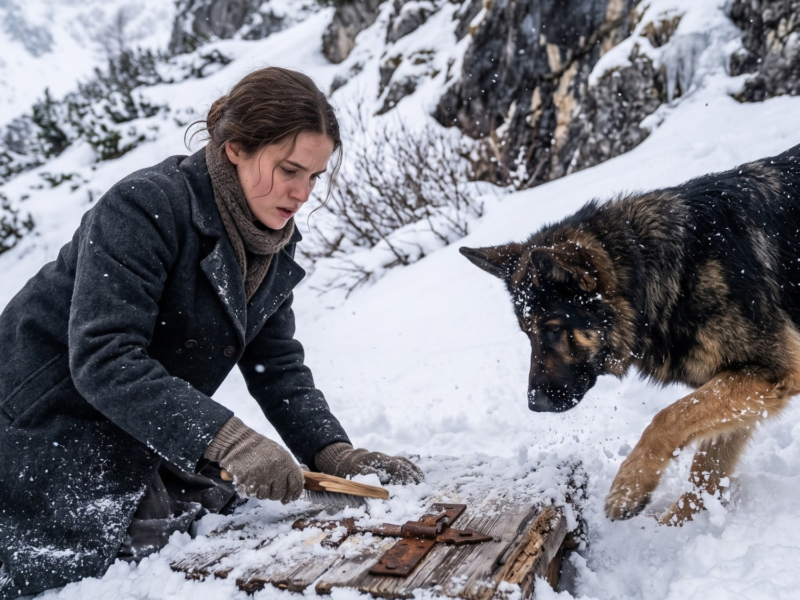
Her Dog Stopped Cold At The Hillside — Then She Found A Hidden Shelter Stocked With Enough Food…..
THE BASKET OF THE WORLD
There came an afternoon at the very end of October when the sky was the dull, dead color of pewter and the light had gone flat—the way it always did in the plains country in the hour before the temperature drops another ten degrees.
Hattie had been splitting kindling behind the cabin, and her fingers had gone completely numb inside her wool mittens. Rather than walk back into that leaning, freezing cabin with its whistling northeast wall, she ducked into the dark, shadowed safety of the barn to breathe air that at least did not have a direct pipeline to the biting sky.
She stood inside the wide double doors, watching her own breath come out in a column of pale gray, and she thought about her dead husband. She thought about her daughters. And she thought about how a human being manages to keep a family alive when the walls of the house are already colder than the raw ground beneath them.
The idea came the way all the truly useful ideas of her life had come: without ceremony, stepping up out of the quiet void of desperation.
She could not possibly heat the barn. Fine; she had already known she could not heat the barn.
But what if she did not try to heat the barn?
What if she built something small inside it? Something the size of a bedroom—something a single, efficient stove could keep comfortably warm—and let the massive barn itself act as the outer, defensive wall?
Two walls instead of one. A dead volume of trapped air between them. The barn to break the crushing force of the wind; the inner room to hold the life-sustaining heat.
She said the thought out loud into the empty, dim barn. The sound of her own voice startled her in the quiet. She said it again just to make sure she had heard it right, to test its structural integrity.
It was not a stroke of academic genius. It was a desperate, wild thought with a set of hard measurements attached, and she decided it was as close to a workable plan as she was ever going to get.
At first light on a Monday, Hattie hitched the buckboard, told Winnie and June that Mrs. Ashby’s oldest girl would sit with them for two days, kissed each daughter on the crown of the head hard enough to leave a physical promise there, and drove north toward Fort Custer Junction with three hundred and forty dollars folded tightly in a leather wallet resting against her ribs.
The road climbed out of the hollow through low sagebrush country and dropped down onto the windswept plain where the Union Pacific spur ran east toward the mainline.
Fort Custer Junction was a raw town made almost entirely out of the railroad’s leftovers: a wooden depot, a pungent stockyard, two raucous saloons, a hotel that perpetually smelled of coal smoke and boiled cabbage, and, stretching along the tracks on the north side of the rail yard, a long, fenced lot where the railroad piled everything it no longer needed.
A yardmaster named Akin took her money at the dusty office window and pointed a stubby finger through the wire-mesh gate.
There were iron rails, heavy oak ties, coupling knuckles, cracked bell housings, and a boneyard of discarded iron stove parts. And there, standing at the far end of the cluttered lot, sat three galvanized steel grain bins that the railroad had used for a temporary grain elevator down the line and no longer had any use for.
They stood in a row like enormous metal kettles turned upside down. Corrugated silver sides bolted together in overlapping panels. Conical roofs pitched at just enough angle to shed snow. Fourteen feet across at the base, nine feet high at the peak, with a small, hinged steel door cut into the side that a grown man could duck through if he stooped a little.
Akin quoted her two hundred and twenty dollars and looked at her over the tops of his wire-rimmed spectacles, as if waiting for her to laugh at the absurdity.
Hattie silently counted the worn bills onto the scarred plank of his desk, told him she would send her hired man with a heavy wagon at the end of the week to fetch it, and did not waste breath telling him what she meant to do with a grain bin. He allowed as how it would keep the rain off a fair pile of oats. She agreed that it certainly would.
Before she left the town, she walked two blocks over to Merrywell’s Hardware on the corner of Front and Depot. She bought a Charter Oak parlor stove straight out of the front window display—a twenty-two-dollar cast-iron model, small enough to fit through the narrow door of the grain bin, yet robust enough to hold a coal bed glowing through the night. She bought twenty feet of six-inch cast-iron stovepipe, four elbow fittings, a chimney thimble, a spool of heavy iron wire, a bag of coarse rock salt, and a tin of black stove polish.
Merrywell himself carried the heavy stove out to her wagon and set it in beside the pipe with the care a man uses for something that has cost him genuine effort. He looked at the stove, then at her, then at the empty, barren bed of the wagon, and asked in the cautious, polite way of a shopkeeper who does not want to lose a customer by being nosy, what she was fitting out.
“Just a small room,” she told him.
He nodded as if that answered anything at all, tipped his hat, and watched her drive south out of town with an expression that suggested he was already telling the bizarre story to his wife in his head.









