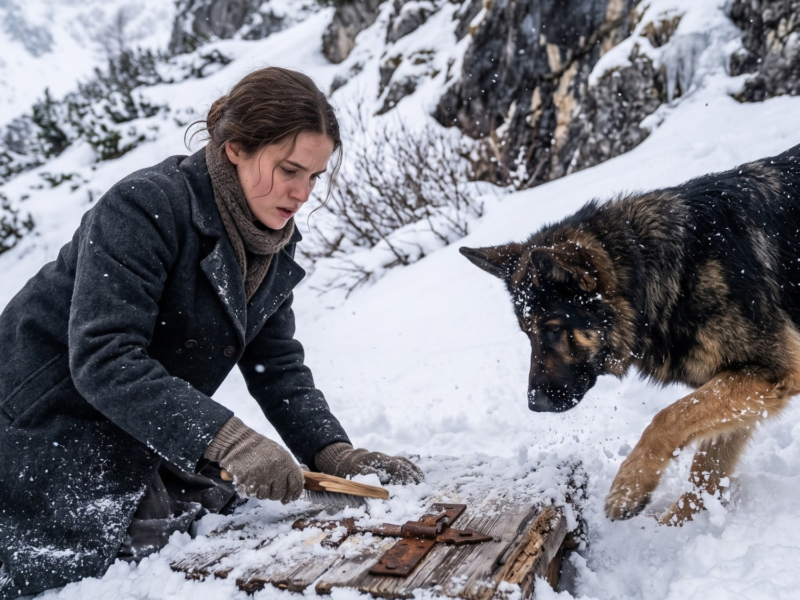
Her Dog Stopped Cold At The Hillside — Then She Found A Hidden Shelter Stocked With Enough Food…..
THE UNCONVINCED
Thaddius Boon rode into the yard on the second Wednesday of November as the sun was sinking behind the jagged peaks.
He was forty-five years old, a broad, formidable man with a thick red beard cut short, and a heavy way of standing with his weight canted onto his back leg that made him look as if he were always about to pack up and leave. He had known Silas since both of them were boys running wild in the Powder River country. He had ridden with Silas one summer before either of them was married, and he had been the second man on the scene the day the heavy log rolled over his old friend in May.
Thaddius owed a quiet, gnawing debt to the memory of Silas Ainsworth—a debt he had not been given the chance to settle before the accident, and it bothered him in a way he did not quite know how to name or resolve.
He tied his lathered horse to the corral rail, walked deliberately to the open double doors of the barn, and stopped dead on the threshold as if he had come up against an invisible physical fence.
The silver grain bin stood before him in the last slanting rays of daylight. The stovepipe rose out of its gleaming crown and vanished up into the gloomy shadows of the gambrel rafters. The neat quarters of split cordwood ran around the base of the metal cylinder like the concentric walls of an ancient maze.
Thaddius stood without moving for what he thought must have been a full minute. When he finally spoke, his voice was quiet—the way a man is quiet when he does not trust himself to speak loudly, for fear of breaking a delusion.
“That is a tin can inside a wooden box, Hattie,” he said, shaking his head slowly. “You are going to freeze to death in there, and those two little girls with you.”
Hattie had been kneeling by the stove door inside the bin, setting the first kindling for a test burn. She stood up slowly, wiped her smudged hands on her work apron, and walked across the barn floor to face him across the threshold.
She was not angry. She had known someone would say it. She had known who would say it. And she had known how it would land.
“Maybe,” Hattie said, her voice level and steady. “But I will freeze significantly slower in here than I will out in that leaning cabin.”
That single sentence opened his mouth, and then instantly closed it. He looked at the towering stovepipe. He looked at the stacked cordwood. He looked at Hattie’s unyielding eyes, and he saw a woman who had crossed a mental bridge he couldn’t even see.
He touched the stiff brim of his hat, turned around without another word, mounted his horse, and rode back down the ruts into the gathering dusk.
She watched him go against the red band of the western horizon. And she felt in her chest the particular grief of losing something she had not known she still had: the last neighbor who might have taken her side without making her earn it first.
Word traveled fast. It was one of the few crops that grew with terrifying reliability in Sweetgrass Hollow.
The story of the widow’s tin can spread from the mercantile counter to the church vestibule, and from there to the blacksmith’s anvil. By the second week of November, half the county had heard some version of it, and no one had contradicted it.
Prudence Whitaker did not repeat gossip in the technical sense; she made public observations, and she made them from the very front row of the Methodist church.
“I do not judge,” Prudence began one Sunday after services, using the phrase that always preceded a merciless execution. “But when a woman has two little dependent girls, perhaps aggressive pride is not the precise thing to lean on when the thermometer drops.”
She didn’t say the name Hattie Ainsworth out loud. She didn’t have to. Every single person sitting on the wooden pews knew the target of the sermon.
The Reverend Ephraim Kohls listened from the altar, stroking his chin. He was a good man—a slow-spoken widower from Ohio who had come to the territory ten years earlier to serve a shrinking congregation. He liked Hattie. He had baptized both her girls. He believed the words of Christian charity, but he also lived in a world where hard arithmetic dictated survival.
On the 21st of November, the reverend drove his modest buggy out to the Ainsworth place. He brought a smoked ham on the seat and a burlap bag of canned peaches and homemade preserves.
He stood in the barn door with his heavy wool hat in his hands, looking at the silver drum, looking at Hattie. He cleared his throat.
“We are praying for you, Hattie,” he began, and his voice caught slightly before he steadied it. “And if you need a place for the winter, there are three families in the congregation who would take you and the girls in without a single question. Warm beds, hot meals, companionship for the little ones. You would not need to answer for anything.”
Hattie took the heavy ham from his hands. She thanked him for it, and for the preserves, and for the bitter trouble of the long drive. But she did not accept the offer of refuge.
“We are staying right here, Reverend,” she said gently.
He looked at her for a long, searching moment. He saw the absolute granite in her eyes. He nodded, tipped his hat, and drove his buggy back down the winding trail.









