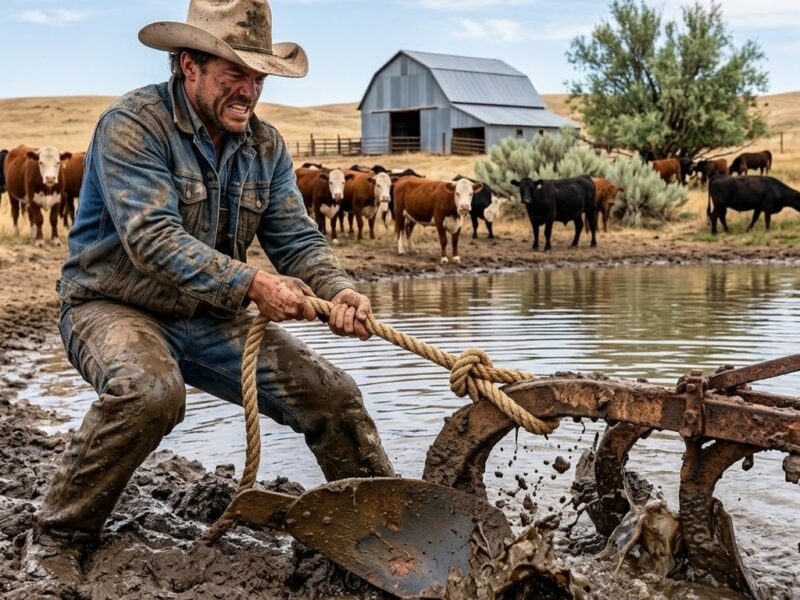
His Cattle Refused to Drink From One Side of the Pond — Then He Found What Was Buried Below
The Old Foundation
Daniel left the rope exactly where he found it. That took more discipline than he cared to admit; every instinct of a man who spent his life fixing broken things screamed at him to haul it up with the tractor winch.
Instead, he tied a strip of bright orange plastic marking tape to a cottonwood branch and walked back toward the barn.
He had good reasons not to be reckless. The pond wasn’t scenery; it was survival. The house well could supply the kitchen, the bathroom, and the milk shed, but watering twenty-three head of cattle from groundwater through another six weeks of a dry September would push the electric pump harder than Daniel cared to trust. Hauling water in a tank-wagon was worse—he’d already called the co-op for prices, and the numbers on his kitchen legal pad were terrifying.
If the drought held, he would have to sell part of the herd. Six cows first, maybe eight. And those weren’t anonymous numbers. Some came from bloodlines his father had started twenty years ago, carefully selected for bone and hardiness. Selling them because of one brutal season felt less like business and more like amputation.
His father used to call the pond the farm’s savings account. “You ignore it when times are good,” Thomas Mercer used to say, leaning against the corral rails with a cup of black coffee. “Then one day, it’s the only thing keeping you alive.”
That afternoon, Daniel returned to the bank with a pair of leather work gloves and a long fiberglass fence pole. The cattle were drinking again—all twenty-three clustered on the east side, leaving the west side dead and silent.
Daniel walked west, knelt by the rope, and began to probe the water with the pole.
Mud. Mud. Clink.
He poked again. Clink. Metal. Something broad and flat was buried less than two feet beneath the muck. He moved the pole farther out. The hard surface continued—three feet, then four feet. Whatever was down there wasn’t an old bucket or a discarded plow disk. It was too large, too geometric.
He lifted the rope again, gingerly. The line tightened. A few bubbles rose, followed by a faint silver thread of current. Daniel dipped his fingers into the water near the line. It was cold—noticeably colder than the tepid, sun-baked soup of the rest of the pond. He brought his wet fingers to his nose. It smelled of earth, iron, and deep mineral salt, but nothing rotten.
Behind him, a cow approached within fifteen feet, stretched her neck toward the western water, sniffed once, and turned away.
Daniel looked from the animal to the rope. Maybe the cattle weren’t just being stubborn. Maybe they were trying to tell him something.
Before sunrise the next morning, Daniel was back at the water’s edge with a shovel, a rake, two clean glass jars, and a pair of rubber chest waders that smelled of mildew.
The rope was where he’d left it. Following it into the shallows, the mud sucked greedily at his boots. Five feet out, the line vanished beneath a layer of black, anaerobic silt. He began clearing the area with his hands.
The first thing he uncovered wasn’t the large object itself. It was an iron ring, thick as a horseshoe, rusted a deep, scabby orange. The faded blue rope had been spliced directly through its eye.
Daniel scraped the rust away with his thumb. Beneath the ring, the edge of a flat, iron surface appeared. A lid. Or a plate. Something had been built here with intention, designed to cover an opening.
He gave the rope the smallest heave. The iron ring rose an inch; the plate moved with it, then stopped. From underneath came a low, wet sucking sound—the sound of a vacuum breaking. Daniel immediately let go. A cluster of dark bubbles raced to the surface, and the water around his knees turned instantly cloudy with black silt.
Then, through his rubber boots, he felt it again: a distinct, subterranean thrum.
Water. Cold water was pushing through the disturbed mud around the metal edge with real pressure.
Backing toward the shore, Daniel filled one glass jar from the normal eastern side of the pond. Then he waded back out and filled the second jar directly above the submerged plate. On the tailgate of his pickup truck in the pale morning light, the difference was subtle but real. The eastern sample was clear; the western jar quickly developed a swirling, gray-brown sediment cloud near the bottom.
Old farms hid mistakes—fuel tanks, chemical dump pits, broken machinery buried when hauling costs were high. A sealed metal lid could be covering something toxic that he had no business opening.
That thought stayed with him until he noticed the rope again.
It didn’t end randomly at the water’s edge. Another section of it disappeared beneath the damp roots of the cottonwoods farther uphill. Daniel pulled away several clumps of dead grass. The line continued through the mud, heading not toward the barns, but uphill toward the old pasture.
Fifteen yards beyond the present waterline, his boot struck something hard beneath the leaf mold. He kicked the dirt aside. One straight concrete edge appeared, then another.
An old foundation.
Daniel turned and looked downhill toward the rope, the submerged plate, the cold water. They weren’t separate pieces of random trash. Somebody had built a system here, long ago. And the rope was still tied to the heart of it.









