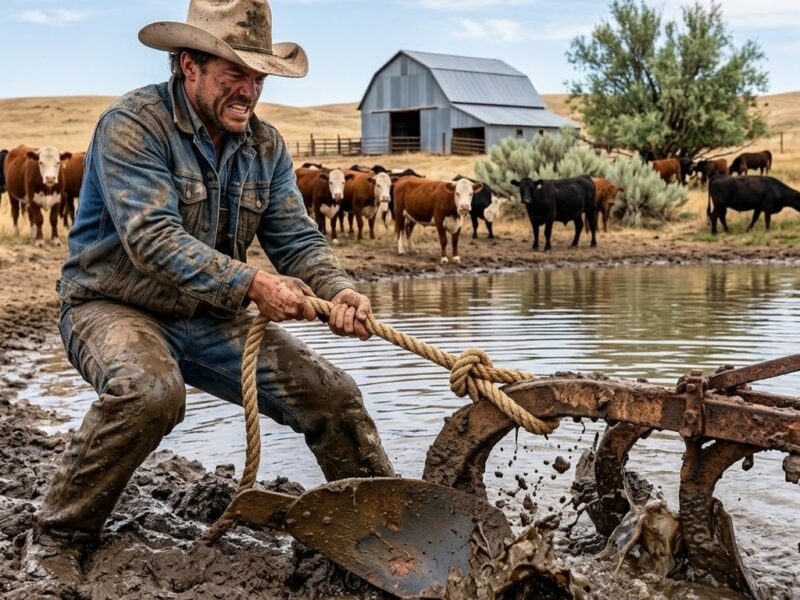
His Cattle Refused to Drink From One Side of the Pond — Then He Found What Was Buried Below
The Memory of Water
The foundation disturbed Daniel more than the buried metal, because somewhere in the dusty attic of his mind, he remembered it. Not clearly—more like the shape of a piece of furniture in a dark room.
A low stone building behind the pasture, a roof dark with rotting cedar shingles, his father telling him never to play near the damp masonry.
Daniel stood among the blackberry canes, trying to force the memory into focus. Thomas Mercer had died nine years ago, taking with him a thousand unwritten rules about how this land operated. For the first few years after the funeral, Daniel had been plagued by questions he wished he’d asked while there was still breath in his father’s chest. Eventually, he had stopped asking.
The farm was full of things Thomas had understood without maps: why one gate hung backward to catch the prevailing wind; why a certain drainage tile made an S-bend no county plat showed; why the west fence followed a boundary that made no logical sense. Daniel had inherited the land, but he hadn’t inherited the dictionary.
That afternoon, he called Walter Hayes.
Walter was eighty-one and had lived three miles down the creek road for his entire life. He had repaired threshing machines for Daniel’s grandfather, dug wells with dynamite, and remembered local history with an irritating, microscopic accuracy.
Daniel described the concrete foundation first. Walter went quiet on the other end of the line. Then Daniel mentioned the blue rope.
“Blue?” Walter rasped. “Used to be. Mostly gray now. Thick poly?”
“Yeah,” Daniel said, gripping the receiver. “You know about it?”
Walter exhaled a long, dry whistle through his teeth. “I might. Your old man left more of that mess than I figured.”
Twenty minutes later, Daniel was driving the old man across the pasture in his truck. Walter used a notched hickory walking stick to push aside the thorny canes. The moment his milky-blue eyes caught the concrete edge, he nodded slowly.
“Well,” Walter said softly. “There used to be a springhouse here.”
Daniel turned. “That pond’s been there forty years.”
“No,” Walter corrected, tapping the dirt with his stick. “Not like it is now. Back before your dad bought the north forty, a natural spring came right out of the side of this hill. The old Germans who settled it built a stone box around it and ran wooden pipes down to the livestock troughs.”
Walter squinted toward the water. “Years later, when you boys were little, Thomas expanded the lower wet area into a bigger stock pond with a D7 cat. Part of the old springhouse got swallowed up by the new shoreline.”
“And the iron plate?” Daniel asked.
“There was a heavy cover on the box,” Walter muttered. “Your dad tied a wire—or a rope, I suppose—to the lifting ring so he could find the thing again if the water ever dropped low enough. Said you never know when you’ll need to clean out the sand.”
Daniel stared at him. “You’re telling me that rope has been sitting there since my father dug the pond?”
“Probably.”
Daniel looked back toward the faded line disappearing into the dark water. His father had touched that rope. Thomas had tied it with his own hands, knowing that one day, decades into the future, a dry year might come along and force his son to look for water in the mud.
Walter remembered pieces of the old system—not enough to give Daniel a blueprint, but enough to offer a compass. The spring had never been dramatic; it didn’t gush like an artesian well. It simply pushed steadily from sand and fractured limestone deep underground. According to Walter, that was why the old-timers valued it. Wells could fail during a dog-day August; creeks could dry to dust. But the spring kept moving, slow and cold.
Thomas Mercer had preserved part of the collection system when he enlarged the pond, but somewhere along the decades, the old outlet pipes had rusted out, and the springhouse had vanished beneath silt and vegetation.
“If the water is coming in from that side,” Daniel asked, “why are the cattle avoiding it?”
Walter shrugged, his shoulders stiff under an old plaid shirt. “Because water doesn’t stay good just because it started clean, Daniel. Old iron, rotting roots, mineral-rich soil, stagnant sediment. Whatever is leaking through a failed system could smell and taste completely different by the time it reaches the edge of the pond.”
Daniel didn’t want guesses. He wanted chemistry.
The following morning, he drove two water samples—one from the normal eastern shore, one collected directly above the submerged plate—to an agricultural lab in town. Then he returned to the hill.
Behind the old foundation, the vegetation changed. While the rest of the pasture was the color of a paper bag from lack of rain, one narrow strip of ground remained stubbornly dark green. Daniel pushed his hand into the soil; it was cool and damp.
He followed the green line uphill, uncovering flat stones arranged with human care, then coarse gravel, and finally a section of old iron pipe, split lengthwise by frost. Clear, sparkling water was seeping steadily through the crack.
The system began to click together in his head like a lock turning: a spring uphill; a stone collection box; a pipe running downhill; an access lid near the old wetland. And then, years later, the cat blade widening it all into a pond.
If the old pipe had failed, spring water was now leaking through black soil and decades of organic rot before it ever reached the cattle. The animals had no idea what iron oxidation or anaerobic bacteria were, but they had noses that could find a dead mouse in a hay mow. They knew the water was bad, even if it came from the ground.









