His Cattle Refused to Drink From One Side of the Pond — Then He Found What Was Buried Below
Lifting the Lid
The lab results arrived by phone two days later. There was no dramatic poison, no fuel contamination, no heavy metals. But the western sample showed a wildly different mineral profile and high levels of iron bacteria—the harmless but foul-smelling organism that feeds on rusted iron and decaying vegetation in stagnant lines.
The spring wasn’t dead. It was just bleeding through a broken pipe.
On a crisp Friday morning, Daniel didn’t pull the rope again until Walter was standing beside him with his hickory stick. They treated the line like it was loaded with dynamite.
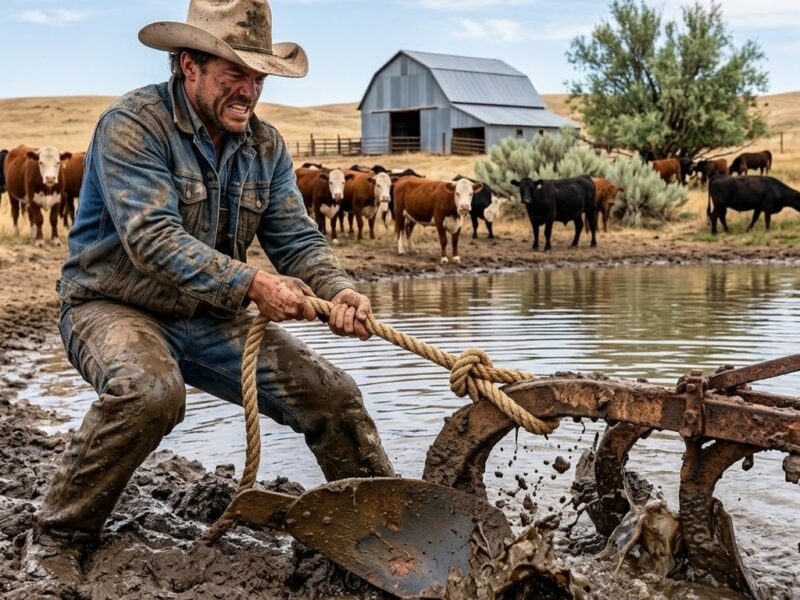
Daniel anchored a small, hand-cranked come-along winch to the trunk of the cottonwood tree and connected it to the faded blue rope with a heavy-duty steel clevis. He wasn’t trying to lift the heavy iron lid yet; he only wanted to see if the winch could break the suction without snapping thirty-year-old hemp.
Click. Click.
The winch drum turned. The rope went tight as a violin string.
Daniel gave the handle another half-turn. The water around the submerged plate reacted instantly: a dark, muddy circle spread outward, and then, with a wet, bronchial sigh, the cover shifted an inch to the left.
Beneath it, the pond erupted. Not violently, just with a steady, pulsing urgency. Dozens of bubbles broke through the surface in a straight line as black sediment rolled outward. Then came the water—clear, sparkling, and unmistakably alive.
“That ain’t trapped rainwater,” Walter breathed, leaning on his stick.
Daniel felt a strange pressure behind his breastbone. His father had known. Thomas Mercer had anticipated the dry years, had anticipated the day when memory would fail and the silt would rise, and had left a twelve-dollar piece of hardware tied to a blue line in the mud.
They didn’t try to lift the lid off completely that day. They needed equipment for that. But Daniel now knew what lay beneath the gray-green surface of his shrinking pond: six feet of hand-laid stone, a sandy floor where the earth wept cold water, and the quiet machinery of a generation that built things to last past their own lifetimes.
That weekend, the drought deepened. The pond dropped another inch, exposing more of the western mudflat. The cattle crowded the east bank as usual, Number 14 standing nervously at the edge of the herd.
Daniel stood on the porch with the repair estimates from the well-drilling contractor in town. The numbers were large—painful enough to make him wince, but not large enough to bankrupt him. He looked from the paper to the dry pasture, then back to the house.
His father had always been a man of calculated risks. “Don’t fall in love with what you think the land is,” Thomas used to say. “Look at what it’s actually doing.”
On Monday morning, Daniel rented a backhoe from the county yard, hired a young local kid named Toby to run the bucket, and drove them both down to the western bank.
They didn’t drain the pond; they built a temporary earthen cofferdam of sandbags around the iron plate to keep the muddy lake water out while they worked. When the pump cleared the little square enclosure, the old springhouse box stood revealed in the sunlight for the first time in thirty years.
It was a marvel of pioneer masonry. The walls were limestone blocks, unmortared but fitted so tightly a knife blade couldn’t find a gap. The floor was clean white sand that danced and heaved gently as water bubbled up through the mineral veins below.
And the outlet pipe—the iron line that was supposed to carry the water safely away—was choked with three decades of oak roots and red rust.
“Well, I’ll be damned,” Toby whispered, staring down into the stone pit with his mouth open. “You got a private swimming pool down here, Mr. Mercer.”
“It’s not a pool,” Daniel said, wiping sweat from his forehead. “It’s an intake.”
They worked until dark, pulling out the shattered sections of old iron pipe and replacing them with modern, schedule-80 PVC line that would never rust, never rot, and never harbor iron bacteria. They cleaned the sand floor, set a new gravel bed around the intake, and built a proper, sealed inspection riser above the waterline where Daniel could test the water without wading into the muck.
When they finally broke the temporary sandbag dam and let the pond water back in around the restored spring box, the difference was immediate.
The water didn’t bubble up black and greasy anymore. It rose crystal-clear, smelling faintly of cold limestone and clean earth, mingling with the pond without leaving a stain.









