Lone Rancher Expected a Farmhand But a Barefoot Widow Stepped Off the Stagecoach
THE CARPETBAG
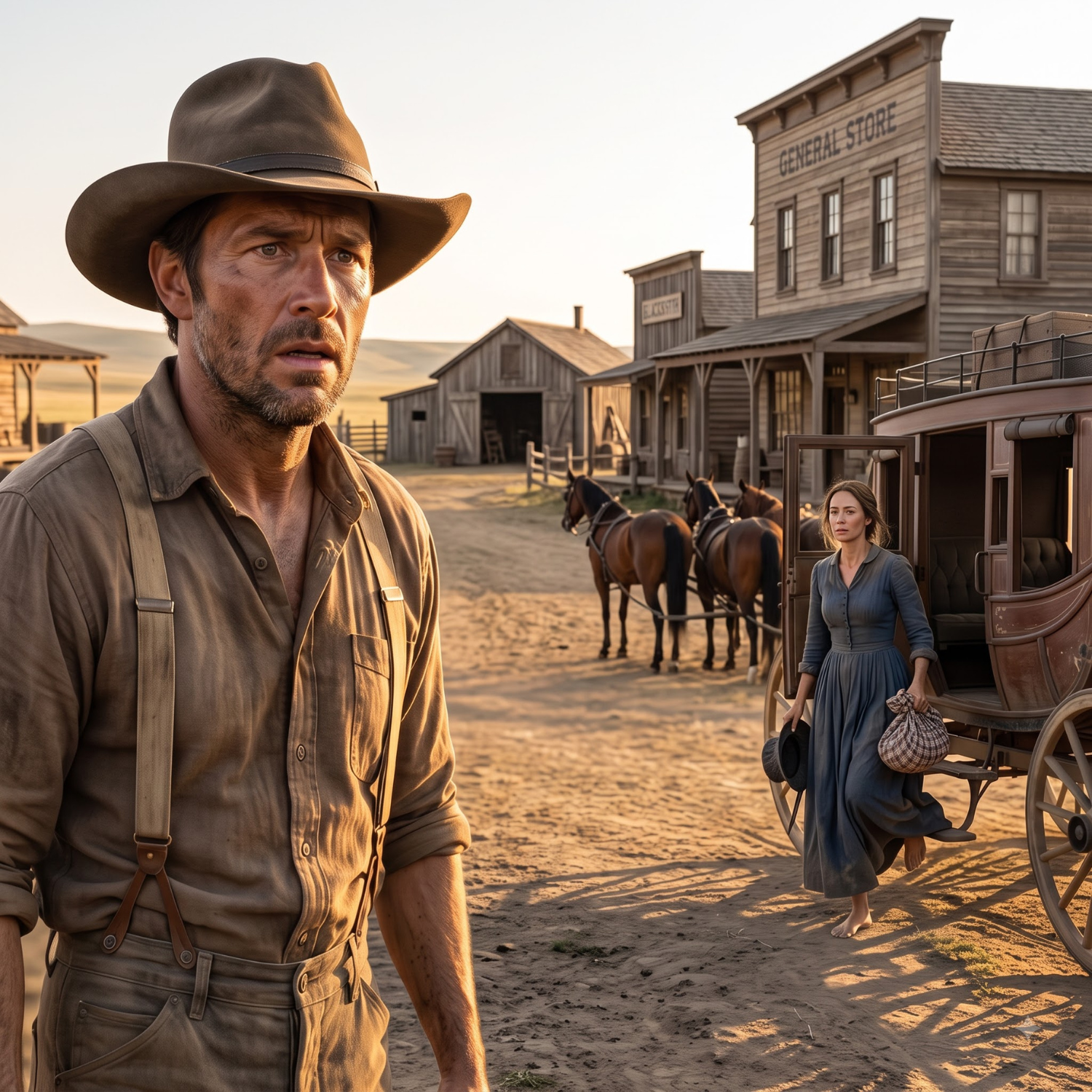
The stagecoach did not slow to a halt; it skidded into Bell’s Crossing in a cloud of choked, yellow dust, the four-horse team lathered in white foam. Caleb Mercer stood by the station post, his thumb resting instinctively against the worn leather of his gun belt.
The driver practically fell from the box, his eyes darting toward the eastern ridge. “Riders at the canyon mouth,” he spat, tossing a mailbag to the dirt. “Didn’t give chase, but they was looking for someone.”
Caleb didn’t care about riders. He was looking at the coach door.
He had expected a man. A broad-shouldered drifter from Nebraska named Samuel Bennett. Someone to help fix the sagging barn roof and mend the western fence line of the Dry Creek Ranch.
An elderly salesman stepped out first, clutching his chest. Then a mother shielding a sleeping child.
The final passenger stepped carefully from the carriage.
It wasn’t a farmhand. It was a woman.
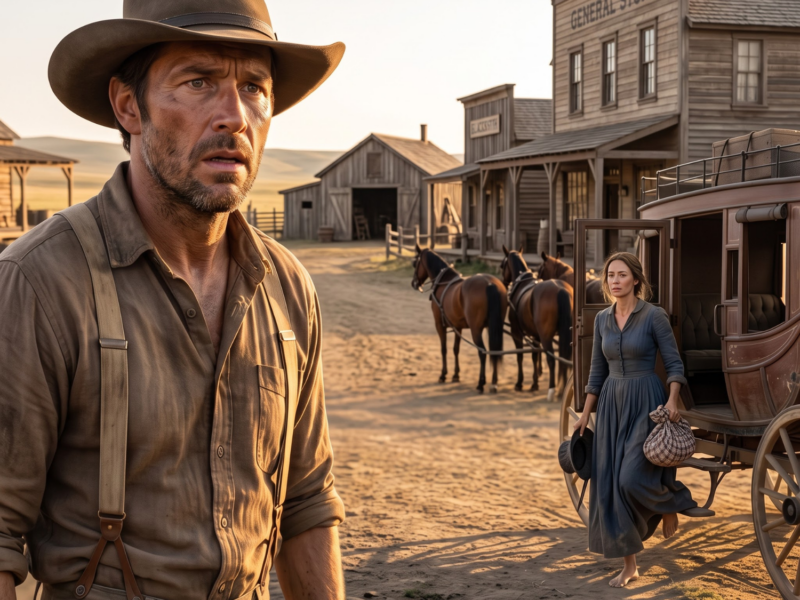
She was barefoot. Her plain brown dress was bleached pale at the shoulders by the merciless sun, the hem caked in dark, dried mud. One sleeve had been mended with thick, black thread. But it was her hands that drew Caleb’s sharp eyes. Her knuckles were bone-white, gripping the handle of a worn carpetbag as if it contained her next heartbeat.
She was perhaps thirty. Thin, but there was a coiled tension in her posture that spoke of adrenaline, not frailty. Dark hair escaped a twisted knot, clinging to a face layered in dust and exhaustion.
Caleb looked past her into the dark interior of the coach. Empty.
The driver tossed down a heavy wooden trunk. “That is all,” he muttered, already moving to check the horses.
Caleb’s jaw tightened. He stepped forward, his boots crunching on the dry earth. “Samuel Bennett.”
Her grip tightened further on the bag. Her eyes, a striking, desperate shade of hazel, met his. “My husband.” The words came quietly, scraped raw by thirst.
Caleb waited. The silence between them stretched, filled only by the nervous stamping of the horses. She looked down at the dirt around her bare feet.
“He died outside Cheyenne.”
Caleb’s gaze dropped to her feet. They were blistered, the skin broken and bleeding into the dust. But the blood wasn’t just on her heels. There was a faint, rust-colored smear across the bottom edge of her carpetbag.
“Did you lose your shoes?” Caleb asked, his voice low, gravelly from disuse.
“They were stolen at the boarding house. Along with most of my money.” She did not say it with self-pity. She said it as a cold, absolute fact.
The station master stepped cautiously from his office, glancing at the eastern ridge before handing Caleb a folded, crinkled paper. “This came with her.”
Caleb opened it. The writing was weak, the ink smeared by sweat or rain.
Mr. Mercer, I have taken ill and do not expect to reach your ranch. My wife knows horses better than I do and has worked beside me since we married. She can mend fence, milk cows, keep accounts, and handle a team. If you have no place for her, please help her reach decent people. — Samuel Bennett
Caleb read it twice. He folded it slowly. “You came all this way because he asked you to.”
“He asked me to keep going.”
“What do you expect from me?” Caleb asked, his tone flat.
“Work.” Her answer was immediate. A reflex. “I don’t want charity. I can do what the letter says.”
Caleb looked at her narrow shoulders. “The bunkhouse is not suitable.”
“I have slept in worse.”
“That is not the point.”
Her face hardened. The vulnerability vanished, replaced by a fierce, defensive pride. “Then pay me less.”
“I didn’t say that.” Caleb pulled his hat lower against the glare of the sun. “You have been looking at the road since I stepped down. You expected a man.”
“I did.”
“And you need a worker.”
“I do.”
She stepped closer, invading his space just enough to force him to look down at her. “Then give me a week.”
Caleb looked at the carpetbag. He looked at the smear of blood. A man living alone for four years learned to recognize the scent of trouble. He should put her on the next eastbound stage. He should walk away.
“One week,” Caleb said.
Eliza nodded once.
Caleb loaded her heavy trunk into his wagon. Before they left the crossing, he walked into the general store. He returned carrying a pair of sturdy work boots, two pairs of thick wool socks, and a small tin of medicinal salve. He set them on the wagon bench beside her.
Eliza stared at them. “Take it from my wages.”
“I will,” Caleb lied.